Thank you for visiting SNEWPapers!
Sign up free
Letter to Editor
September 10, 1812
Virginia Argus
Richmond, Virginia
What is this article about?
Samuel Simple sarcastically critiques a paragraph in Davis's Parriot praising a memorial for a misguided insurgent near the President's house, mocking claims of government control by 'lawless banditti' (Federalists) and linking it to recent war setbacks like Hull's capture and the President's retreat.
Clipping
OCR Quality
95%
Excellent
Full Text
Mr. Pleasants,
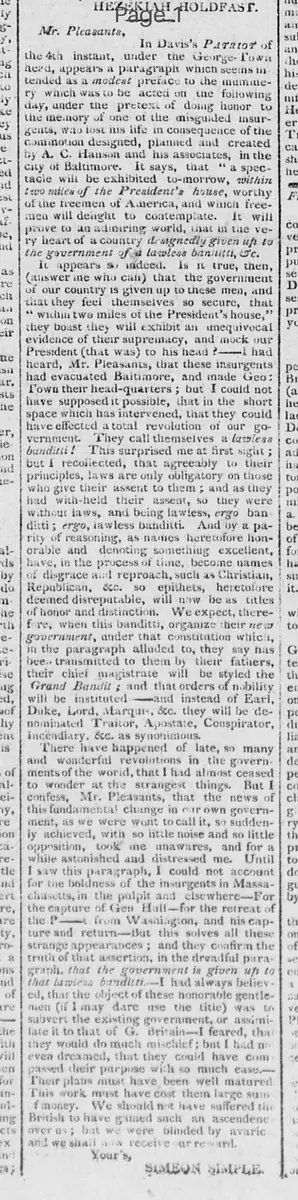
In Davis's Parriot of the 4th instant, under the George-Town head, appears a paragraph which seems intended as a modest preface to the mummery which was to be acted on the following day, under the pretext of doing honor to the memory of one of the misguided insurgents, who lost his life in consequence of the commotion designed, planned and created by A. C. Hanson and his associates, in the city of Baltimore. It says, that "a spectacle will be exhibited to-morrow, within two miles of the President's house, worthy of the freemen of America, and which freemen will delight to contemplate. it will prove to an admiring world, that in the very heart of a country designedly given up to the government of a lawless banditti, Fe."
It appears so indeed. Is it true, then, answer me who can) that the government of our country is given up to these men, and that they feel themselves so secure, that "within two miles of the President's house," they boast they will exhibit an unequivocal evidence of their supremacy, and mock our President (that was) to his head ?---I had heard, Mr. Pleasants, that these insurgents had evacuated Baltimore, and made Geo: Town their head-quarters; but I could not have supposed it possible, that in the short space which has intervened, that they could have effected a total revolution of our government. They call themselves a lawless banditti! This surprised me at first sight; but I recollected, that agreeably to their principles, laws are only obligatory on those who give their assent to them; and as they had with-held their assent, so they were without laws, and being lawless, ergo banditti; ergo, lawless banditti. And by a parity of reasoning, as names heretofore honorable and denoting something excellent, have, in the process of time, become names of disgrace and reproach, such as Christian, Republican, &c. so epithets, heretofore deemed disreputable, will now be as titles of honor and distinction. We expect, therefore, when this banditti, organize their new government, under that constitution which, in the paragraph alluded to, they say has been transmitted to them by their fathers, their chief magistrate will be styled the Grand Bandit ; and that orders of nobility will be instituted -and instead of Earl, Duke, Lord, Marquis, &c. they will be denominated Traitor, Apostate, Conspirator, Incendiary. &c. as synonymous.
There have happened of late, so many and wonderful revolutions in the governments of the world, that I had almost ceased to wonder at the strangest things. But I confess, Mr. Pleasants, that the news of this fundamental change in our own government, as we were wont to call it, so suddenly achieved, with so little noise and so little opposition, took me unawares, and for a while astonished and distressed me. Until I saw this paragraph, I could not account for the boldness of the insurgents in Massachusetts, in the pulpit and elsewhere For the capture of Genl Hull-for the retreat of the P. from Washington, and his capture and return-But this solves all these strange appearances ; and they confirm the truth of that assertion, in the dreadful paragraph, that the government is given up to that lawless banditti.-I had always believed, that the object of these honorable gentlemen (if I may dare use the title) was to subvert the existing government, or assimilate it to that of G. Britain-I feared, that they would do much mischief; but I had not even dreamed, that they could have accomplished their purpose with so much ease.—
Their plans must have been well matured This work must have cost them large sums of money. We should not have suffered the British to have gained such an ascendency over us; but we were blinded by avarice and we shall now receive our reward.
Your's,
SAMUEL SIMPLE.
In Davis's Parriot of the 4th instant, under the George-Town head, appears a paragraph which seems intended as a modest preface to the mummery which was to be acted on the following day, under the pretext of doing honor to the memory of one of the misguided insurgents, who lost his life in consequence of the commotion designed, planned and created by A. C. Hanson and his associates, in the city of Baltimore. It says, that "a spectacle will be exhibited to-morrow, within two miles of the President's house, worthy of the freemen of America, and which freemen will delight to contemplate. it will prove to an admiring world, that in the very heart of a country designedly given up to the government of a lawless banditti, Fe."
It appears so indeed. Is it true, then, answer me who can) that the government of our country is given up to these men, and that they feel themselves so secure, that "within two miles of the President's house," they boast they will exhibit an unequivocal evidence of their supremacy, and mock our President (that was) to his head ?---I had heard, Mr. Pleasants, that these insurgents had evacuated Baltimore, and made Geo: Town their head-quarters; but I could not have supposed it possible, that in the short space which has intervened, that they could have effected a total revolution of our government. They call themselves a lawless banditti! This surprised me at first sight; but I recollected, that agreeably to their principles, laws are only obligatory on those who give their assent to them; and as they had with-held their assent, so they were without laws, and being lawless, ergo banditti; ergo, lawless banditti. And by a parity of reasoning, as names heretofore honorable and denoting something excellent, have, in the process of time, become names of disgrace and reproach, such as Christian, Republican, &c. so epithets, heretofore deemed disreputable, will now be as titles of honor and distinction. We expect, therefore, when this banditti, organize their new government, under that constitution which, in the paragraph alluded to, they say has been transmitted to them by their fathers, their chief magistrate will be styled the Grand Bandit ; and that orders of nobility will be instituted -and instead of Earl, Duke, Lord, Marquis, &c. they will be denominated Traitor, Apostate, Conspirator, Incendiary. &c. as synonymous.
There have happened of late, so many and wonderful revolutions in the governments of the world, that I had almost ceased to wonder at the strangest things. But I confess, Mr. Pleasants, that the news of this fundamental change in our own government, as we were wont to call it, so suddenly achieved, with so little noise and so little opposition, took me unawares, and for a while astonished and distressed me. Until I saw this paragraph, I could not account for the boldness of the insurgents in Massachusetts, in the pulpit and elsewhere For the capture of Genl Hull-for the retreat of the P. from Washington, and his capture and return-But this solves all these strange appearances ; and they confirm the truth of that assertion, in the dreadful paragraph, that the government is given up to that lawless banditti.-I had always believed, that the object of these honorable gentlemen (if I may dare use the title) was to subvert the existing government, or assimilate it to that of G. Britain-I feared, that they would do much mischief; but I had not even dreamed, that they could have accomplished their purpose with so much ease.—
Their plans must have been well matured This work must have cost them large sums of money. We should not have suffered the British to have gained such an ascendency over us; but we were blinded by avarice and we shall now receive our reward.
Your's,
SAMUEL SIMPLE.
What sub-type of article is it?
Satirical
Political
Persuasive
What themes does it cover?
Politics
Military War
What keywords are associated?
Lawless Banditti
Insurgents
Baltimore
George Town
A C Hanson
Genl Hull
President Retreat
Federalist Satire
What entities or persons were involved?
Samuel Simple
Mr. Pleasants
Letter to Editor Details
Author
Samuel Simple
Recipient
Mr. Pleasants
Main Argument
the letter mocks a paragraph in davis's parriot that celebrates a memorial for an insurgent as evidence of federalist ('lawless banditti') control over the government, sarcastically suggesting they have easily subverted it and linking this to recent war failures.
Notable Details
References A. C. Hanson And Associates In Baltimore Commotion
Mentions Spectacle Near President's House
Alludes To Capture Of Genl Hull And Retreat Of P. From Washington
Sarcastic Redefinition Of 'Banditti' As Honorable Title