Thank you for visiting SNEWPapers!
Sign up free
The New Hampshire Gazette And General Advertiser
Portsmouth, Rockingham County, New Hampshire
What is this article about?
In 1789, John Read of Roxbury submits detailed observations on successfully raising and processing hemp to the Committee for Promoting Agriculture, chaired by Benjamin Lincoln, highlighting methods, yields, and economic benefits to encourage its cultivation.
Merged-components note: The short notice instructs printers to insert the foregoing content, which is the letter on raising hemp, making it part of the same letter to the editor.
Clipping
OCR Quality
Full Text
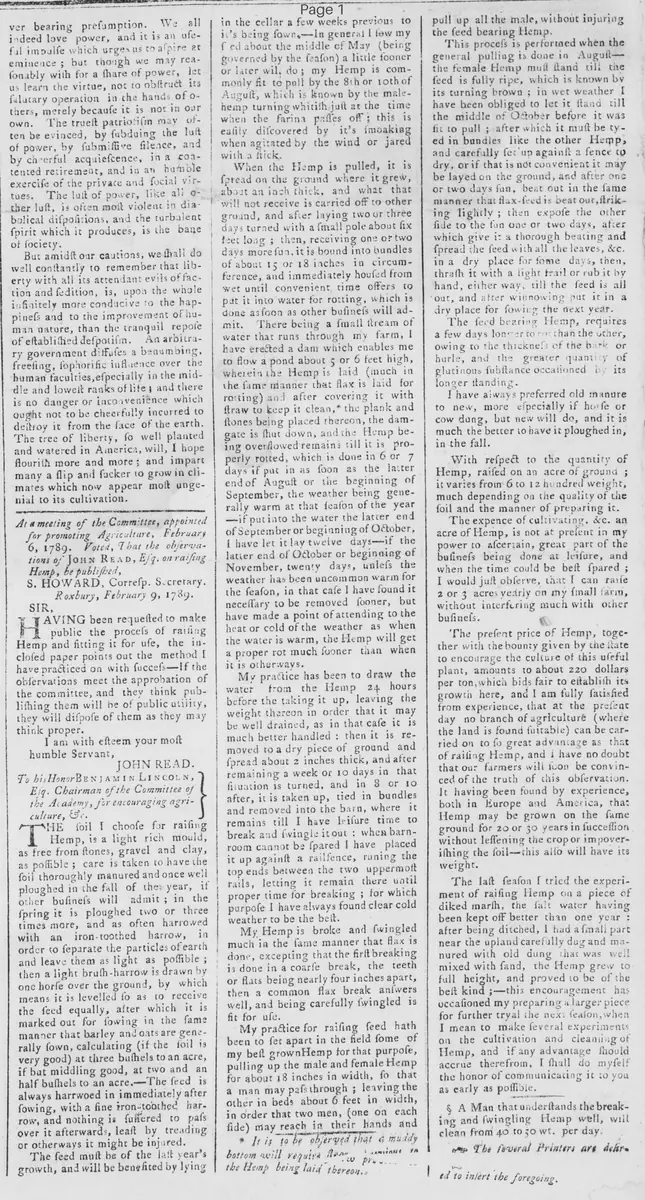
S. HOWARD, Corresp. Secretary.
Roxbury, February 9, 1789.
SIR,
Having been requested to make public the process of raising Hemp and fitting it for use, the enclosed paper points out the method I have practiced on with success--If the observations meet the approbation of the committee, and they think publishing them will be of public utility, they will dispose of them as they may think proper.
I am with esteem your most humble Servant,
JOHN READ.
To his Honor Benjamin Lincoln, Esq. Chairman of the Committee of the Academy, for encouraging agriculture, &c.
THE soil I choose for raising Hemp, is a light rich mould, as free from stones, gravel and clay, as possible; care is taken to have the soil thoroughly manured and once well ploughed in the fall of the year, if other business will admit: in the spring it is ploughed two or three times more, and as often harrowed with an iron-toothed harrow, in order to separate the particles of earth and leave them as light as possible; then a light brush-harrow is drawn by one horse over the ground, by which means it is levelled so as to receive the seed equally, after which it is marked out for sowing in the same manner that barley and oats are generally sown, calculating (if the soil is very good) at three bushels to an acre, if but middling good, at two and a half bushels to an acre.--The seed is always harrowed in immediately after sowing, with a fine iron-toothed harrow, and nothing is suffered to pass over it afterwards, least by treading or otherways it might be injured.
The seed must be of the last year's growth, and will be benefited by lying in the cellar a few weeks previous to it's being sown,--In general I sow my seed about the middle of May (being governed by the season) a little sooner or later will do; my Hemp is commonly fit to pull by the 8th or 10th of August, which is known by the male-hemp turning whitish, just at the time when the farina passes off: this is easily discovered by it's smoking when agitated by the wind or jarred with a stick.
When the Hemp is pulled, it is spread on the ground where it grew, about an inch thick, and what that will not receive is carried off to other ground, and after laying two or three days turned with a small pole about six feet long; then, receiving one or two days more sun, it is bound into bundles of about 15 or 18 inches in circumference, and immediately housed from wet until convenient time offers to put it into water for rotting, which is done as soon as other business will admit. There being a small stream of water that runs through my farm, I have erected a dam which enables me to flow a pond about 5 or 6 feet high, wherein the Hemp is laid (much in the same manner that flax is laid for rotting) and after covering it with straw to keep it clean, the plank and stones being placed thereon, the dam-gate is shut down, and the Hemp being overflowed remains till it is properly rotted, which is done in 6 or 7 days if put in as soon as the latter end of August or the beginning of September, the weather being generally warm at that season of the year -if put into the water the latter end of September or beginning of October, I have let it lay twelve days--if the latter end of October or beginning of November, twenty days, unless the weather has been uncommon warm for the season, in that case I have found it necessary to be removed sooner, but have made a point of attending to the heat or cold of the weather as when the water is warm, the Hemp will get a proper rot much sooner than when it is otherways.
My practice has been to draw the water from the Hemp 24 hours before the taking it up, leaving the weight thereon in order that it may be well drained, as in that case it is much better handled: then it is removed to a dry piece of ground and spread about 2 inches thick, and after remaining a week or 10 days in that situation is turned, and in 8 or 10 after, it is taken up, tied in bundles and removed into the barn, where it remains till I have leisure time to break and swingle it out: when barn-room cannot be spared I have placed it up against a rail fence, running the top ends between the two uppermost rails, letting it remain there until proper time for breaking; for which purpose I have always found clear cold weather to be the best.
My Hemp is broke and swingled much in the same manner that flax is done, excepting that the first breaking is done in a coarse break, the teeth or slats being nearly four inches apart, then a common flax break answers well, and being carefully swingled is fit for use.
My practice for raising seed has been to set apart in the field some of my best grown Hemp for that purpose, pulling up the male and female Hemp for about 18 inches in width, so that a man may pass through; leaving the other in beds about 6 feet in width, in order that two men, (one on each side) may reach in their hands and pull up all the male, without injuring the seed bearing Hemp.
This process is performed when the general pulling is done in August- the female Hemp must stand till the seed is fully ripe, which is known by its turning brown: in wet weather I have been obliged to let it stand till the middle of October before it was fit to pull; after which it must be tied in bundles like the other Hemp; and carefully set up against a fence to dry, or if that is not convenient it may be layed on the ground, and after one or two days sun, beat out in the same manner that flax-seed is beat out, striking lightly; then expose the other side to the sun one or two days, after which give it a thorough beating and spread the seed with all the leaves, &c. in a dry place for some days, then, thrash it with a light flail or rub it by hand, either way, till the seed is all out, and after winnowing put it in a dry place for sowing the next year.
The seed bearing Hemp, requires a few days longer to rot than the other, owing to the thickness of the bark or hurle, and the greater quantity of glutinous substance occasioned by its longer standing.
I have always preferred old manure to new, more especially if horse or cow dung, but new will do, and it is much the better to have it ploughed in, in the fall.
With respect to the quantity of Hemp, raised on an acre of ground; it varies from 6 to 12 hundred weight, much depending on the quality of the soil and the manner of preparing it.
The expence of cultivating, &c. an acre of Hemp, is not at present in my power to ascertain, great part of the business being done at leisure, and when the time could be best spared: I would just observe, that I can raise 2 or 3 acres yearly on my small farm, without interfering much with other business.
The present price of Hemp, together with the bounty given by the state to encourage the culture of this useful plant, amounts to about 20 dollars per ton, which bids fair to establish its growth here, and I am fully satisfied from experience, that at the present day no branch of agriculture (where the land is found suitable) can be carried on to so great advantage as that of raising Hemp, and I have no doubt that our farmers will soon be convinced of the truth of this observation.
It having been found by experience, both in Europe and America, that Hemp may be grown on the same ground for 20 or 30 years in succession without lessening the crop or impoverishing the soil-this also will have its weight.
The last season I tried the experiment of raising Hemp on a piece of diked marsh, the salt water having been kept off better than one year: after being ditched, I had a small part near the upland carefully dug and manured with old dung that was well mixed with sand, the Hemp grew to full height, and proved to be of the best kind;--this encouragement has occasioned my preparing a larger piece for further tryal the next season, when I mean to make several experiments on the cultivation and cleansing of Hemp, and if any advantage should accrue therefrom, I shall do myself the honor of communicating it to you as early as possible.
A Man that understands the breaking and swingling Hemp well, will clean from 40 to 50 wt. per day.
The several Printers are desired to insert the foregoing.
What sub-type of article is it?
What themes does it cover?
What keywords are associated?
What entities or persons were involved?
Letter to Editor Details
Author
John Read
Recipient
His Honor Benjamin Lincoln, Esq. Chairman Of The Committee Of The Academy, For Encouraging Agriculture, &C.
Main Argument
john read describes his successful process for raising, rotting, breaking, and swingling hemp on light rich soil, emphasizing its profitability and suitability for repeated cultivation without soil depletion.
Notable Details