Thank you for visiting SNEWPapers!
Sign up free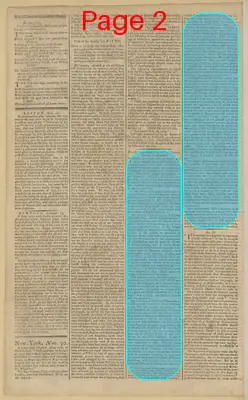
The Daily Advertiser
New York, New York County, New York
What is this article about?
George Mason presents detailed objections to the proposed US Constitution, arguing it lacks a bill of rights, undermines state sovereignty, creates imbalanced representation, empowers the Senate excessively, weakens state judiciaries, risks executive overreach, and may lead to aristocracy or monarchy.
Clipping
OCR Quality
Full Text
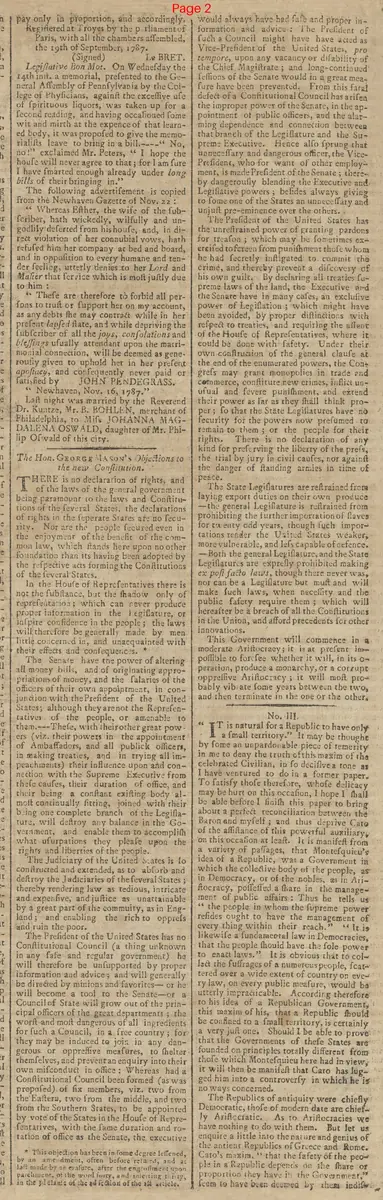
THERE is no declaration of rights, and of the laws of the general government being paramount to the laws and Constitutions of the several States, the declarations of rights in the separate States are no security. Nor are the people secured even in the enjoyment of the benefit of the common law, which stands here upon no other foundation than its having been adopted by the respective acts forming the Constitutions of the several States.
In the House of Representatives there is not the substance, but the shadow only of representation; which can never produce proper information in the Legislature, or inspire confidence in the people; the laws therefore will therefore be generally made by men little concerned in, and unacquainted with their effects and consequences. *
The Senate have the power of altering all money bills, and of originating appropriations of money, and the salaries of the officers of their own appointment, in conjunction with the President of the United States; although they are not the Representatives of the people, or amenable to them. These, with their other great powers (viz. their powers in the appointment of Ambassadors, and all public officers, in making treaties, and in trying all impeachments) their influence upon and connection with the Supreme Executive from these causes, their duration of office, and their being a constant existing body almost continually sitting, joined with their being one complete branch of the Legislature, will destroy any balance in the Government, and enable them to accomplish what usurpations they please upon the rights and liberties of the people.
The Judiciary of the United States is so constructed and extended, as to absorb and destroy the Judiciaries of the several States; thereby rendering law as tedious, intricate and expensive, and justice as unattainable by a great part of the community, as in England; and enabling the rich to oppress and ruin the poor.
The President of the United States has no Constitutional Council (a thing unknown in any safe and regular government) he will therefore be unsupported by proper information and advice; and will generally be directed by minions and favorites—or he will become a tool to the Senate—or a Council of State will grow out of the principal officers of the great departments; the worst—and most dangerous of all ingredients for such a Council, in a free country; for they may be induced to join in any dangerous or oppressive measures, to shelter themselves, and prevent an enquiry into their own misconduct in office: Whereas had a Constitutional Council been formed (as was proposed) of six members, viz. two from the Eastern, two from the middle, and two from the Southern States, to be appointed by vote of the States in the House of Representatives, with the same duration and rotation of office as the Senate, the executive
* This objection has been in some degree lessened by an amendment, often before refused, and at last made by an erasure, after the engrossment upon parchment, of the word forty, and inserting thirty, in the 2d clause of the 1st section of the 1st article.
would always have had safe and proper information and advice: The President of such a Council might have acted as Vice-President of the United States, pro tempore, upon any vacancy or disability of the Chief Magistrate; and long-continued sessions of the Senate would in a great measure have been prevented. From this fatal defect of a Constitutional Council has arisen the improper power of the Senate, in the appointment of public officers, and the alarming dependence and connection between that branch of the Legislature and the Supreme Executive. Hence also sprung that unnecessary and dangerous officer, the Vice-President, who for want of other employment, is made President of the Senate; thereby dangerously blending the Executive and Legislative powers; besides always giving to some one of the States an unnecessary and unjust pre-eminence over the others.
The President of the United States has the unrestrained power of granting pardons for treason; which may be sometimes exercised to screen from punishment those whom he had secretly instigated to commit the crime, and thereby prevent a discovery of his own guilt. By declaring all treaties supreme laws of the land, the Executive and the Senate have in many cases, an exclusive power of legislation; which might have been avoided, by proper distinctions with respect to treaties, and requiring the assent of the House of Representatives, where it could be done with safety. Under their own construction of the general clause at the end of the enumerated powers, the Congress may grant monopolies in trade and commerce, constitute new crimes, inflict unusual and severe punishments, and extend their power as far as they shall think proper; so that the State Legislatures have no security for the powers now presumed to remain to them; or the people for their rights. There is no declaration of any kind for preserving the liberty of the press, the trial by jury in civil causes, nor against the danger of standing armies in time of peace.
The State Legislatures are restrained from laying export duties on their own produce—the general Legislature is restrained from prohibiting the further importation of slaves for twenty odd years, though such importations render the United States weaker, more vulnerable, and less capable of defence. Both the general Legislature, and the State Legislatures are expressly prohibited making ex post facto laws, though there never was, nor can be a legislature but must and will make such laws, when necessity and the public safety require them; which will hereafter be a breach of all the Constitutions in the Union, and afford precedents for other innovations.
This Government will commence in a moderate Aristocracy; it is at present impossible to foresee whether it will, in its operation, produce a monarchy, or a corrupt oppressive Aristocracy; it will most probably vibrate some years between the two, and then terminate in the one or the other.
What sub-type of article is it?
What themes does it cover?
What keywords are associated?
What entities or persons were involved?
Where did it happen?
Story Details
Key Persons
Location
United States
Story Details
George Mason lists objections to the US Constitution including absence of rights declaration, inadequate representation, excessive Senate powers, flawed judiciary, lack of presidential council, pardon powers, treaty legislation, potential congressional overreach, restrictions on state duties and slave imports, ex post facto law bans, and prediction of aristocracy or monarchy.