Thank you for visiting SNEWPapers!
Sign up free
Story
October 15, 1804
The National Intelligencer And Washington Advertiser
Washington, District Of Columbia
What is this article about?
The Court of Session in Scotland granted an interdict prohibiting the publication and sale of poet Burns' letters to Clarinda, ruling that recipients cannot publish letters without the writer's or representatives' consent.
Clipping
OCR Quality
98%
Excellent
Full Text
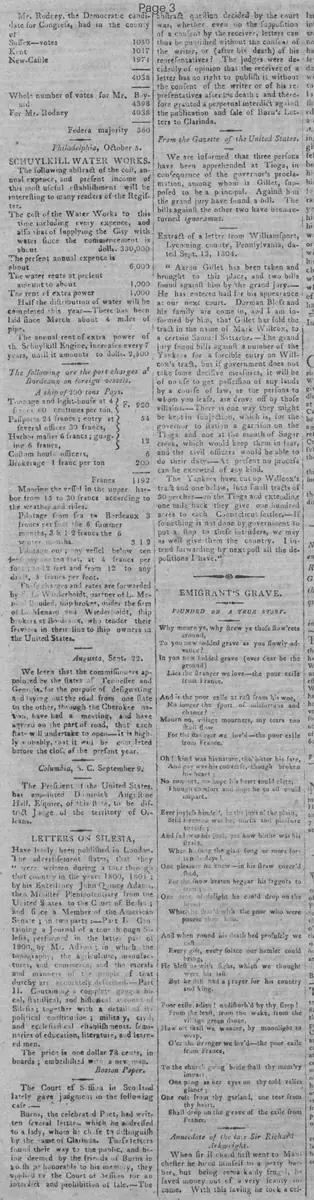
The Court of Session in Scotland lately gave judgment in the following case.—
Burns, the celebrated Poet, had written several letters, which he addressed to a lady, whom he chose to distinguish by the name of Clarinda. These letters found their way to the public, and being deemed by the friends of Burns in no way honorable to his memory, they applied to the Court of Session for an interdict and prohibition of sale.—The abstract auction decided by the court was, whether even on the supposition of a consent by the receiver, letters can thus be published without the consent of the writer, or (after his death) of his representatives? The judges were decidedly of opinion that the receiver of a letter has no right to publish it without the consent of the writer or of his representatives after his death: and therefore granted a perpetual interdict against the publication and sale of Burns's Letters to Clarinda.
Burns, the celebrated Poet, had written several letters, which he addressed to a lady, whom he chose to distinguish by the name of Clarinda. These letters found their way to the public, and being deemed by the friends of Burns in no way honorable to his memory, they applied to the Court of Session for an interdict and prohibition of sale.—The abstract auction decided by the court was, whether even on the supposition of a consent by the receiver, letters can thus be published without the consent of the writer, or (after his death) of his representatives? The judges were decidedly of opinion that the receiver of a letter has no right to publish it without the consent of the writer or of his representatives after his death: and therefore granted a perpetual interdict against the publication and sale of Burns's Letters to Clarinda.
What sub-type of article is it?
Biography
Historical Event
What themes does it cover?
Justice
What keywords are associated?
Burns Letters
Clarinda
Court Of Session
Publication Prohibition
Interdict
Scotland
What entities or persons were involved?
Burns
Clarinda
Where did it happen?
Court Of Session In Scotland
Story Details
Key Persons
Burns
Clarinda
Location
Court Of Session In Scotland
Event Date
Lately
Story Details
Burns wrote letters to a lady called Clarinda, which were to be published; his friends sought court interdict to prevent sale, arguing it dishonored his memory. The court ruled that even with receiver's consent, letters cannot be published without writer's or representatives' consent after death, granting perpetual interdict.