Thank you for visiting SNEWPapers!
Sign up free
The New Hampshire Gazette
Portsmouth, Rockingham County, New Hampshire
What is this article about?
Senator Benton's speech in reply to Mr. Clay denounces the Bank of the United States for charter breaches like usury and oppression, warns of its political ambitions for re-charter and control, praises Jackson's opposition, and proposes resolutions for gold and silver currency reform. (248 characters)
Merged-components note: These two components form a continuous report of Mr. Benton's speech in the Senate; the second picks up directly after the first, so they should be merged into a single logical unit. Label changed to 'story' as it is a full narrative report of a political speech.
Clippings
1 of 2
OCR Quality
Full Text
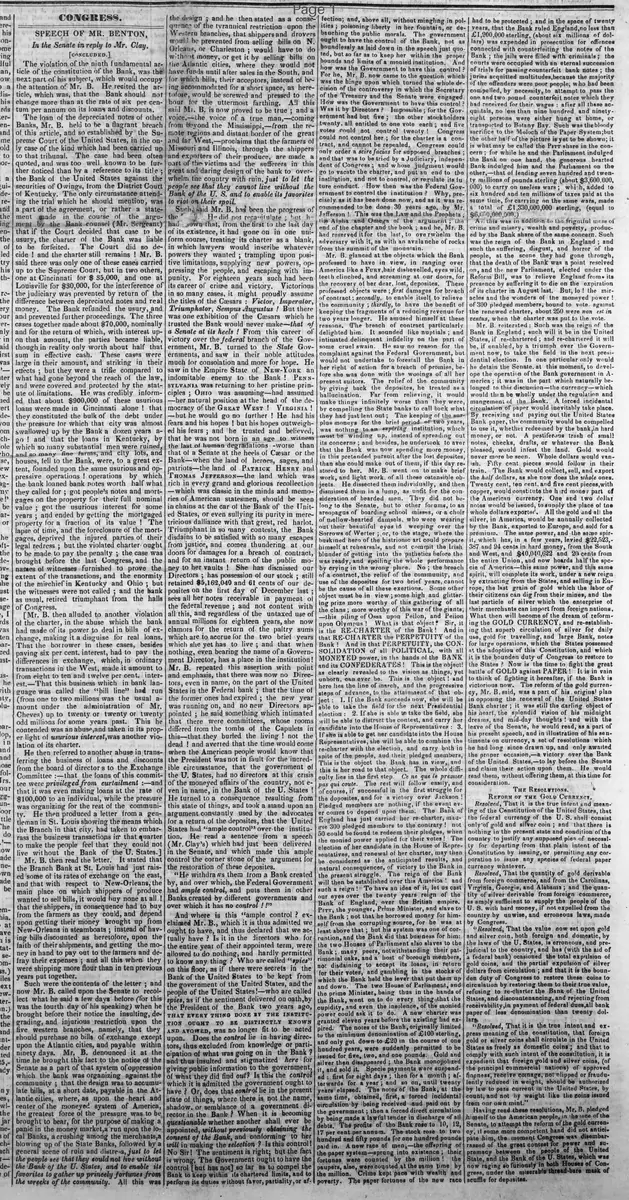
In the Senate in reply to Mr. Clay.
[CONCLUDED.]
'The violation of the ninth fundamental article of the constitution of the Bank, was the next part of his subject, which would occupy the attention of Mr. B. He recited the article, which was, that the Bank should not charge more than at the rate of six per centum per annum on its loans and discounts.
The loan of the depreciated notes of other Banks, Mr. B. held to be a flagrant breach of this article, and so established by the Supreme Court of the United States, in the only case of the kind which had been carried up to that tribunal. The case had been often quoted, and was too well known to be further noticed than by a reference to its title; the Bank of the United States against the securities of Owings, from the District Court of Kentucky. The only circumstance attending the trial which he should mention, was a part of the agreement, or rather a statement made in the course of the argument by the Bank counsel (Mr. Sergeant) that if the Court decided that case to be usury, the charter of the Bank was liable to be forfeited. The Court did so decide! and the charter still remains! Mr. B. said there was only one of these cases carried up to the Supreme Court, but in two others, one at Cincinnati for $35,000, and one at Louisville for $30,000, for the interference of the judiciary was prevented by return of the difference between depreciated notes and real money. The Bank refunded the usury, and prevented further proceedings. The three cases together made about $70,000, nominally and for the return of which, with interest upon that amount, the parties became liable. though in reality only worth about half that sum in effective cash. These cases were large in their amount, and striking in their effects; but they were a trifle compared to what had gone beyond the reach of the law, and were covered and protected by the statute of limitations. He was credibly informed that about $900,000 of these usurious loans were made in Cincinnati alone! that they constituted the bulk of the debt under the pressure for which that city was almost swallowed up by the Bank a dozen years ago! and that the loans in Kentucky, by which so many substantial men were ruined, and so many fine farms, and city lots, and houses, fell to the Bank, were, to a great extent, founded upon the same usurious and oppressive operations! operations by which the bank loaned bank notes worth half what they called for; got people's notes and mortgages on the property for their full nominal value; got the usurious interest for some years; and ended by getting the mortgaged property for a fraction of its value! The lapse of time, and the foreclosure of the mortgages, deprived the injured parties of their legal redress; but the violated charter ought to be made to pay the penalty; the case was brought before the last Congress, and the names of witnesses furnished to prove the extent of the transactions, and the enormity of the mischief in Kentucky and Ohio; but the witnesses were not called; and the bank as usual, retired triumphant from the halls of Congress.
[Mr. B. then alluded to another violation of the charter, in the abuse which the bank had made of its power to deal in bills of exchange, making it a disguise for real loans. That the borrower in these cases, besides paying six per cent. interest, had to pay the differences in exchange, which, in ordinary transactions in the West, made it amount to from eight to ten and twelve per cent. interest.—That this business which in bank language was called the "bill line" had run (from one to two millions was the usual amount under the administration of Mr. Cheves) up to twenty or twenty-five millions for some years past. This he contended was an abuse, and taken in its proper light of usurious interest, was another violation of its charter.
He then referred to another abuse in transferring the business of loans and discounts from the board of directors to the Exchange Committee:—that the loans of this committee were privileged from curtailment: and that it was even making loans at the rate of $100,000 to an individual, while the pressure was operating on the rest of the community. He then produced a letter from a gentleman in St. Louis showing the means which the Branch in that city, had taken to embarrass the business transactions in that quarter to make the people feel that they could not live without the Bank of the U. States.]
Mr. B. then read the letter. It stated that the Branch Bank at St. Louis had just raised some of its rates of exchange on the east, and that with respect to New-Orleans, the main place on which shippers of produce wanted to sell bills, it would buy none at all.! that the shippers, in consequence had to buy from the farmers as they could, and depend upon getting their money brought up from New-Orleans in steamboats; instead of having bills discounted as heretofore, upon the faith of their shipments, and getting the money in hand to pay out to the farmers and defray their expenses; and all this when they were shipping more flour than in ten previous years put together.
Such were the contents of the letter; and now Mr. B. called upon the Senate to recollect what he said a few days before (for this was the fourth day of his speaking) when he brought before their notice the insulting, degrading, and injurious restriction upon the five western branches, namely, that they should purchase no bills of exchange except upon the Atlantic cities, and payable within ninety days. Mr. B. denounced it at the time he brought this fact to the notice of the Senate as a part of that system of oppression which the bank was organizing against the community; that the design was to accumulate bills, at a short date, payable in the Atlantic cities, where, as upon the heart and center of the moneyed system of America, the greatest force of the pressure was to be brought to bear, for the purpose of making a panic in the money market, a run upon the local Banks, a crushing among the merchants, a blowing up of the State Banks, followed by a general scene of ruin and distress, just to let the people see that they could not live without the Bank of the U. States, and to enable its favorites to gather up princely fortunes from the wrecks of the community. All this was the design; and he then stated as a consequence of the tyrannical restriction upon the Western branches, that shippers and drovers would be prevented from selling bills on N. Orleans, or Charleston: would have to do without money, or get it by selling bills on the Atlantic cities, where they would not have funds until after sales in the South, and for which bills, their acceptors, instead of being accommodated for a short space, as heretofore, would be screwed and pressed to the hour for the uttermost farthing. All this said Mr. B. is now proved to be true; and a voice,—the voice of a true man,—coming from beyond the Mississippi,—from the remote regions and distant border of the great and far West,—proclaims that the farmers of Missouri and Illinois, through the shippers and exporters of their produce, are made a part of the victims and the sufferers in this great and daring design of the bank to overwhelm the country with ruin, just to let the people see that they cannot live without the 'Bank of the U. S. and to enable its favorites to riot on their spoil.
Such, said Mr. B. has been the progress of the He did not recapitulate: but he had shown that, from the first to the last day of its existence, it had gone on in one uniform course, treating its charter as a blank, in which lawyers would inscribe whatever powers they wanted; trampling upon positive limitations, supplying new powers, oppressing the people, and escaping with impunity. For eighteen years such had been its career of crime and victory. Victorious in so many cases, it might proudly assume the titles of the Cæsars: Victor, Imperator, Triumphator. Semper Augustus! But there was one exhibition of the Cæsars which he trusted the Bank would never make—that of a Senate at its heels! From this career of victory over the federal branch of the Government. Mr. B. turned to the State Governments, and saw in their noble attitudes much for consolation and more for hope. He saw in the Empire State of New-York an indomitable enemy to the Bank! Pennsylvania was returning to her pristine principles; Ohio was assuming—had assumed -her natural position at the head of the democracy of the Great West! Virginia! -but he would go no further! He had his fears and his hopes! but his hopes outweighed his fears; and he trusted and believed, that he was not born in an age to witness the last of human degradations —worse than that of a Senate at the heels of Cæsar or the Bank—when the land of heroes, sages, and patriots—the land of Patrick Henry and Thomas Jefferson —the land which was rich in every grand and glorious recollection -which was classic in the minds and memories of American statesmen, should be seen in chains at the car of the Bank of the United States, or even sullying its purity in meretricious dalliance with that great, red harlot.
'Triumphant in so many contests, the Bank disdains to be satisfied with so many escapes from justice, and comes thundering at our doors for damages for a breach of contract, and for an instant return of the public money to her vaults! She has dismissed our Directors; has possession of our stock: still retained $5,162,049 and 61 cents of our deposits on the first day of December last: sees all her notes receivable in payment of the federal revenue; and not content with all this, and regardless of the untaxed use of annual millions for eighteen years, she now clamors for the return of the paltry sums which are to accrue for the two brief years which she yet has to live; and that when nothing, even bearing the name of a Government Director, has a place in the institution!
Mr. B. repeated this assertion with point and emphasis, that there was now no Directors, even in name, on the part of the United States in the Federal bank; that the time of the former ones had expired; the new year was running on, and no new Directors appointed; he said something which intimated that there were committees, whose rooms differed from the tombs of the Capulets in this—that they buried the living! not the dead! and averred that the time would come when the American people would know that the President was not in fault for the incredible circumstance, that the government of the U. States, had no directors at this crisis of the moneyed affairs of the country, not even in name, in the Bank of the U. States!
He turned to a consequence resulting from this state of things, and took a stand upon an argument constantly used by the advocates for a return of the deposites, that the United States had "ample control" over the institution. He read a sentence from a speech (Mr. Clay's) which had just been delivered in the Senate, and which made this ample control the corner stone of the argument for the restoration of these deposites.
"He withdraws them from a Bank created by, and over which, the Federal Government had ample control, and puts them in other Banks created by different governments and over which it has no control!!"
And where is this "ample control? ex-claimed Mr. B., which it is thus admitted we ought to have, and thus declared that we actually have? Is it in the directors who for the entire year of their appointed term, were allowed to do nothing, and hardly permitted to know any thing? Who are called "spies" on this floor, as if there were secrets in the Bank of the United States to be kept from the government of the United States, and the people of the United States!—who are called spies, as if the sentiment delivered on oath, by the President of the Bank two years ago, THAT EVERY THING DONE BY THE INSTITUTION OUGHT TO BE DISTINCTLY KNOWN AND AVOWED, was no longer fit to be acted upon. Does the control lie in having directors, thus excluded from knowledge or participation of what was going on in the Bank? and thus insulted and stigmatized here for giving public information to the government, of what they did find out? Is this the control which it is admitted the government ought to have? Or, does that control lie in the present state of things, where there is not the name, shadow, or semblance of a government director in the Bank? When it is becoming questionable whether another shall ever be appointed, without previously obtaining the consent of the Bank, and conforming to her will in making the selection? Is this control! No Sir! The sentiment is right; but the act is wrong. The Government ought to have the control [but has not] so far as to compel the Bank to keep within its chartered limits, and to perform its duties without favor, partiality, or affection; and, above all, without mingling in politics; poisoning liberty in her fountain, or debouching the public morals. The government ought to have the control of the Bank, not as boundlessly as laid down in the speech just quoted, but so far as to keep her within the proper bounds and limits of a monied institution. And how was the Government to have this control?
For he, Mr. B. now came to the question which was the hinge upon which turned the whole decision of the controversy in which the Secretary of the Treasury and the Senate were engaged.
How was the Government to have this control? Was it by Directors? Impossible; for the Government had but five; the other stockholders twenty, all entitled to one vote each; and five votes could not control twenty! Congress could not control her; for the charter is a contract, and cannot be repealed. Congress could only order a scire facias for supposed breaches; and that was to be tried by a Judiciary, independent of Congress; and whose judgment would go to vacate the charter, and put an end to the institution, and not to control, or regulate its future conduct. How then was the Federal Government to control the institution? Why, precisely as it has been done now, and as it was recommended to be done 30 years ago, by Mr. Jefferson! This was the Law and the Prophets; the Alpha and Omega of the argument; the end of the chapter and the book; and he, Mr. B. had reserved it for the last, to overwhelm the adversary with it, as with an avalanche of rocks from the summit of the mountain.
Mr. B. glanced at the objects which the Bank professed to have in view, in ranging over America like a Fury, hair dishevelled, eyes wild, teeth clinched, and screaming at our doors, for the recovery of her dear, lost, deposites. These professed objects were; first damages for breach of contract: secondly. to enable itself to relieve the community; thirdly, to have the benefit of keeping the fragments of a reducing revenue for two years longer. He amused himself at these reasons. The breach of contract particularly delighted him. It sounded like nuptials; and intimated delinquent infidelity on the part of some cruel swain. He saw no reason for the complaint against the Federal Government, but would not undertake to forestall the Bank in her right of action for a breach of promise, before she was done with the wooings of all her present suitors. The relief of the community by giving back the deposites, he treated as a hallucination. Far from relieving, it would make things infinitely worse than they were. by compelling the State banks to call back what they had just lent out; The keeping of the surplus moneys for the brief period of two years, was nothing to an expiring institution, which must be winding up, instead of spreading out its concerns; and besides, he undertook to aver that the Bank was now spending more money, in this pretended pursuit after the lost deposites, than she could make out of them, if this day restored to her. Mr. B. went on to make brief work, and light work. of all these ostensible objects. He dissected them individually, and then dismissed them in a lump, as unfit for the consideration of bearded men. They did not belong to the Senate, but to other forums, to an areopagus of boarding school misses, or a choir of mellow-hearted damsels, who were wearing out their beautiful eyes in weeping over the Sorrows of Werter; or, to the stage, where the buskined hero of the histrionic art could prepare himself at rehearsals, and not commit the Irish blunder of getting into the pathetics before the time was ready, and spoiling the whole performance by crying in the wrong place. No; the breach of a contract, the relief of the community, and use of the deposites for two brief years, cannot be the cause of all these exertions. Some other object must be in view; some high and glittering prize more worthy of this gathering of all the clans; more worthy of this war of the giants. -this piling of Ossa upon Pelion, and Pelion upon Olympus! What is that object? Sir, it is the RE-CHARTER of the Bank! And in that RE-CHARTER the PERPETUITY of the Bank! And in that PERPETUITY, the CONSOLIDATION of all POLITICAL, with all MONEYED power, in the hands of the BANK and its CONFEDERATES! This is the object! as clearly revealed to the vision as things, yet unborn, can ever be. This is the object! and here lies the line of march, and the progressive steps of advance, to the attainment of that object: 1. If the Bank succeeds now, she will be able to take the field for the next Presidential election: 2. If she is able to take the field, she will be able to distract the contest, and carry her candidate into the House of Representatives: 3. If she is able to get her candidate into the House Representatives, she will be able to combine the re-charter with the election, and carry both in spite of the people, and their pledged members,
This is the object the Bank has in view, and this is her road to that object. The whole difficulty lies in the first step. Ce n'est que le premier pas qui coute. The rest will follow easily, and of course, if successful in the first struggle for the deposites, and for a victory over Jackson! Pledged members are nothing, if the event ever comes to depend upon them. The Bank of England has just carried her re-charter, maugre 300 pledged members to the contrary! not 50 could be found to redeem their pledges, when the monied power applied for their votes! The election of her candidate in the House of Representatives, and renewal of her charter, may then be considered as the anticipated results, and natural consequences, of victory to the Bank in the present struggle. The reign of the Bank will then be established over this America! and such a reign! To have an idea of it, let us cast our eyes over the twenty years reign of the Bank of England, over the British empire.
Pitt, the younger, Prime Minister, and slave to the Bank; not that he borrowed money for himself from the corrupting source, for he was at least above that; but his system was one of corruption, and the Bank did that business for him: the two Houses of Parliament also slaves to the Bank; many peers, notwithstanding their patrimonial oaks, and a host of borough members, not disdaining to accept its loans, in return for their votes, and gambling in the stocks of which the Bank held the lever that put them up and down. The two Houses of Parliament, and the prime Minister, being thus in the hands of the Bank, went on to do every thing that the cupidity, and even the insolence, of the monied power could ask it to do. A new charter was granted eleven years before the existing had expired. The notes of the Bank, originally limited to the minimum denomination of £100 sterling, and only got down to 20 in the course of one hundred years, were suddenly permitted to be issued for five, two, and one pounds. Gold and silver then disappeared; the Bank monopolized it, and sold it, Specie payments were suspended: first for eight days; then for a month; afterwards for a year; and so on, until twenty years elapsed. The notes of the Bank, at the same time, obtained, first, a forced incidental circulation by being received and paid out by the government; then a forced direct circulation by being made a lawful tender in discharge of all debts. The profits of the Bank rose to 10, 12, 17 per cent per annum. The stock rose to two hundred and fifty pounds for one hundred pounds paid in, A new race of men, -the offspring of the paper system-sprung into existence; their fortunes were counted by the million! the paupers, also, were counted at the same time by the million. Crime kept pace with wealth and poverty. The paper fortunes of the new race had to be protected; and in the space of twenty years, that the Bank ruled England, no less than £1,200,000 sterling, (about six millions of dollars) was expended in prosecution for offences connected with counterfeiting the notes of the Bank; the jails were filled with criminals; the courts were occupied with an eternal succession of trials for passing counterfeit bank notes; the juries acquitted multitudes, because the majority of the offenders were poor people, who had been compelled, by necessity, to attempt to pass the one and two pound counterfeit notes which they had received for their wages; after all these acquittals, no less than nine hundred and ninety-eight persons were either hung at home, or transported to Botany Bay. Such was the bloody sacrifice to the Moloch of the Paper System; but the other half of the picture is yet to be shown; it is what may be called the Pitt share in the concern; for while he and the Parliament indulged the Bank on one hand, the generous hearted Bank indulged him and the Parliament on the other, -that of lending seven hundred and twenty millions of pounds sterling (about $3,600,000,000) to carry on useless wars; which, added to six hundred and ten millions of taxes paid at the same time, for carrying on the same wars, made a total of £1,330,000,000 sterling, (equal to $6,650,000,000.)
And this was in addition to the frightful mass of crime and misery, wealth and poverty, produced by the Bank share of the same concern. Such was the reign of the Bank in England; and such the suffering, disgust, and horror of the people, at the scene they had gone through, that the death of the Bank was a point resolved on. and the new Parliament, elected under the Reform Bill, was to relieve England from its presence by suffering it to die on the expiration of its charter in August last. But. lo! the miracles and the wonders of the moneyed power! of 300 pledged members, bound to vote. against the renewed charter, about 250 were non est inventus, when the charter was put to the vote.
Mr. B. reiterated: Such was the reign of the Bank in England; such will it be in the United States, if re-chartered; and re-chartered it will be, if enabled, by a triumph over the Government now, to take the field in the next presidential election, In one particular only would he detain the Senate, at this moment, to develop the operation of the Bank government in America; it was in the part which naturally belonged to this discussion—the currency—which would then be wholly under the regulation and management of the Bank. A forced incidental circulation of paper would inevitably take place. By receiving and paying out the United States Bank paper, the community would be compelled to use it, whether redeemed by the bank, in hard money, or not. A pestiferous trash of small notes, checks, drafts, or whatever the Bank pleased, would infest the land. Gold would never more be seen. Whole dollars would vanish. Fifty cent pieces would follow in their train. The Bank would collect, sell, and export the half dollars, as she now does the whole ones. Twenty cent, ten cent, and five cent pieces, with copper, would constitute the hard money part of the American currency. One and two dollar notes would be issued, to supply the place of the whole dollars exported. All the gold and all the silver, in America, would be annually collected by the Bank, exported to Europe, and sold for a premium. The same power, and the same spirit, which has, in a few years, levied $22,523,387 and 94 cents in hard money, from the South and West, and $40,040,622 and 20 cents from the entire Union, and now hoards half the specie of America—this same power, and this same spirit, will complete its work, under a new reign by extracting from the States, and selling in Europe. the last grain of gold which the labor of their citizens can dig from their mines, and the last particle of silver which the enterprise of their merchants can import from foreign nations,
What then will become of the dream of reforming the GOLD CURRENCY, and re-establishing that superb circulation of silver for daily use, gold for travelling, and large Bank, notes for large operations, which the States possessed at the adoption of this Constitution, and which it is the bounden duty of Congress to restore to the States? Now is the time to fight the great battle of GOLD against PAPER! It is in vain to think of fighting it hereafter, if the Bank is victorious now. The reform of the gold currency, Mr. B. said, was a part of his, original plan in opposing the renewal of the United States Bank charter: it was still the darling object of his heart, the splendid vision of his midnight dreams, and mid-day thoughts! and with the leave of the Senate, he would read, as a part of his present speech, and in illustration of his sentiments on currency, a set of resolutions which he had long since drawn up, and only awaited the proper occasion,—a victory over the Bank of the United States, —to lay before the Senate and claim their action upon them. He would read them, without offering them, at this time for consideration.
The Resolutions.
Reform of the Gold Currency.
Resolved, That it is the true intent and meaning of the Constitution of the United States, that the federal currency of the U. S. shall consist only of gold and silver coin; and that there is nothing in the present state and condition of the country to justify any supposed plea of necessity for departing from that plain intent of the Constitution by issuing, or permitting any corporation to issue any species of federal paper currency whatever.
Resolved, That the quantity of gold derivable from foreign commerce, and from the Carolinas, Virginia, Georgia, and Alabama; and the quantity of silver derivable from foreign commerce. as amply sufficient to supply the people of the U. S. with hard money, if not expelled from the country by unwise, and erroneous laws, made by Congress.
"Resolved, That the value now set upon gold and silver coin, both foreign and domestic, by the laws of the U. States, is erroneous, and prejudicial to the country, and has (with the aid of a federal bank) occasioned the total expulsion of gold coins, and the partial expulsion of silver dollars from circulation; and that it is the bounden duty of Congress to restore these coins to circulation by restoring them to their true value, refusing to re-charter the Bank of the United States, and discountenancing, and rejecting from receivability, in payment of federal dues, all bank paper of less denomination than twenty dollars.
"Resolved, That it is the true intent and express meaning of the constitution, that foreign gold or silver coins shall circulate in the United States as freely as domestic coins; and that to comply with such intent of the constitution, it is expedient that foreign gold and silver coins, (of the principal commercial nations) of approved fineness, receive coinage, not clipped or fraudulently reduced in weight, should be authorized by law to pass current in the United States, by count, and not by weight like the coins issued from our own mint."
Having read these resolutions, Mr. B. pledged himself to the American people, in the face of the Senate, to attempt the reform of the gold currency, if some more competent hand did not anticipate him, the moment Congress was disembarrassed of the great contest for power and supremacy between the. people of the United States. and the Bank of the U. States, which was now raging so furiously in both Houses of Congress, under the miserable thread-bare mask of scuffle for deposites.
Mr. B. expressed his regret and amazement that those who were so full of indignation, and so saturated with wrath, against the Secretary of the Treasury, and the President of the United States, could not discover in the Bank of the United States, a more fit and suitable object for the exercise of their vehement rage. The removal of the deposits, from one place of keeping to another place of keeping, and that under the sanction of clear law, was a poor cause for the production of so much patriot vengeance. The conduct of the Bank would have furnished a more fuel to feed the flame of such consuming fires. Her oppression of the community in an unnecessary curtailment; her expulsion of the Government directors from the business of the institution; supersedeas of the lawful board by a subaltern committee; the surrender of the moneys of the Bank without limitation of time, or amount, to the President of the Bank for electioneering and political objects, and the reiteration of that surrender, after knowing that the moneys had been used to poison liberty in all her fountains; the abuse of the People, and of the Republic, in the person of their First Magistrate; the long list of charter violations; dealing in coin, and in negroes; practising usury; building houses for rent; digging canal basins; engaging in schemes of internal improvement; depriving the country of its hard money, and substituting an illegal, irresponsible, and counterfeit currency of checks; purchasing slips of charter from lawyers when it wished to exercise ungranted powers, or to trample on prescribed limitations; oppressing some and favoring others, at the same moment; imposing an insulting and injurious restriction upon the western branches; organizing an attack upon the moneyed system of America; contriving, exciting, and hatching, a panic in the public mind, that all State banks might be broken, and all merchants ruined, and the country covered with desolation, that itself might stand forth as the Tutelary Deity that could save, or the Avenging Fury that could destroy America. These, and innumerable others, her fresh and flagrant crimes, should surely furnish deeper causes for patriot wrath—nobler themes for patriot invective—than can have been found in the lawful and laudable act of the Secretary of the Treasury in doing what Jefferson recommended, and Jackson sanctioned!
Mr. B. would say a word as to the abuse which the bank directory had lavished upon President Jackson. He did not speak of the newspapers, but of the official report which had been drawn up by a committee, sanctioned by a board, and communicated to the members of Congress. He considered it the abuse of the institution—of the Bank institution, against the form of our Constitution. The President was assailed for an official act done in the performance of a constitutional duty. Tyrant, despot, calumniator, spreader of false reports, and down to a comparison with the most infamous order of felons! were the epithets lavished upon the President, and through him upon the American people, and the republican form of Government, of which he is the Chief Officer! Grateful to the monarchists of Europe,—grateful to the enemies of free and popular government throughout the world, must be this attempted degradation of republican governments in the person of the first magistrate of the first republic now existing. What a figure it will make in the Trollope travels, and in the reviews, periodicals, and daily press, of the British high tory school. But, what say the people?—the free American people, who mean to save their free government, or perish with it? They will say, that President Jackson's opposition to the Bank of the United States, belongs to the most glorious period of his life. They will say that, if any thing was wanting to complete his titles to the gratitude and admiration of his countrymen—to raise his civil to a level with his military fame—it will be found in his noble and undaunted stand against the great moneyed power which is overshadowing the land, and overturning the altars and temples of liberty. His Veto Message upon the Bank, and his communication to his Cabinet, will crown the labors of his life. They will go down to posterity on the same historic page which carries down the feats of arms, which drove the savages from our borders and repulsed a ferocious soldiery from a noble city. The civil and the military deeds will go down the stream of time together. They will live together in marble, and in brass, in poetry and in eloquence. Unborn generations shall witness their renown. Matrons, and sires, and infant childhood, in times and ages far yet to come, shall contemplate the statue of the hero President, crowned with laurel, surrounded by the emblems of a nation's prosperity and gratitude, pointing with one hand to a city saved, holding in the other the Constitution of his country, inscribed with the monumental papers which stayed the march, and checked the progress of a new and daring power over the liberties and property of the people. Such will be the age of Jackson, when the names of those who have loaded him with obloquy for his noblest deeds, shall be lost to the knowledge of the human race! or only known to be repeated and remembered for the cruelty and injustice with which they have assailed him.
What sub-type of article is it?
What themes does it cover?
What keywords are associated?
What entities or persons were involved?
Where did it happen?
Story Details
Key Persons
Location
Senate
Story Details
Mr. Benton delivers a speech in the Senate criticizing the Bank of the United States for violating its charter through usurious loans, abuse of exchange bills, and oppressive practices, arguing against its re-charter and advocating for gold currency reform.