Thank you for visiting SNEWPapers!
Sign up free
Literary
June 15, 1886
The Sedalia Weekly Bazoo
Sedalia, Pettis County, Missouri
What is this article about?
Essay on the distinction between casual talk and true conversation as a rare fine art, requiring innate culture, inspiration, and intellectual assimilation rather than mere knowledge or social exposure. Emphasizes its spiritual and magnetic qualities, quoting Emerson.
Clipping
OCR Quality
98%
Excellent
Full Text
CONVERSATIONAL ART.
Rare Gift Which Requires Inspiration as Well as Knowledge.
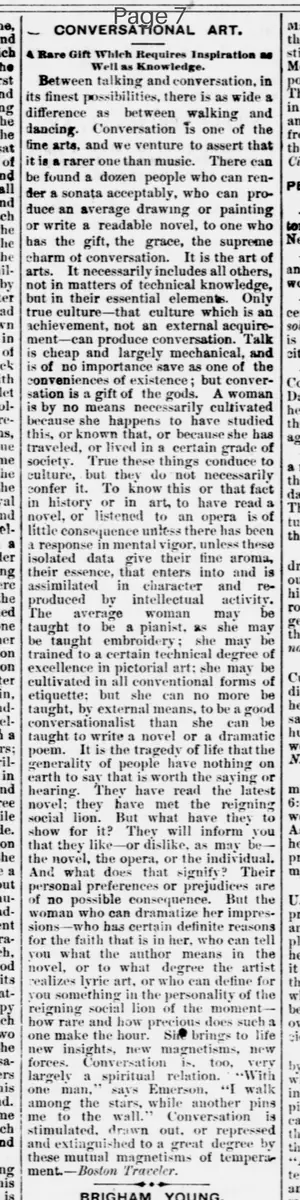
Between talking and conversation, in its finest possibilities, there is as wide a difference as between walking and dancing. Conversation is one of the fine arts, and we venture to assert that it is a rarer one than music. There can be found a dozen people who can render a sonata acceptably, who can produce an average drawing or painting or write a readable novel, to one who has the gift, the grace, the supreme charm of conversation. It is the art of arts. It necessarily includes all others, not in matters of technical knowledge, but in their essential elements. Only true culture—that culture which is an achievement, not an external acquisition—can produce conversation. Talk is cheap and largely mechanical, and is of no importance save as one of the conveniences of existence; but conversation is a gift of the gods. A woman is by no means necessarily cultivated because she happens to have studied this, or known that, or because she has traveled, or lived in a certain grade of society. True these things conduce to culture, but they do not necessarily confer it. To know this or that fact in history or in art, to have read a novel, or listened to an opera is of little consequence unless there has been a response in mental vigor, unless these isolated data give their fine aroma, their essence, that enters into and is assimilated in character and reproduced by intellectual activity. The average woman may be taught to be a pianist, as she may be taught embroidery; she may be trained to a certain technical degree of excellence in pictorial art; she may be cultivated in all conventional forms of etiquette; but she can no more be taught, by external means, to be a good conversationalist than she can be taught to write a novel or a dramatic poem. It is the tragedy of life that the generality of people have nothing on earth to say that is worth the saying or hearing. They have read the latest novel; they have met the reigning social lion. But what have they to show for it? They will inform you that they like—or dislike, as may be—the novel, the opera, or the individual. And what does that signify? Their personal preferences or prejudices are of no possible consequence. But the woman who can dramatize her impressions—who has certain definite reasons for the faith that is in her, who can tell you what the author means in the novel, or to what degree the artist realizes his art, or who can define for you something in the personality of the reigning social lion of the moment—how rare and how precious does such a one make the hour. She brings to life new insights, new magnetisms, new forces. Conversation is, too, very largely a spiritual relation. "With one man," says Emerson, "I walk among the stars, while another pins me to the wall." Conversation is stimulated, drawn out, or repressed and extinguished to a great degree by these mutual magnetisms of temperament.—Boston Traveler.
Rare Gift Which Requires Inspiration as Well as Knowledge.
Between talking and conversation, in its finest possibilities, there is as wide a difference as between walking and dancing. Conversation is one of the fine arts, and we venture to assert that it is a rarer one than music. There can be found a dozen people who can render a sonata acceptably, who can produce an average drawing or painting or write a readable novel, to one who has the gift, the grace, the supreme charm of conversation. It is the art of arts. It necessarily includes all others, not in matters of technical knowledge, but in their essential elements. Only true culture—that culture which is an achievement, not an external acquisition—can produce conversation. Talk is cheap and largely mechanical, and is of no importance save as one of the conveniences of existence; but conversation is a gift of the gods. A woman is by no means necessarily cultivated because she happens to have studied this, or known that, or because she has traveled, or lived in a certain grade of society. True these things conduce to culture, but they do not necessarily confer it. To know this or that fact in history or in art, to have read a novel, or listened to an opera is of little consequence unless there has been a response in mental vigor, unless these isolated data give their fine aroma, their essence, that enters into and is assimilated in character and reproduced by intellectual activity. The average woman may be taught to be a pianist, as she may be taught embroidery; she may be trained to a certain technical degree of excellence in pictorial art; she may be cultivated in all conventional forms of etiquette; but she can no more be taught, by external means, to be a good conversationalist than she can be taught to write a novel or a dramatic poem. It is the tragedy of life that the generality of people have nothing on earth to say that is worth the saying or hearing. They have read the latest novel; they have met the reigning social lion. But what have they to show for it? They will inform you that they like—or dislike, as may be—the novel, the opera, or the individual. And what does that signify? Their personal preferences or prejudices are of no possible consequence. But the woman who can dramatize her impressions—who has certain definite reasons for the faith that is in her, who can tell you what the author means in the novel, or to what degree the artist realizes his art, or who can define for you something in the personality of the reigning social lion of the moment—how rare and how precious does such a one make the hour. She brings to life new insights, new magnetisms, new forces. Conversation is, too, very largely a spiritual relation. "With one man," says Emerson, "I walk among the stars, while another pins me to the wall." Conversation is stimulated, drawn out, or repressed and extinguished to a great degree by these mutual magnetisms of temperament.—Boston Traveler.
What sub-type of article is it?
Essay
What themes does it cover?
Social Manners
Moral Virtue
What keywords are associated?
Conversation
Culture
Fine Arts
Social Interaction
Intellectual Assimilation
Emerson Quote
What entities or persons were involved?
Boston Traveler
Literary Details
Title
Conversational Art.
Author
Boston Traveler
Subject
On The Art Of Conversation
Key Lines
Between Talking And Conversation, In Its Finest Possibilities, There Is As Wide A Difference As Between Walking And Dancing.
Conversation Is One Of The Fine Arts, And We Venture To Assert That It Is A Rarer One Than Music.
"With One Man," Says Emerson, "I Walk Among The Stars, While Another Pins Me To The Wall."