Thank you for visiting SNEWPapers!
Sign up free
The Daily Worker
Chicago, Cook County, Illinois
What is this article about?
The Russian Academy of Sciences marks its 200th anniversary in Moscow (Sept 5-15, 1925) with international scientists from 20 countries, including Americans, to revive contacts post-war/revolution. Soviet government has enlarged the academy since 1921, boosting research, libraries, and expeditions.
Merged-components note: Image on page 5 likely depicts Russian academicians or related scene mentioned in the text; reading order proximity.
Clipping
OCR Quality
Full Text
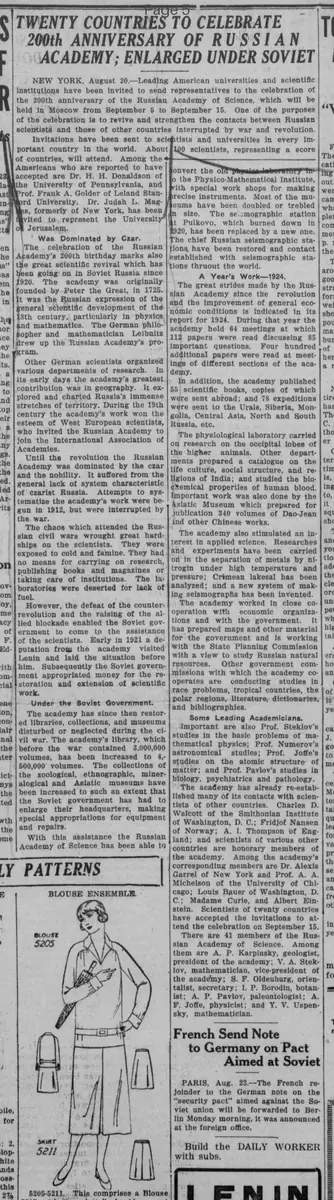
200th ANNIVERSARY OF
RUSSIAN
ACADEMY; ENLARGED UNDER SOVIET
NEW YORK, August 20. - Leading institutions have been invited to send American universities and scientific representatives to the celebration of the Academy of Science, which will be held in Moscow from September 5 to September 15. One of the purposes of the celebration is to revive and strengthen the contacts between Russian scientists and those of other countries interrupted by war and revolution.
Invitations have been sent to scientists and universities in every important country in the world. About 100 scientists, representing a score of countries, will attend. Among the Americans who are reported to have accepted are Dr. H. H. Donaldson of the University of Pennsylvania, and Prof. Frank A. Golder of Leland Stanford University. Dr. Judah L. Magnes, formerly of New York, has been invited to represent the University of Jerusalem.
Was Dominated by Czar.
The celebration of the Russian Academy's 200th birthday marks also the great scientific revival which has been going on in Soviet Russia since 1920. The academy was originally founded by Peter the Great, in 1725. It was the Russian expression of the general scientific development of the 18th century, particularly in physics and mathematics. The German philosopher and mathematician Leibnitz drew up the Russian Academy's program.
Other German scientists organized various departments of research. In its early days the academy's greatest contribution was in geography. It explored and charted Russia's immense stretches of territory. During the 19th century the academy's work won the esteem of West European scientists, who invited the Russian Academy to join the International Association of Academies.
Until the revolution the Russian Academy was dominated by the czar and the nobility. It suffered from the general lack of system characteristic of czarist Russia. Attempts to systematize the academy's work were begun in 1912, but were interrupted by the war.
The chaos which attended the Russian civil wars wrought great hardships on the scientists. They were exposed to cold and famine. They had no means for carrying on research, publishing books and magazines or taking care of institutions. The laboratories were deserted for lack of fuel.
However, the defeat of the counter-revolution and the raising of the allied blockade enabled the Soviet government to come to the assistance of the scientists. Early in 1921 a deputation from the academy visited Lenin and laid the situation before him. Subsequently the Soviet government appropriated money for the restoration and extension of scientific work.
Under the Soviet Government.
The academy has since then restored libraries, collections, and museums disturbed or neglected during the civil war. The academy's library, which before the war contained 3,000,000 volumes, has been increased to 4,500,000 volumes. The collections of the zoological, ethnographic, mineralogical and Asiatic museums have been increased to such an extent that the Soviet government has had to enlarge their headquarters, making special appropriations for equipment and repairs.
With this assistance the Russian Academy of Science has been able to convert the old building to the Physico-Mathematical Institute, with special work shops for making precise instruments. Most of the museums have been doubled or trebled in size. The seismographic station at Pulkovo, which burned down in 1920, has been replaced by a new one. The chief Russian seismographic stations have been restored and contact established with seismographic stations throughout the world.
A Year's Work - 1924
The great strides made by the Russian Academy since the revolution and the improvement of general economic conditions is indicated in its report for 1924. During that year the academy held 64 meetings at which 112 papers were read discussing 85 important questions. Four hundred additional papers were read at meetings of different sections of the academy.
In addition, the academy published 55 scientific books, copies of which were sent abroad; and 78 expeditions were sent to the Urals, Siberia, Mongolia, Central Asia, North and South Russia, etc.
The physiological laboratory carried on research on the occipital lobes of the higher animals. Other departments prepared a catalogue on the life culture, social structure, and religions of India; and studied the biochemical properties of human blood.
Important work was also done by the Asiatic Museum which prepared for publication 340 volumes of Dao-Jean and other Chinese works.
The academy also stimulated an interest in applied science. Researches and experiments have been carried on in the separation of metals by nitrogen under high temperature and pressure; Crimean lake salt has been analyzed; and a new system of making seismographs has been invented.
The academy worked in close co-operation with economic organizations and with the government. It has prepared maps and other material for the government and is working with the State Planning Commission with a view to study Russian natural resources.
Other government commissions with which the academy co-operates are conducting studies in race problems, tropical countries, the polar regions, literature, dictionaries, and bibliographies.
Some Leading Academicians.
Important are also Prof. Stekloy's studies in the basic problems of mathematical physics; Prof. Numerov's astronomical studies; Prof. Joffe's studies on the atomic structure of matter; and Prof. Pavlov's studies in biology, psychiatrics and pathology.
"The academy has already re-established many of its contacts with scientists of other countries. Charles D. Walcott of the Smithsonian Institute of Washington, D. C.; Fridjof Nansen of Norway; A. I. Thompson of England; and scientists of various other countries are honorary members of the academy. Among the academy's corresponding members are Dr. Alexis Carrel of New York and Prof. A. A. Michelson of the University of Chicago; Louis Bauer of Washington, D. C.; Madame Curie, and Albert Einstein. Scientists of twenty countries have accepted the invitations to attend the celebration on September 15.
There are 41 members of the Russian Academy of Science. Among them are A. P. Karpinsky, geologist, president of the academy; V. A. Steklov, mathematician, vice-president of the academy; S. F. Oldenburg, orientalist, secretary; I. P. Borodin, botanist; A. P. Pavlov, paleontologist; A. F. Joffe, physicist; and Y. V. Uspensky, mathematician.
What sub-type of article is it?
What keywords are associated?
What entities or persons were involved?
Where did it happen?
Foreign News Details
Primary Location
Moscow
Event Date
September 5 To September 15
Key Persons
Outcome
the russian academy of sciences has been revived and enlarged under the soviet government, with increased libraries, museums, and scientific output; international contacts re-established with scientists from 20 countries attending the celebration.
Event Details
Leading institutions invited to send representatives to the 200th anniversary celebration of the Russian Academy of Sciences in Moscow from September 5 to 15, aiming to revive international scientific contacts interrupted by war and revolution. About 100 scientists from 20 countries expected, including Americans Dr. H. H. Donaldson, Prof. Frank A. Golder, and Dr. Judah L. Magnes for University of Jerusalem. Founded by Peter the Great in 1725, dominated by czar until revolution; suffered during civil wars but restored by Soviet government from 1921, with expanded facilities, publications, expeditions, and cooperation on economic and governmental projects. Key figures include President A. P. Karpinsky and others; honorary members like Charles D. Walcott, Fridjof Nansen, Marie Curie, Albert Einstein.