Thank you for visiting SNEWPapers!
Sign up free
Editorial
April 11, 1949
The Augusta Courier
Augusta, Richmond County, Georgia
What is this article about?
Editorial criticizes federal matching grants to states, arguing they discriminate against poorer states like Georgia, give federal control over state funds and functions, and restrict local priorities in areas like roads, pensions, and schools. Calls for Congress to eliminate matching requirements.
Clipping
OCR Quality
98%
Excellent
Full Text
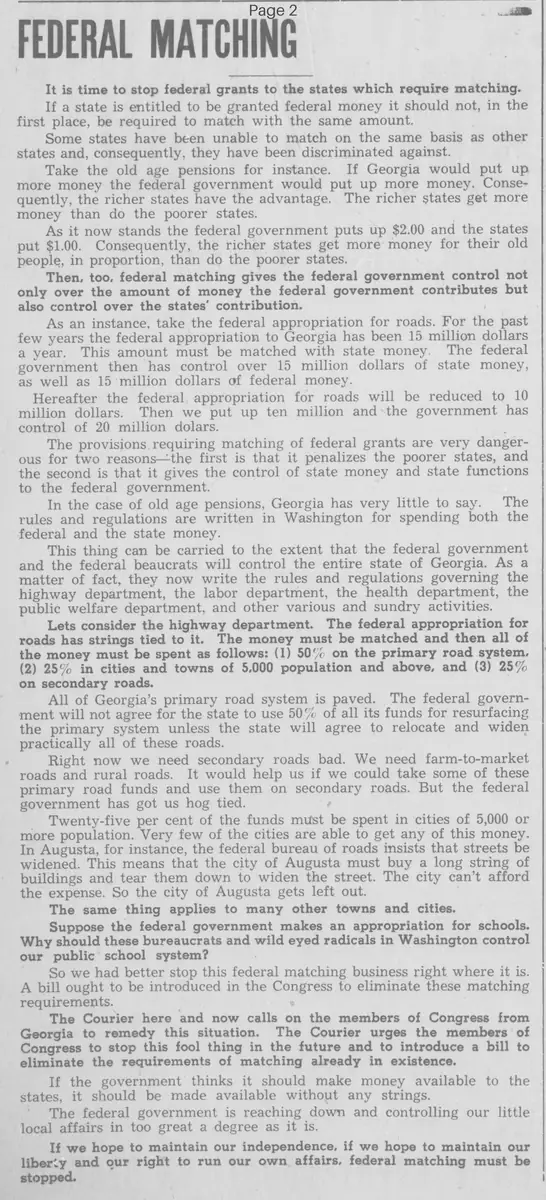
FEDERAL MATCHING
It is time to stop federal grants to the states which require matching. If a state is entitled to be granted federal money it should not, in the first place, be required to match with the same amount. Some states have been unable to match on the same basis as other states and, consequently, they have been discriminated against.
Take the old age pensions for instance. If Georgia would put up more money the federal government would put up more money. Consequently, the richer states have the advantage. The richer states get more money than do the poorer states.
As it now stands the federal government puts up $2.00 and the states put $1.00. Consequently, the richer states get more money for their old people, in proportion, than do the poorer states.
Then, too, federal matching gives the federal government control not only over the amount of money the federal government contributes but also control over the states' contribution.
As an instance, take the federal appropriation for roads. For the past few years the federal appropriation to Georgia has been 15 million dollars a year. This amount must be matched with state money. The federal government then has control over 15 million dollars of state money, as well as 15 million dollars of federal money.
Hereafter the federal appropriation for roads will be reduced to 10 million dollars. Then we put up ten million and the government has control of 20 million dollars.
The provisions requiring matching of federal grants are very dangerous for two reasons the first is that it penalizes the poorer states, and the second is that it gives the control of state money and state functions to the federal government.
In the case of old age pensions, Georgia has very little to say. The rules and regulations are written in Washington for spending both the federal and the state money.
This thing can be carried to the extent that the federal government and the federal bureaucrats will control the entire state of Georgia. As a matter of fact, they now write the rules and regulations governing the highway department, the labor department, the health department, the public welfare department, and other various and sundry activities.
Lets consider the highway department. The federal appropriation for roads has strings tied to it. The money must be matched and then all of the money must be spent as follows: (1) 50% on the primary road system, (2) 25% in cities and towns of 5,000 population and above, and (3) 25% on secondary roads.
All of Georgia's primary road system is paved. The federal government will not agree for the state to use 50% of all its funds for resurfacing the primary system unless the state will agree to relocate and widen practically all of these roads.
Right now we need secondary roads bad. We need farm-to-market roads and rural roads. It would help us if we could take some of these primary road funds and use them on secondary roads. But the federal government has got us hog tied.
Twenty-five per cent of the funds must be spent in cities of 5,000 or more population. Very few of the cities are able to get any of this money. In Augusta, for instance, the federal bureau of roads insists that streets be widened. This means that the city of Augusta must buy a long string of buildings and tear them down to widen the street. The city can't afford the expense. So the city of Augusta gets left out.
The same thing applies to many other towns and cities.
Suppose the federal government makes an appropriation for schools. Why should these bureaucrats and wild eyed radicals in Washington control our public school system?
So we had better stop this federal matching business right where it is. A bill ought to be introduced in the Congress to eliminate these matching requirements. 2
The Courier here and now calls on the members of Congress from Georgia to remedy this situation. The Courier urges the members of Congress to stop this fool thing in the future and to introduce a bill to eliminate the requirements of matching already in existence.
If the government thinks it should make money available to the states, it should be made available without any strings.
The federal government is reaching down and controlling our little local affairs in too great a degree as it is.
If we hope to maintain our independence, if we hope to maintain our liberty and our right to run our own affairs, federal matching must be stopped.
It is time to stop federal grants to the states which require matching. If a state is entitled to be granted federal money it should not, in the first place, be required to match with the same amount. Some states have been unable to match on the same basis as other states and, consequently, they have been discriminated against.
Take the old age pensions for instance. If Georgia would put up more money the federal government would put up more money. Consequently, the richer states have the advantage. The richer states get more money than do the poorer states.
As it now stands the federal government puts up $2.00 and the states put $1.00. Consequently, the richer states get more money for their old people, in proportion, than do the poorer states.
Then, too, federal matching gives the federal government control not only over the amount of money the federal government contributes but also control over the states' contribution.
As an instance, take the federal appropriation for roads. For the past few years the federal appropriation to Georgia has been 15 million dollars a year. This amount must be matched with state money. The federal government then has control over 15 million dollars of state money, as well as 15 million dollars of federal money.
Hereafter the federal appropriation for roads will be reduced to 10 million dollars. Then we put up ten million and the government has control of 20 million dollars.
The provisions requiring matching of federal grants are very dangerous for two reasons the first is that it penalizes the poorer states, and the second is that it gives the control of state money and state functions to the federal government.
In the case of old age pensions, Georgia has very little to say. The rules and regulations are written in Washington for spending both the federal and the state money.
This thing can be carried to the extent that the federal government and the federal bureaucrats will control the entire state of Georgia. As a matter of fact, they now write the rules and regulations governing the highway department, the labor department, the health department, the public welfare department, and other various and sundry activities.
Lets consider the highway department. The federal appropriation for roads has strings tied to it. The money must be matched and then all of the money must be spent as follows: (1) 50% on the primary road system, (2) 25% in cities and towns of 5,000 population and above, and (3) 25% on secondary roads.
All of Georgia's primary road system is paved. The federal government will not agree for the state to use 50% of all its funds for resurfacing the primary system unless the state will agree to relocate and widen practically all of these roads.
Right now we need secondary roads bad. We need farm-to-market roads and rural roads. It would help us if we could take some of these primary road funds and use them on secondary roads. But the federal government has got us hog tied.
Twenty-five per cent of the funds must be spent in cities of 5,000 or more population. Very few of the cities are able to get any of this money. In Augusta, for instance, the federal bureau of roads insists that streets be widened. This means that the city of Augusta must buy a long string of buildings and tear them down to widen the street. The city can't afford the expense. So the city of Augusta gets left out.
The same thing applies to many other towns and cities.
Suppose the federal government makes an appropriation for schools. Why should these bureaucrats and wild eyed radicals in Washington control our public school system?
So we had better stop this federal matching business right where it is. A bill ought to be introduced in the Congress to eliminate these matching requirements. 2
The Courier here and now calls on the members of Congress from Georgia to remedy this situation. The Courier urges the members of Congress to stop this fool thing in the future and to introduce a bill to eliminate the requirements of matching already in existence.
If the government thinks it should make money available to the states, it should be made available without any strings.
The federal government is reaching down and controlling our little local affairs in too great a degree as it is.
If we hope to maintain our independence, if we hope to maintain our liberty and our right to run our own affairs, federal matching must be stopped.
What sub-type of article is it?
Economic Policy
Infrastructure
Constitutional
What keywords are associated?
Federal Matching Grants
State Discrimination
Federal Control
Road Appropriations
Old Age Pensions
Georgia Highways
Congressional Action
What entities or persons were involved?
Federal Government
Georgia
Congress Members From Georgia
The Courier
Washington Bureaucrats
Editorial Details
Primary Topic
Opposition To Federal Matching Grants
Stance / Tone
Strongly Against Federal Matching Requirements
Key Figures
Federal Government
Georgia
Congress Members From Georgia
The Courier
Washington Bureaucrats
Key Arguments
Matching Requirements Discriminate Against Poorer States Like Georgia
Richer States Receive More Benefits Proportionally
Federal Matching Gives Washington Control Over State Funds And Functions
Road Appropriations Force Specific Spending Allocations That Hinder Local Needs
Old Age Pensions And Other Programs Are Regulated By Federal Rules
Federal Control Extends To Highway, Labor, Health, Welfare, And Education Departments
Cities Like Augusta Cannot Afford Federal Mandated Projects
Bill Needed In Congress To Eliminate Matching Requirements