Thank you for visiting SNEWPapers!
Sign up free
Editorial
November 25, 1861
The New York Herald
New York, New York County, New York
What is this article about?
This editorial criticizes Jefferson Davis's message to the Confederate Congress as a sign of weakening rebellion, highlighting admissions of no secession right by Gen. Polk, fears of Union advances, ignored defeats, and desperate hopes for European intervention amid effective blockade and cotton famine in Britain.
Clipping
OCR Quality
95%
Excellent
Full Text
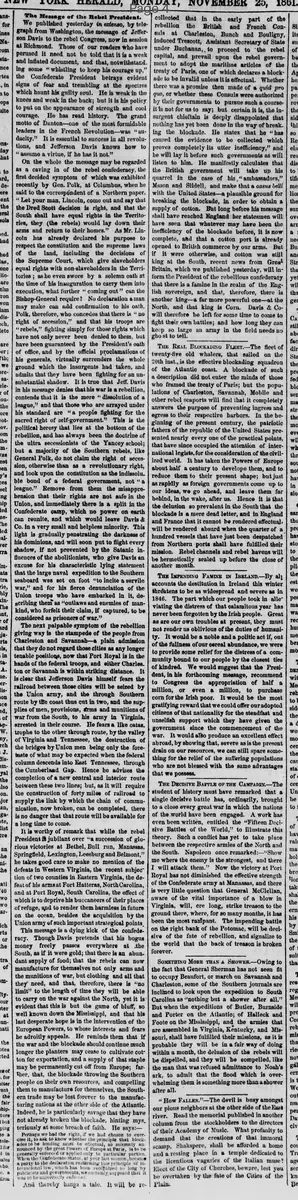
The Message of the Rebel President.
We published yesterday in extenso, by telegraph from Washington, the message of Jefferson Davis to the rebel Congress, now in session at Richmond. Those of our readers who have perused it need not be told that it is a weak and inflated document, and that, notwithstanding some "whistling to keep his courage up," the Confederate President betrays evident signs of fear and trembling at the spectres which haunt his guilty soul. He is weak in the knees and weak in the back; but it is his policy to put on the appearance of strength and cool courage. He has read history. The grand motto of Danton-one of the most formidable leaders in the French Revolution-was "audacity." It is essential to success in all revolutions, and Jefferson Davis knows how to "assume a virtue, if he has it not."
On the whole the message may be regarded as a caving in of the rebel confederacy, the first decided symptom of which was exhibited recently by Gen. Polk, at Columbus, when he said to the correspondent of a Northern paper, "Let your man, Lincoln, come out and say that the Dred Scott decision is right, and that the South shall have equal rights in the Territories, they (the rebels) would lay down their arms and return to their homes." As Mr. Lincoln has already declared his purpose to respect the constitution and the supreme laws of the land, including the decisions of the Supreme Court, which give slaveholders equal rights with non-slaveholders in the Territories; as he even swore by a solemn oath at the time of his inauguration to carry them into execution, what further "coming out" can the Bishop-General require? No declaration a man may make can add confirmation to his oath.
Polk, therefore, who concedes that there is "no right of secession," and that his troops are "rebels," fighting simply for those rights which have not only never been denied to them, but have been guaranteed by the President's oath of office, and by the official proclamations of his generals, virtually surrenders the whole ground which the insurgents had taken, and admits that they have been fighting for an unsubstantial shadow. It is true that Jeff. Davis in his message denies that his war is a rebellion, contends that it is the mere "dissolution of a league," and that those who are arrayed under his standard are "a people fighting for the sacred right of self-government." This is the political heresy that lies at the bottom of the rebellion, and has always been the doctrine of the ultra secessionists of the Yancey school: but a majority of the Southern rebels, like General Polk, do not claim the right of secession, otherwise than as a revolutionary right, and look upon the constitution as the indissoluble bond of a federal government, not "a league." Remove from them the misapprehension that their rights are not safe in the Union, and immediately there is a split in the Confederate camp, which no power on earth can reunite, and which would leave Davis & Co. in a very small and helpless minority. This light is gradually penetrating the darkness of his dominions, and will soon put to flight every shadow, if not prevented by the Satanic influences of the abolitionists, who give Davis an excuse for his characteristic lying statement that the large naval expedition to the Southern seaboard was set on foot "to incite a servile war," and for his fierce denunciation of the Union troops who have embarked in it, describing them as "outlaws and enemies of mankind, who forfeit their claim, if captured, to be considered as prisoners of war."
The next palpable symptom of the rebellion giving way is the stampede of the people from Charleston and Savannah-a plain admission that they do not regard those cities as any longer tenable positions, now that Port Royal is in the hands of the federal troops, and either Charleston or Savannah is within striking distance. It is clear that Jefferson Davis himself fears the railroad between those cities will be seized by the Union army, and the through Southern route by the coast thus cut in two, and the supplies of men, provisions, arms and munitions of war from the South, to his army in Virginia, arrested in their course. He fears a like catastrophe to the other through route, by the valley of Virginia and Tennessee, the destruction of the bridges by Union men being only the foretaste of what may be expected when the federal column descends into East Tennessee, through the Cumberland Gap. Hence he advises the completion of a new central and interior route between these two lines; but, as it will require the construction of forty miles of railroad to supply the link by which the chain of communication, now broken, can be completed, there is no danger that that route will be available for a long time to come.
It is worthy of remark that while the rebel President is jubilant over "a succession of glorious victories at Bethel, Bull Run, Manassas, Springfield, Lexington, Leesburg and Belmont," he takes good care to make no mention of the defeats in Western Virginia, the recent subjection of two counties in Eastern Virginia, the defeat of his arms at Fort Hatteras, North Carolina, and at Port Royal, South Carolina, the effect of which is to deprive his buccaneers of their places of refuge, and to render them harmless in future on the ocean, besides the acquisition by the Union army of such important strategical points
This message is a dying kick of the confederacy. Though Davis pretends that his bogus money freely passes everywhere at the South, as if it were gold; that there is an abundant supply of food; that the rebels can now manufacture for themselves not only arms and the munitions of war, but clothing and all that they need, and that, therefore, there is "no limit" to the length of time they will be able to carry on the war against the North, yet it is evident that this is but the game of bluff, so well known down the Mississippi, and that his last desperate hope is in the intervention of the European Powers, to whose interests and fears he adroitly appeals. He reminds them that if the war and the blockade should continue much longer the planters may cease to cultivate cotton for exportation, and a supply of that staple may be permanently cut off from Europe; further, that, the blockade throwing the Southern people on their own resources, and compelling them to manufacture for themselves, the Southern trade may be lost forever to the manufacturing nations at the other side of the Atlantic.
Indeed, he is particularly savage that they have not already broken the blockade, hinting mysteriously at some breach of faith. He says:
Perhaps we had the right, if we had chosen to exercise it, to ask to know whether the principle that blockades to be binding must be effectual, so solemnly announced by the great Powers of Europe at Paris, is to be generally enforced or applied only to particular parties. When the Confederate States, at your last session, became a party to the declaration reaffirming this principle of international law, which has been recognized so long by publicists and governments, we certainly supposed that it was to be universally enforced.
And thereby hangs a tale. It will be recollected that in the early part of the rebellion the British and French Consuls at Charleston, Bunch and Bouligny, induced Trescott, Assistant Secretary of State under Buchanan, to proceed to the rebel capital, and prevail upon the rebel government to adopt the maritime articles of the treaty of Paris, one of which declares a blockade to be invalid unless it is effectual. Whether there was a promise then made of a quid pro quo, or whether these Consuls were authorized by their governments to pursue such a course it is not for us to say; but certain it is, the insurgent chieftain is deeply disappointed that nothing has yet been done in the way of breaking the blockade. He states that he "has caused the evidence to be collected which proves completely its utter inefficiency," and he will lay it before such governments as will listen to him. He manifestly calculates that the British government will take up his quarrel in the case of his "ambassadors," Mason and Slidell, and make that a casus belli with the United States--a plausible ground for breaking the blockade, in order to obtain a supply of cotton. But long before his message shall have reached England her statesmen will have seen that whatever may have been the inefficiency of the blockade before, it is now complete, and that a cotton port is already opened to British commerce by our arms. But if it were otherwise, and cotton was still king at the South, recent news from Great Britain, which we published yesterday, will inform the President of the rebellious confederacy that there is a famine in the realm of the English sovereign, and that, therefore, there is another king--a far more powerful one--at the North, and that king is Corn. Davis & Co will therefore be left for some time to come to fight their own battles; and how long they can keep so large an army in the field needs no ghost to tell.
We published yesterday in extenso, by telegraph from Washington, the message of Jefferson Davis to the rebel Congress, now in session at Richmond. Those of our readers who have perused it need not be told that it is a weak and inflated document, and that, notwithstanding some "whistling to keep his courage up," the Confederate President betrays evident signs of fear and trembling at the spectres which haunt his guilty soul. He is weak in the knees and weak in the back; but it is his policy to put on the appearance of strength and cool courage. He has read history. The grand motto of Danton-one of the most formidable leaders in the French Revolution-was "audacity." It is essential to success in all revolutions, and Jefferson Davis knows how to "assume a virtue, if he has it not."
On the whole the message may be regarded as a caving in of the rebel confederacy, the first decided symptom of which was exhibited recently by Gen. Polk, at Columbus, when he said to the correspondent of a Northern paper, "Let your man, Lincoln, come out and say that the Dred Scott decision is right, and that the South shall have equal rights in the Territories, they (the rebels) would lay down their arms and return to their homes." As Mr. Lincoln has already declared his purpose to respect the constitution and the supreme laws of the land, including the decisions of the Supreme Court, which give slaveholders equal rights with non-slaveholders in the Territories; as he even swore by a solemn oath at the time of his inauguration to carry them into execution, what further "coming out" can the Bishop-General require? No declaration a man may make can add confirmation to his oath.
Polk, therefore, who concedes that there is "no right of secession," and that his troops are "rebels," fighting simply for those rights which have not only never been denied to them, but have been guaranteed by the President's oath of office, and by the official proclamations of his generals, virtually surrenders the whole ground which the insurgents had taken, and admits that they have been fighting for an unsubstantial shadow. It is true that Jeff. Davis in his message denies that his war is a rebellion, contends that it is the mere "dissolution of a league," and that those who are arrayed under his standard are "a people fighting for the sacred right of self-government." This is the political heresy that lies at the bottom of the rebellion, and has always been the doctrine of the ultra secessionists of the Yancey school: but a majority of the Southern rebels, like General Polk, do not claim the right of secession, otherwise than as a revolutionary right, and look upon the constitution as the indissoluble bond of a federal government, not "a league." Remove from them the misapprehension that their rights are not safe in the Union, and immediately there is a split in the Confederate camp, which no power on earth can reunite, and which would leave Davis & Co. in a very small and helpless minority. This light is gradually penetrating the darkness of his dominions, and will soon put to flight every shadow, if not prevented by the Satanic influences of the abolitionists, who give Davis an excuse for his characteristic lying statement that the large naval expedition to the Southern seaboard was set on foot "to incite a servile war," and for his fierce denunciation of the Union troops who have embarked in it, describing them as "outlaws and enemies of mankind, who forfeit their claim, if captured, to be considered as prisoners of war."
The next palpable symptom of the rebellion giving way is the stampede of the people from Charleston and Savannah-a plain admission that they do not regard those cities as any longer tenable positions, now that Port Royal is in the hands of the federal troops, and either Charleston or Savannah is within striking distance. It is clear that Jefferson Davis himself fears the railroad between those cities will be seized by the Union army, and the through Southern route by the coast thus cut in two, and the supplies of men, provisions, arms and munitions of war from the South, to his army in Virginia, arrested in their course. He fears a like catastrophe to the other through route, by the valley of Virginia and Tennessee, the destruction of the bridges by Union men being only the foretaste of what may be expected when the federal column descends into East Tennessee, through the Cumberland Gap. Hence he advises the completion of a new central and interior route between these two lines; but, as it will require the construction of forty miles of railroad to supply the link by which the chain of communication, now broken, can be completed, there is no danger that that route will be available for a long time to come.
It is worthy of remark that while the rebel President is jubilant over "a succession of glorious victories at Bethel, Bull Run, Manassas, Springfield, Lexington, Leesburg and Belmont," he takes good care to make no mention of the defeats in Western Virginia, the recent subjection of two counties in Eastern Virginia, the defeat of his arms at Fort Hatteras, North Carolina, and at Port Royal, South Carolina, the effect of which is to deprive his buccaneers of their places of refuge, and to render them harmless in future on the ocean, besides the acquisition by the Union army of such important strategical points
This message is a dying kick of the confederacy. Though Davis pretends that his bogus money freely passes everywhere at the South, as if it were gold; that there is an abundant supply of food; that the rebels can now manufacture for themselves not only arms and the munitions of war, but clothing and all that they need, and that, therefore, there is "no limit" to the length of time they will be able to carry on the war against the North, yet it is evident that this is but the game of bluff, so well known down the Mississippi, and that his last desperate hope is in the intervention of the European Powers, to whose interests and fears he adroitly appeals. He reminds them that if the war and the blockade should continue much longer the planters may cease to cultivate cotton for exportation, and a supply of that staple may be permanently cut off from Europe; further, that, the blockade throwing the Southern people on their own resources, and compelling them to manufacture for themselves, the Southern trade may be lost forever to the manufacturing nations at the other side of the Atlantic.
Indeed, he is particularly savage that they have not already broken the blockade, hinting mysteriously at some breach of faith. He says:
Perhaps we had the right, if we had chosen to exercise it, to ask to know whether the principle that blockades to be binding must be effectual, so solemnly announced by the great Powers of Europe at Paris, is to be generally enforced or applied only to particular parties. When the Confederate States, at your last session, became a party to the declaration reaffirming this principle of international law, which has been recognized so long by publicists and governments, we certainly supposed that it was to be universally enforced.
And thereby hangs a tale. It will be recollected that in the early part of the rebellion the British and French Consuls at Charleston, Bunch and Bouligny, induced Trescott, Assistant Secretary of State under Buchanan, to proceed to the rebel capital, and prevail upon the rebel government to adopt the maritime articles of the treaty of Paris, one of which declares a blockade to be invalid unless it is effectual. Whether there was a promise then made of a quid pro quo, or whether these Consuls were authorized by their governments to pursue such a course it is not for us to say; but certain it is, the insurgent chieftain is deeply disappointed that nothing has yet been done in the way of breaking the blockade. He states that he "has caused the evidence to be collected which proves completely its utter inefficiency," and he will lay it before such governments as will listen to him. He manifestly calculates that the British government will take up his quarrel in the case of his "ambassadors," Mason and Slidell, and make that a casus belli with the United States--a plausible ground for breaking the blockade, in order to obtain a supply of cotton. But long before his message shall have reached England her statesmen will have seen that whatever may have been the inefficiency of the blockade before, it is now complete, and that a cotton port is already opened to British commerce by our arms. But if it were otherwise, and cotton was still king at the South, recent news from Great Britain, which we published yesterday, will inform the President of the rebellious confederacy that there is a famine in the realm of the English sovereign, and that, therefore, there is another king--a far more powerful one--at the North, and that king is Corn. Davis & Co will therefore be left for some time to come to fight their own battles; and how long they can keep so large an army in the field needs no ghost to tell.
What sub-type of article is it?
War Or Peace
Constitutional
Partisan Politics
What keywords are associated?
Jefferson Davis Message
Confederate Weakness
Civil War
Blockade
Secession
European Intervention
Dred Scott Decision
What entities or persons were involved?
Jefferson Davis
Gen. Polk
Abraham Lincoln
Confederate Congress
Danton
Editorial Details
Primary Topic
Critique Of Jefferson Davis's Message To The Confederate Congress
Stance / Tone
Strongly Anti Confederate And Pro Union
Key Figures
Jefferson Davis
Gen. Polk
Abraham Lincoln
Confederate Congress
Danton
Key Arguments
Davis's Message Shows Weakness And Fear Despite Bluster
Polk Admits No Right Of Secession And Conditional Surrender
Davis Denies Rebellion But Claims Self Government
Southern Fears Of Union Advances On Key Routes
Rebel Jubilation Over Victories Ignores Defeats
Confederacy Relies On Bluff And Hopes For European Intervention
Disappointment Over Ineffective Blockade Recognition
Calculates On British Intervention Via Mason And Slidell