Thank you for visiting SNEWPapers!
Sign up free
Alexandria Advertiser And Commercial Intelligencer
Alexandria, Virginia
What is this article about?
This editorial, part V of 'The Appeal,' criticizes President Jefferson's fiscal policies, particularly the repeal of internal revenues, for threatening public credit and the sinking fund despite inaugural pledges to honor debts. It highlights partisan hypocrisy and potential deficits, referencing congressional debates.
Merged-components note: Continuation of the editorial essay 'The Appeal--No. V. Public Credit' across pages 2 and 3, as the text flows directly from the end of component 23 to the start of component 24.
Clippings
1 of 2
OCR Quality
Full Text
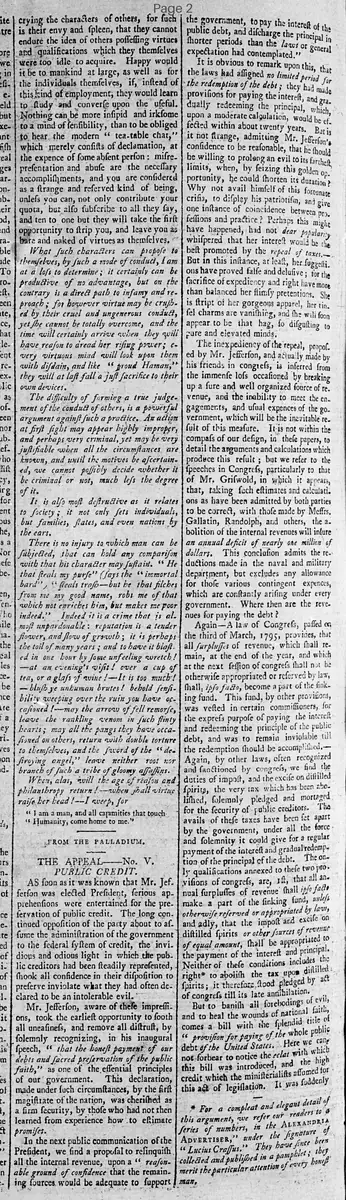
THE APPEAL.--No. V.
PUBLIC CREDIT
AS soon as it was known that Mr. Jefferson was elected President, serious apprehensions were entertained for the preservation of public credit. The long continued opposition of the party about to assume the administration of the government to the federal system of credit, the invidious and odious light in which the public creditors had been steadily represented, shook all confidence in their disposition to preserve inviolate what they had often declared to be an intolerable evil.
Mr. Jefferson, aware of these impressions, took the earliest opportunity to sooth all uneasiness, and remove all distrust, by solemnly recognizing, in his inaugural speech, " that the honest payment of our debts and sacred preservation of the public faith," as one of the essential principles of our government. This declaration, made under such circumstances, by the first magistrate of the nation, was cherished as a firm security, by those who had not then learned from experience how to estimate promises.
In the next public communication of the President, we find a proposal to relinquish all the internal revenue, upon a " reasonable ground of confidence that the remaining sources would be adequate to support the government, to pay the interest of the public debt, and discharge the principal in shorter periods than the laws or general expectation had contemplated."
It is obvious to remark upon this, that the laws had assigned no limited period for the redemption of the debt ; they had made provisions for paying the interest, and gradually redeeming the principal, which, upon a moderate calculation, would be effected within about twenty years. But is it not strange, admitting Mr. Jefferson's confidence to be reasonable, that he should be willing to prolong an evil to its farthest limits, when, by seizing this golden opportunity, he could shorten its duration? Why not avail himself of this fortunate crisis, to display his patriotism, and give one instance of coincidence between professions and practice? Perhaps this might have happened, had not dear popularity whispered that her interest would be best promoted by the repeal of taxes.-- But in this instance, at least, her suggestions have proved false and delusive ; for the sacrifice of expediency and right have more than balanced her flimsy pretensions. She is stript of her gorgeous apparel, her tinselly charms are vanishing, and she will soon appear to be that hag, so disgusting to pure and elevated minds.
The inexpediency of the repeal, proposed by Mr. Jefferson, and actually made by his friends in congress, is inferred from the immense loss occasioned by breaking up a sure and well organized source of revenue, and the inability to meet the engagements, and usual expenses of the government, which will be the inevitable result of this measure. It is not within the compass of our design, in these papers, to detail the arguments and calculations which produce this result : but we refer to the speeches in Congress, particularly to that of Mr. Griswold, in which it appears, that, taking such estimates and calculations as have been admitted by both parties to be correct, with those made by Messrs. Gallatin, Randolph, and others, the abolition of the internal revenues will insure an annual deficit of nearly one million of dollars. This conclusion admits the reductions made in the naval and military department, but excludes any allowance for those various contingent expenses, which are constantly arising under every government. Where then are the revenues for paying the debt ?
Again--A law of Congress, passed on the third of March, 1795, provides, that all surpluses of revenue, which shall remain, at the end of the year, and which at the next session of congress shall not be otherwise appropriated or reserved by law. shall, ipso facto, become a part of the sinking fund. This fund, by other provisions, was vested in certain commissioners, for the express purpose of paying the interest and redeeming the principle of the public debt, and was to remain inviolable till the redemption should be accomplished.-- Again, by other laws, often recognized and sanctioned by congress, we find the duties of impost, and the excise on distilled spirits, the very tax which has been abolished, solemnly pledged and mortgaged for the security of public creditors. The faith and solemnity it could give for a regular payment by the government, under all the force avails of these taxes have been set apart for the payment of the interest and gradual redemption of the principal of the debt. The only qualifications annexed to these two provisions of congress, are, 1st, that all annual surpluses of revenue shall ipso facto make a part of the sinking fund, unless otherwise reserved or appropriated by laws, and 2dly, that the impost and excise on distilled spirits or other sources of revenue of equal amount, shall be appropriated to the payment of the interest and principal. Neither of these conditions includes the right to abolish the tax upon distilled spirits; it therefore stood pledged by act of congress till its late annihilation.
But to banish all forebodings of evil, comes a bill with the splendid title of "provision for paying of the whole public debt of the United States." Here we cannot forbear to notice the eclat with which this bill was introduced, and the high credit which the ministerialists assumed for this act of legislation. It was placarded in every newspaper, and proclaimed where met the eye in staring capitals.—The provision for paying the whole debt, every claim by ten thousand tongues; their sacred regard to public faith was proclaimed. Provisions for its preservation were trumpeted in every corner. One would have thought, from the reception of its friends, that the bill was a work of supererogation, not that of common honesty and justice; an exuberance of virtue, not its usual and steady course. But when we know that this very bill, with its imposing title, contains provisions for reloaning, to an indefinite period, the whole of the Dutch debt, amounting to nine millions of dollars, we set down all those expressions of complacency and triumph, as the tribute which hypocrisy pays to virtue. If the bill had been in fact, what it pretended to be, why should it be the subject of eulogium?—Would a common act of justice in a national legislature be thought worthy of such marked applause? Provisions for the same purpose had been made by the federal administration, but did the ministerialists then hold the language of praise? Their motives are too obvious to be misunderstood.
* For a compleat and elegant detail of this argument, we refer our readers to a Series of numbers, in the ALEXANDRIA ADVERTISER, under the signature of "Lucius Crassus." They have since been collected and published in a pamphlet ; they merit the particular attention of every honest man,
In addition to these acts, whose operation can hardly fail to effect the very existence of public credit, there are certain other corroborating proofs of a plain and unequivocal nature. These are manifested in that bitter, vindictive spirit towards public creditors, which has, till the epoch of inaugural speeches, characterized the present administration and its adherents. They have been denounced as speculators, usurers, and jews, and held up as objects so odious, that to cheat them would be deemed a virtue. What then is the true value of an official promise, intended to soothe the public mind under its fears when balanced with those declarations, made without any possible motives of concealment, in the very gall of those feelings which must now be disguised? What confidence can we repose in one promise which is sanctioned by the violation of another? Alas, they are made of such stuff as dreams are. Mere baubles thrown out to amuse children.
We do not wish to multiply dangers, or arraign the measures of government unjustly. We should be glad to know that our apprehensions were ill founded; but when we look around us and find nothing but professions and promises, renewed as often as they are broken we confess our confidence droops.
We remember that the economists and reformers of France, when about to seize upon the property of the Church, made the most solemn promises to provide for the support of religion. We remember too, that they did seize the property, and we leave it to certain of our own philosophers to inform us in what manner religion received its promised support in France.
PUBLIUS LENTULUS.
What sub-type of article is it?
What keywords are associated?
What entities or persons were involved?
Editorial Details
Primary Topic
Threat To Public Credit Under Jefferson's Fiscal Policies
Stance / Tone
Critical And Alarmist
Key Figures
Key Arguments