Thank you for visiting SNEWPapers!
Sign up free
Letter to Editor
June 15, 1846
Arkansas State Gazette
Little Rock, Pulaski County, Arkansas
What is this article about?
A Suitor refutes A.B.'s defense of Judge Sneed's misconduct, insisting the charges of corruptly refusing to certify court cases due to personal dislike are true and motivated by duty, not spite. He accuses Sneed of defying the Supreme Court and his oath, demanding the judge address the allegations publicly.
Clipping
OCR Quality
98%
Excellent
Full Text
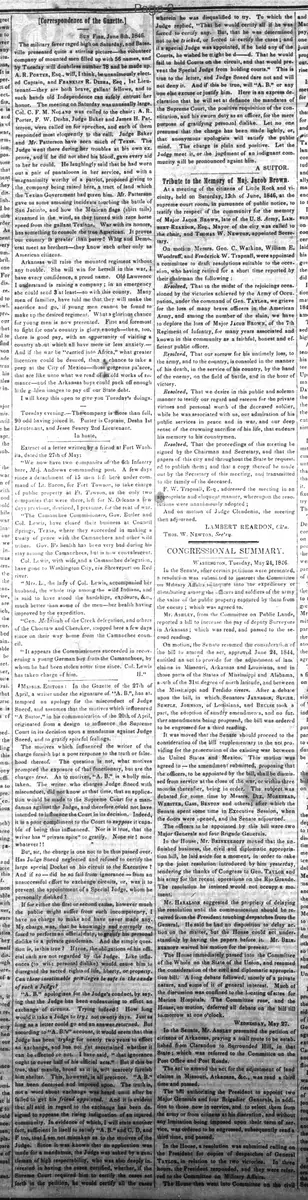
Messrs. Editors: In the Gazette of the 27th of April, a writer under the signature of "A. B." has attempted an apology for the misconduct of Judge Sneed, and assumes that the motives which influenced "A Sutor," in his communication of the 20th of April, originated from a design to influence the Supreme Court in its decision upon a mandamus against Judge Sneed, and to gratify spiteful feelings.
The motives which influenced the writer of the charge furnish but a poor response to the truth or falsehood thereof. The question is not, what motives prompted the exposure of that functionary, but are the charges true. As to motives "A. B." is wholly mistaken. The writer who charges Judge Sneed with misconduct, did not know at that time, that an application would be made to the Supreme Court for a mandamus against the Judge, and therefore could not have intended to influence the Court in its decision. Indeed, it is a poor compliment to the Court to suppose it capable of being thus influenced. Nor is it true, that the writer has "private spite" to gratify. None sir! none whatever!!
But, sir, the charge is one not to be thus passed over. Has Judge Sneed neglected and refused to certify the large special Docket on his circuit to the Executive? And if so—did he so fail from ignorance—from an unsuccessful effort to exchange circuits, or, was it to prevent the appointment of a Special Judge, whom he personally disliked?
If for either the first or second cause, however much the public might suffer from such incompetency, I have no charge to make and have never made any.
My charge was, that he knowingly and corruptly refused to perform an official duty, to gratify his personal dislike to a private gentleman. And the simple question is, is this true? If true, the obligations of his official oath are not regarded by the Judge. Like influences (to wit: personal dislike) would cause him to disregard the sacred rights of life, liberty, or property. Can these inestimable privileges be safe in the hands of such a Judge?
"A. B." apologizes for the Judge's conduct, by saying that the Judge has been endeavoring to effect an exchange of circuits. Trying indeed! How long would it take a Judge to try; not twenty days. Just as long as a letter could go and an answer returned. But according to "A. B.'s" account, it would seem that this Judge has been trying for nearly two years to effect an exchange, and has not yet ascertained whether it can be effected or not. I have said, "that ignorance ought to cover half of his official acts." But if this be true, that mantle, broad as it is, will scarcely furnish him shelter. This, however is all pretence. "A B." has been deceived and imposed upon. The truth is, not a word about exchange was heard until after he failed to get his friend appointed. And it is evident that all said in regard to the exchange has been designed to appease the rising indignation- of an injured community. In evidence of which, I will state another fact, sufficient in itself to satisfy "A.B." and C, D, and F too, that I am not mistaken as to the motives of the Judge. Since it was known that an application was made for a mandamus, the Judge was asked by a gentleman of high respectability, who was also deeply interested in having the cases certified, whether, if the Supreme Court required him to certify the cases set forth in the petition, he would certify all the cases wherein he was disqualified to try. To which the Judge replied, "That he would certify all if he was forced to certify any. But, that he was determined not to be tricked, or forced to certify the cases; and if a special Judge was appointed, if he held any of the Courts, he wished he might be d-d. That he would fail to hold Courts on the circuit, and that would prevent the Special Judge from holding courts." This is true to the letter, and Judge Sneed dare not and will not deny it. And if this be true, will "A. B." or any one else excuse or justify him. Here is an express declaration that he will set at defiance the mandates of the Supreme Court, the positive requisition of the constitution, and his sworn duty as an officer, for the mere purpose of gratifying personal dislike. Let no one presume that the charge has been made lightly, or, that anonymous apologists will satisfy the public mind. The charge is plain and positive. Let the Judge meet it, or the judgment of an indignant community will be pronounced against him.
A SUITOR.
The motives which influenced the writer of the charge furnish but a poor response to the truth or falsehood thereof. The question is not, what motives prompted the exposure of that functionary, but are the charges true. As to motives "A. B." is wholly mistaken. The writer who charges Judge Sneed with misconduct, did not know at that time, that an application would be made to the Supreme Court for a mandamus against the Judge, and therefore could not have intended to influence the Court in its decision. Indeed, it is a poor compliment to the Court to suppose it capable of being thus influenced. Nor is it true, that the writer has "private spite" to gratify. None sir! none whatever!!
But, sir, the charge is one not to be thus passed over. Has Judge Sneed neglected and refused to certify the large special Docket on his circuit to the Executive? And if so—did he so fail from ignorance—from an unsuccessful effort to exchange circuits, or, was it to prevent the appointment of a Special Judge, whom he personally disliked?
If for either the first or second cause, however much the public might suffer from such incompetency, I have no charge to make and have never made any.
My charge was, that he knowingly and corruptly refused to perform an official duty, to gratify his personal dislike to a private gentleman. And the simple question is, is this true? If true, the obligations of his official oath are not regarded by the Judge. Like influences (to wit: personal dislike) would cause him to disregard the sacred rights of life, liberty, or property. Can these inestimable privileges be safe in the hands of such a Judge?
"A. B." apologizes for the Judge's conduct, by saying that the Judge has been endeavoring to effect an exchange of circuits. Trying indeed! How long would it take a Judge to try; not twenty days. Just as long as a letter could go and an answer returned. But according to "A. B.'s" account, it would seem that this Judge has been trying for nearly two years to effect an exchange, and has not yet ascertained whether it can be effected or not. I have said, "that ignorance ought to cover half of his official acts." But if this be true, that mantle, broad as it is, will scarcely furnish him shelter. This, however is all pretence. "A B." has been deceived and imposed upon. The truth is, not a word about exchange was heard until after he failed to get his friend appointed. And it is evident that all said in regard to the exchange has been designed to appease the rising indignation- of an injured community. In evidence of which, I will state another fact, sufficient in itself to satisfy "A.B." and C, D, and F too, that I am not mistaken as to the motives of the Judge. Since it was known that an application was made for a mandamus, the Judge was asked by a gentleman of high respectability, who was also deeply interested in having the cases certified, whether, if the Supreme Court required him to certify the cases set forth in the petition, he would certify all the cases wherein he was disqualified to try. To which the Judge replied, "That he would certify all if he was forced to certify any. But, that he was determined not to be tricked, or forced to certify the cases; and if a special Judge was appointed, if he held any of the Courts, he wished he might be d-d. That he would fail to hold Courts on the circuit, and that would prevent the Special Judge from holding courts." This is true to the letter, and Judge Sneed dare not and will not deny it. And if this be true, will "A. B." or any one else excuse or justify him. Here is an express declaration that he will set at defiance the mandates of the Supreme Court, the positive requisition of the constitution, and his sworn duty as an officer, for the mere purpose of gratifying personal dislike. Let no one presume that the charge has been made lightly, or, that anonymous apologists will satisfy the public mind. The charge is plain and positive. Let the Judge meet it, or the judgment of an indignant community will be pronounced against him.
A SUITOR.
What sub-type of article is it?
Persuasive
Investigative
Political
What themes does it cover?
Politics
Morality
Crime Punishment
What keywords are associated?
Judge Sneed
Judicial Misconduct
Mandamus
Supreme Court
Certify Cases
Personal Dislike
Official Duty
Circuit Exchange
What entities or persons were involved?
A Suitor.
Messrs. Editors
Letter to Editor Details
Author
A Suitor.
Recipient
Messrs. Editors
Main Argument
judge sneed corruptly refused to certify court cases to the executive due to personal dislike for a potential special judge, defying his official oath, the constitution, and supreme court mandates, endangering public rights.
Notable Details
Refutes A.B.'S Apology In Gazette Of April 27
References Prior Communication By 'A Sutor' On April 20
Quotes Judge Sneed's Defiant Statement Against Certifying Cases And Cooperating With A Special Judge