Thank you for visiting SNEWPapers!
Sign up free
Arkansas State Press
Little Rock, Pulaski County, Arkansas
What is this article about?
Review of significant 1955 trends in Arkansas, driven by Supreme Court desegregation rulings: Hoxie school integration succeeds amid opposition; other districts delay; educational disparities highlighted; anti-integration rallies; population loss; college changes; bus incidents; crimes; state hospital refusal; defeat of segregation bill; African American political gains.
Clipping
OCR Quality
Full Text
Fri., Dec. 30, 1955
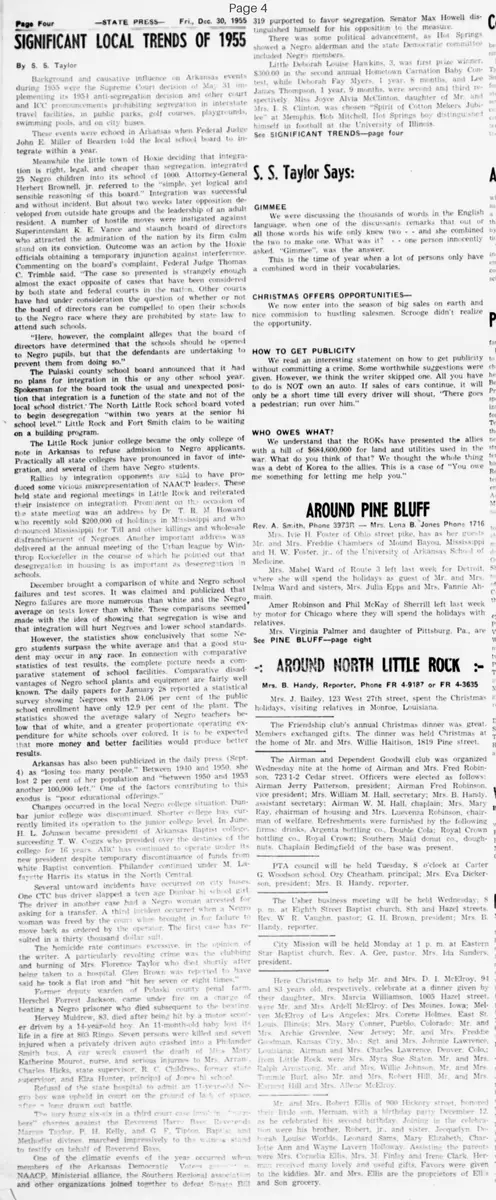
SIGNIFICANT LOCAL TRENDS OF 1955
By S. S. Taylor
Background and causative influence on Arkansas events during 1955 were the Supreme Court decision of May 31 implementing its 1954 anti-segregation decision and other court and legal pronouncements prohibiting segregation in interstate travel facilities, in public parks, golf courses, playgrounds, swimming pools, and on city buses.
These events were echoed in Arkansas when Federal Judge John E. Miller of Bearden told the local school board to integrate within a year. 25 Negro children into its school of 1000. Attorney-General Herbert Brownell, jr. referred to the "simple, yet logical and sensible reasoning of this board." Integration was successful and without incident. But about two weeks later opposition developed from outside hate groups and the leadership of an adult resident. A number of hostile moves were instigated against Superintendent K. E. Vance and staunch board of directors who attracted the admiration of the nation by its firm calm stand on its conviction. Outcome was an action by the Hoxie officials obtaining a temporary injunction against interference.
Commenting on the board's complaint, Federal Judge Thomas C. Trimble said, "The case so presented is strangely enough almost the exact opposite of cases that have been considered by both state and federal courts in the nation. Other courts have had under consideration the question of whether or not the board of directors can be compelled to open their schools to the Negro race where they are prohibited by state law to attend such schools. Here, however, the complaint alleges that the board of directors have determined that the schools should be opened to Negro pupils, but that the defendants are undertaking to prevent them from doing so."
The Pulaski County school board announced that it had no plans for integration in this or any other school year. Spokesman for the board took the usual and unexpected position that integration is a function of the state and not of the local school district. The North Little Rock school board voted to begin desegregation "within two years at the senior high school level." Little Rock and Fort Smith claim to be waiting on a building program.
The Little Rock junior college became the only college of note in Arkansas to refuse admission to Negro applicants. Practically all state colleges have pronounced in favor of integration, and several of them have Negro students.
Meanwhile the little town of Hoxie deciding that integration is right, legal, and cheaper than segregation. integrated 25 Negro children into its school of 1000.
Rallies by integration opponents are said to have produced some vicious misrepresentation of NAACP leaders. These held state and regional meetings in Little Rock and reiterated their insistence on integration. Prominent on the occasion of the state meeting was an address by Dr. T. R. M. Howard who recently sold $200,000 of holdings in Mississippi and who denounced Mississippi for Till and other killings and wholesale disfranchisement of Negroes. Another important address was delivered at the annual meeting of the Urban League by Winthrop Rockefeller in the course of which he pointed out that desegregation in housing is as important as desegregation in schools.
December brought a comparison of white and Negro school failures and test scores. It was claimed and publicized that Negro failures are more numerous than white and the Negro average on tests lower than white. These comparisons seemed made with the idea of showing that segregation is wise and that integration will hurt Negroes and lower school standards. However, the statistics show conclusively that some Negro students surpass the white average and that a good student may occur in any race. In connection with comparative statistics of test results, the complete picture needs a comparative statement of school facilities. Comparative disadvantages of Negro school plants and equipment are fairly well known. The daily papers for January 28 reported a statistical survey showing Negroes with 24.06 per cent of the public school enrollment have only 12.9 per cent of the plant. The statistics showed the average salary of Negro teachers be low that of white, and a greater proportionate operating expenditure for white schools over colored. It is to be expected that more money and better facilities would produce better results.
Arkansas has also been publicized in the daily press (Sept. 4) as "losing too many people." Between 1940 and 1950, she lost 2 per cent of her population and "between 1950 and 1953 another 100,000 left." One of the factors contributing to this exodus is "poor educational offerings."
Changes occurred in the local Negro college situation. Dunbar junior college was discontinued. Shorter college has currently limited its operation to the junior college level. In June, H. L. Johnson became president of Arkansas Baptist College, succeeding T. W. Coggs who presided over the destinies of the college for 16 years. ABC has continued to operate under its new president despite temporary discontinuance of funds from white Baptist convention. Philander continued under Lafayette Harris its status in the North Central.
Several untoward incidents have occurred on city buses. One CTC bus driver slapped a teen age Dunbar high school girl. The driver in another case had a Negro woman arrested for asking for a transfer. A third incident occurred when a Negro woman was freed by the court when brought in for failure to move back as ordered by the operator. The first case has resulted in a thirty thousand dollar suit.
The homicide rate continues excessive, in the opinion of the writer. A particularly revolting crime was the clubbing and burning of Mrs. Florence Taylor who died shortly after being taken to a hospital. Glen Brown was reported to have said he took a flat iron and "hit her seven or eight times."
Former deputy warden of Pulaski county penal farm, Herschel Forrest Jackson, came under fire on a charge of beating a Negro prisoner who died subsequent to the beating.
Hervey Muldrew, 83, died after being hit by a motor scooter driven by a 14-year-old boy. An 11-month-old baby lost its life in a fire at 503 Ringo. Seven persons were killed and seven injured when a privately driven auto crashed into a Philander Smith bus. A car wreck caused the death of Miss Mary Katherine Mourot, nurse, and serious injuries to Mrs. Arran.
Charles Hicks, state supervisor. R. C. Childress, former state supervisor, and Elza Hunter, principal of Jones high school.
Refusal of the state hospital to admit an 11-year-old Negro boy was upheld in court on the ground of lack of space, after long drawn out battle.
The jury hung six-six in a third court case involving "numbers" charges against the Reverend Harry Bass. Reverends Marcus Taylor, P. H. Kelly, and G. F. Tipton, Baptist and Methodist divines, marched impressively to the witness stand to testify on behalf of Reverend Bass.
One of the climactic events of the year occurred when members of the Arkansas Democratic Voters Association, NAACP, Ministerial Alliance, the Southern Regional Association and other organizations joined together to defeat Senate Bill 319 purported to favor segregation. Senator Max Howell distinguished himself for his opposition to the measure.
There was some political advancement, as Hot Springs showed a Negro alderman and the state Democratic committee included Negro members.
Little Deborah Louise Hawkins, 3, was first prize winner, $300.00 in the second annual Hometown Carnation Baby Contest, while Deborah Fay Myers, 1 year, 8 months, and Lee James Thompson, 1 year, 9 months, were second and third respectively. Miss Joyce Alvia McClinton, daughter of Mr. and Mrs. I. S. Clinton, was chosen "Spirit of Cotton Makers Jubilee" at Memphis. Bob Mitchell, Hot Springs boy distinguished himself in football at the University of Illinois.
See SIGNIFICANT TRENDS page four.
What sub-type of article is it?
What themes does it cover?
What keywords are associated?
What entities or persons were involved?
Where did it happen?
Story Details
Key Persons
Location
Arkansas
Event Date
1955
Story Details
Influenced by Supreme Court desegregation decisions, Arkansas saw Hoxie integrate 25 Negro students successfully despite opposition from hate groups, leading to a federal injunction; other school boards delayed or refused; Little Rock junior college denied Negro admissions; rallies misrepresented NAACP; addresses by Howard and Rockefeller emphasized integration; statistics revealed educational disparities favoring whites; population loss linked to poor education; Negro colleges changed leadership and operations; bus discrimination incidents sparked suits; high homicide rate included brutal crimes; state hospital refused Negro boy admission; Reverend Bass's trial hung; groups defeated segregation bill 319; political gains for Negroes; local achievements in contests and sports.