Thank you for visiting SNEWPapers!
Sign up free
Literary
July 26, 1828
Literary Cadet And Rhode Island Statesman
Providence, Providence County, Rhode Island
What is this article about?
A tale of pirates robbing a house near Rochelle, leading to Jean St. Aubin's wrongful accusation and near-execution for the crime. Through the reformed pirate's confession, his innocence is proven, reuniting him with Annette amid themes of justice, redemption, and love.
Clipping
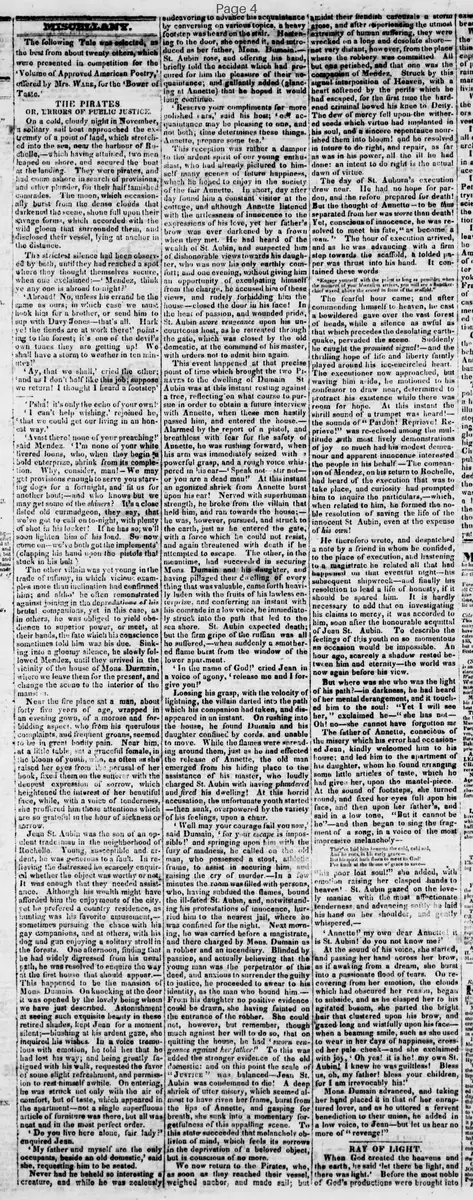
OCR Quality
88%
Good
Full Text
MISCELLANY.
The following Tale was selected, as the best from about twenty others, which were presented in competition for the 'Volume of Approved American Poetry,' offered by Mrs. Welby, for the Bower of Taste.
THE PIRATES
OR. ERRORS OF PUBLIC JUSTICE.
On a cold, cloudy night in November, a solitary sail boat approached the extremity of a point of land, which stretched into the sea, near the harbour of Rochelle,—which having attained, two men leaped on shore, and secured the boat at the landing. They were pirates, and had come ashore in search of provisions, and other plunder, for their half-famished comrades. The moon, which occasionally burst from the dense clouds that darkened the scene, shone full upon their savage forms, which accorded with the wild gloom that surrounded them, and disclosed their vessel, lying at anchor in the distance.
The strictest silence had been observed by both, until they had reached a spot where they thought themselves secure, when one exclaimed;—' Mendez, think you any one is abroad to-night?'
'Abroad! No, unless his errand be the same as ours; in which case we must hook him for a brother, or send him to sup with Davy Jones—that's all. Hark ye! the fiends are at work there!' pointing to the forest; it's one of the devil's own tunes they are getting up! We shall have a storm to weather in ten minutes?'
Ay, that we shall,' cried the other: 'and as I don't half like this job; suppose we return! I thought I heard a footstep'
'Psha! it's only the echo of your own!'
'I can't help wishing,' rejoined he, 'that we could get our living in an honest way.'
'Avast there! none of your preaching!' said Mendez. I'm none of your white livered loons, who, when they begin a bold enterprise, shrink from its completion. Why, consider, man!—We may get provisions enough to serve you starving dogs for a fortnight, and fit us for another bout;—and who knows but we may get some of the shiners? It's a close listed old curmudgeon, they say, that we've got to call on to-night, with plenty of shot in his locker! If he has so; we'll soon lighten him of his load. So now come on—we've both got the implements' (clapping his hand upon the pistols that stuck in his belt )
The other villain was yet young in the trade of infamy, in which vicious examples more than inclination had confirmed him; and altho' he often remonstrated against joining in the depredations of his brutal companions, yet in this case, as in others, he was obliged to yield obedience to superior power, or meet, at their hands, the fate which his conscience sometimes told him was his due. Sinking into a gloomy silence, he slowly followed Mendez, until they arrived in the vicinity of the house of Mons. Dumain. where we leave them for the present, and change the scene to the interior of the mansion.
Near the fire place sat a man, about forty five years of age, wrapped in an evening gown, of a morose and forbidding aspect, who from his querulous complaints, and frequent groans, seemed to be in great bodily pain. Near him, at a little table, sat a graceful female, in the bloom of youth, who, as often as she raised her eyes from the perusal of her book, fixed them on the sufferer with the deepest expression of sorrow, which heightened the interest of her beautiful face, while, with a voice of tenderness, she proffered him those attentions which are so grateful in the hour of sickness or sorrow
Jean St. Aubin was the son of an opulent tradesman in the neighborhood of Rochelle. Young, susceptible and ardent. he was generous to a fault. In relieving the distressed he scarcely enquired whether the object was worthy or not. It was enough that they needed assistance. Although his wealth might have afforded him the enjoyments of the city, yet he preferred a country residence, as hunting was his favorite amusement,—sometimes pursuing the chase with his gay companions, and at others, with his dog and gun enjoying a solitary stroll in the forests. One afternoon, finding that he had widely digressed from his usual path, he was resolved to enquire the way at the first house that should appear.—This happened to be the mansion of Mons. Dumain. On knocking at the door it was opened by the lovely being whom we have just described. Astonishment at seeing such exquisite beauty in those retired shades, kept Jean for a moment silent;—blushing at his ardent gaze, she inquired his wishes. In a voice tremulous with emotion, he told her that he had lost his way; and being greatly fatigued with his walk, requested the favor of some slight refreshment, and permission to rest himself awhile. On entering. he was struck not only with the air of comfort, but of taste, which appeared in the apartment—not a single superfluous article of furniture was there, but all was neat and in the most perfect order.
'Do you live here alone, fair lady?' enquired Jean.
My father and myself are the only occupants, beside an old domestic,' said she, requesting him to be seated.
Never had he beheld so interesting a creature, and while he was zealously endeavoring to advance his acquaintance by conversing on various topics. a heavy footstep was heard on the stair. Hastening to the door, she opened it, and introduced as her father, Mons. Dumain.—St. Aubin rose, and offering his hand. briefly told the accident which had procured for him the pleasure of their acquaintance; and gallantly added (glancing at Annette) that he hoped it would long continue.
'Reserve your compliments for more polished ears,' said his host; 'our acquaintance may be pleasing to one, and not both; time determines these things. Annette, prepare some tea.'
This reception was rather a damper to the ardent spirit of our young enthusiast, who had already pictured to himself many scenes of future happiness, which he hoped to enjoy in the society of the fair Annette. In short, day after day found him a constant visitor at the cottage, and although Annette listened with the artlessness of innocence to the expressions of his love, yet her father's brow was ever darkened by a frown when they met. He had heard of the wealth of St. Aubin, and suspected him of dishonorable views towards his daughter, who was now his only earthly comfort; and one evening, without giving him an opportunity of exculpating himself from the charge, he accused him of these views, and rudely forbidding him the house—closed the door in his face! In the heat of passion, and wounded pride, St. Aubin swore vengeance upon his uncourteous host, as he retreated through the gate, which was closed by the old domestic, at the command of his master, with orders not to admit him again.
This event happened at that precise point of time which brought the two Pirates to the dwelling of Dumain St. Aubin was at this instant resting against a tree, reflecting on what course to pursue in order to obtain a future interview with Annette, when these men hastily passed him, and entered the house.—Alarmed by the report of a pistol, and breathless with fear for the safety of Annette, he was rushing forward, when his arm was immediately seized with powerful grasp, and a rough voice whispered in his ear—' Speak not—stir not— or you are a dead man!' At this instant an agonized shriek from Annette burst upon his ear! Nerved with superhuman strength, he broke from the villain that held him, and ran towards the house;—he was, however, pursued, and struck to the earth, just as he entered the gate. with a force which he could not resist, and again threatened with death if he attempted to escape. The other, in the meantime, had succeeded in securing Mons. Dumain and his daughter, and having pillaged their dwelling of every thing that was valuable, came forth heavily laden with the fruits of his lawless enterprise, and conferring an instant with his comrade in a low voice, he immediately struck into the path that led to the sea shore. St. Aubin expected death: but the firm gripe of the ruffian was all he suffered,—when suddenly a smothered flame burst from the window of the lower apartment.
' In the name of God!' cried Jean in a voice of agony, 'release me and I forgive you!'
Loosing his grasp, with the velocity of lightning, the villain darted into the path which his companion had taken, and disappeared in an instant. On rushing into the house, he found Dumain and his daughter confined by cords, and unable to move. While the flames were spreading around them, just as he had effected the release of Annette, the old man emerged from his hiding place to the assistance of his master, who loudly charged St. Aubin with having plundered and fired his dwelling! At this horrid accusation, the unfortunate youth started—then sunk, overpowered by the variety of his feelings, upon a chair.
Well may your courage fail you now, said Dumain, 'for your escape is impossible!' and springing upon him with the fury of madness, he called on the old man, who possessed a stout, athletic frame, to assist in securing him, and raising the cry of murder.—In a few minutes the room was filled with persons, who, having subdued the flames, bound the ill-fated St. Aubin, and, notwithstanding his protestations of innocence, hurried him to the nearest jail, where he was confined for the night. Next morning, he was carried before a magistrate, and there charged by Mons. Dumain as a robber and an incendiary. Blinded by passion, and actually believing that the young man was the perpetrator of this deed, and anxious to surrender the guilty to justice, he proceeded to swear to his identity, as the man who bound him.—From his daughter no positive evidence could be drawn, she having fainted on the entrance of the robber. She could not, however, but remember, though much against her will to do so, that on quitting the house, he had 'sworn vengeance against her father!' To this was added the stronger evidence of the old domestic: and on this point the scale of 'Justice' was balanced—Jean St. Aubin was condemned to die! A deep shriek of utter misery, which seemed almost to have riven her frame, burst from the lips of Annette, and gasping for breath, she sunk into a momentary forgetfulness of this appalling scene. To this state succeeded that melancholy oblivion of mind, which feels its sorrows in the deprivation of a beloved object, but is conscious of no more.
We now return to the Pirates, who, as soon as they reached their vessel, weighed anchor, and made sail; but amidst their fiendish Carousals a storm arose, and after experiencing the utmost extremity of human suffering, they were wrecked on a lone and desolate shore—not very distant, however, from the place where the robbery was committed. All but one perished, and that one was the companion of Mendez. Struck by this signal interposition of Heaven, with a heart softened by the perils which he had escaped, or the first time the hardened criminal bowed his knee to Deity. The dew of mercy fell upon the withered seeds which virtue had implanted in his soul, and a sincere repentance nourished them into bloom! and he resolved in future to do right, and repair, as far as was in his power, all the ill he had done: an intent to do right is the actual dawn of virtue.
The day of St. Aubin's execution drew near. He had no hope for pardon, and therefore prepared for death! But the thought of Annette—to be thus separated from her was worse than death! Yet, conscious of innocence, he was resolved to meet his fate, "as become a man. " The hour of execution arrived, and as he was advancing with a firm step towards. the scaffold, a folded paper was thrust into his hand. It contained these words
"Engage yourself with the priest as long as possible; when the moment of your execution arrive, you will see a handkerchief waved above the crowd in front of the scaffold."
The fearful hour came; and after commending himself to heaven, he cast a bewildered gaze over the vast forest of heads, while a silence as awful as that which precedes the desolating earthquake, pervaded the scene. Suddenly he caught the promised signal!—and the thrilling hope of life and liberty faintly played around his ice-encircled heart. The executioner now approached, but waving him aside, he motioned to his confessor to draw near, determined to protract his existence while there was room for hope. At this instant the shrill sound of a trumpet was heard!—the sounds of "Pardon! Reprieve! Reprieve!" was re-echoed among the multitude with most lively demonstrations of joy so much had his modest demeanour and apparent innocence interested the people in his behalf —The companion of Mendez, on his return to Rochello, had heard of the execution that was to take place, and curiosity had prompted him to inquire the particulars,—which, when related to him, he formed the noble resolution of saving the life of the innocent St Aubin, even at the expense of his own!
He therefore wrote, and despatched a note by a friend in whom he confided, to the place of execution, and hastening to a magistrate he related all that had happened on that eventful night—his subsequent shipwreck—and finally his resolution to lead a life of honesty, if it should be spared him. It is hardly necessary to add that on investigating his claims to mercy, it was accorded to him, soon after the honourable acquittal of Jean St. Aubin. To describe the feelings of this youth on so momentous an occasion would be impossible. An hour ago, scarcely a shadow rested between him and eternity—the world was now again before his view.
But where was she who was the light of his path?—in darkness, he had heard of her mental derangement, and it touched him to the soul: "Yet I will see her," exclaimed he—"she has not— Oh! no—she cannot have forgotten me The father of Annette, conscious of the misery which his error had occasioned Jean, kindly welcomed him to his house; and led him to the apartment of his daughter, whom he found arranging some little articles of taste, which he had given her, upon the mantel-piece. At the sound of footsteps, she turned round, and fixed her eyes full upon his face, and then upon her father's, and said in a low tone, "But it cannot be he"—and then began to sing the fragment of a song, in a voice of the most impressive melancholy—
They've laid him here beneath the cold, cold sod,
And he rests, in his early grave—
But his spirit hath flown to meet its God
I've knelt at the throne of grace to save—
"his poor lost soul!" she added, with emotion raising her clasped hands to heaven. St. Aubin gazed on the lovely maniac with the most affectionate tenderness, and advancing softly he laid his hand on her shoulder, and gently whispered,—
Annette! my own dear Annette! it is St. Aubin! do you not know me?'
At the sound of his voice, she started, and passing her hand across her brow, as if awaking from a dream, she burst into a passionate flood of tears. On recovering from her emotion, the clouds which had obscured her reason, began to subside, and as he clasped her to his agitated bosom, she parted the bright hair that clustered upon his brow, and gazed— long and wistfully upon his face—when a beaming smile, such as she used to wear in her days of happiness, crossed her pale cheek—and she exclaimed with joy, ' Oh yes! it is he! my own St. Aubin! I knew he was guiltless! Bless us, oh, my father! bless your children, for I am irrevocably his!'
Mons. Dumain advanced, and taking her hand placed it in that of her enraptured lover, and as he uttered a fervent benediction to their union, he added in a low voice, to Jean—but let us hear no more of "revenge!"
The following Tale was selected, as the best from about twenty others, which were presented in competition for the 'Volume of Approved American Poetry,' offered by Mrs. Welby, for the Bower of Taste.
THE PIRATES
OR. ERRORS OF PUBLIC JUSTICE.
On a cold, cloudy night in November, a solitary sail boat approached the extremity of a point of land, which stretched into the sea, near the harbour of Rochelle,—which having attained, two men leaped on shore, and secured the boat at the landing. They were pirates, and had come ashore in search of provisions, and other plunder, for their half-famished comrades. The moon, which occasionally burst from the dense clouds that darkened the scene, shone full upon their savage forms, which accorded with the wild gloom that surrounded them, and disclosed their vessel, lying at anchor in the distance.
The strictest silence had been observed by both, until they had reached a spot where they thought themselves secure, when one exclaimed;—' Mendez, think you any one is abroad to-night?'
'Abroad! No, unless his errand be the same as ours; in which case we must hook him for a brother, or send him to sup with Davy Jones—that's all. Hark ye! the fiends are at work there!' pointing to the forest; it's one of the devil's own tunes they are getting up! We shall have a storm to weather in ten minutes?'
Ay, that we shall,' cried the other: 'and as I don't half like this job; suppose we return! I thought I heard a footstep'
'Psha! it's only the echo of your own!'
'I can't help wishing,' rejoined he, 'that we could get our living in an honest way.'
'Avast there! none of your preaching!' said Mendez. I'm none of your white livered loons, who, when they begin a bold enterprise, shrink from its completion. Why, consider, man!—We may get provisions enough to serve you starving dogs for a fortnight, and fit us for another bout;—and who knows but we may get some of the shiners? It's a close listed old curmudgeon, they say, that we've got to call on to-night, with plenty of shot in his locker! If he has so; we'll soon lighten him of his load. So now come on—we've both got the implements' (clapping his hand upon the pistols that stuck in his belt )
The other villain was yet young in the trade of infamy, in which vicious examples more than inclination had confirmed him; and altho' he often remonstrated against joining in the depredations of his brutal companions, yet in this case, as in others, he was obliged to yield obedience to superior power, or meet, at their hands, the fate which his conscience sometimes told him was his due. Sinking into a gloomy silence, he slowly followed Mendez, until they arrived in the vicinity of the house of Mons. Dumain. where we leave them for the present, and change the scene to the interior of the mansion.
Near the fire place sat a man, about forty five years of age, wrapped in an evening gown, of a morose and forbidding aspect, who from his querulous complaints, and frequent groans, seemed to be in great bodily pain. Near him, at a little table, sat a graceful female, in the bloom of youth, who, as often as she raised her eyes from the perusal of her book, fixed them on the sufferer with the deepest expression of sorrow, which heightened the interest of her beautiful face, while, with a voice of tenderness, she proffered him those attentions which are so grateful in the hour of sickness or sorrow
Jean St. Aubin was the son of an opulent tradesman in the neighborhood of Rochelle. Young, susceptible and ardent. he was generous to a fault. In relieving the distressed he scarcely enquired whether the object was worthy or not. It was enough that they needed assistance. Although his wealth might have afforded him the enjoyments of the city, yet he preferred a country residence, as hunting was his favorite amusement,—sometimes pursuing the chase with his gay companions, and at others, with his dog and gun enjoying a solitary stroll in the forests. One afternoon, finding that he had widely digressed from his usual path, he was resolved to enquire the way at the first house that should appear.—This happened to be the mansion of Mons. Dumain. On knocking at the door it was opened by the lovely being whom we have just described. Astonishment at seeing such exquisite beauty in those retired shades, kept Jean for a moment silent;—blushing at his ardent gaze, she inquired his wishes. In a voice tremulous with emotion, he told her that he had lost his way; and being greatly fatigued with his walk, requested the favor of some slight refreshment, and permission to rest himself awhile. On entering. he was struck not only with the air of comfort, but of taste, which appeared in the apartment—not a single superfluous article of furniture was there, but all was neat and in the most perfect order.
'Do you live here alone, fair lady?' enquired Jean.
My father and myself are the only occupants, beside an old domestic,' said she, requesting him to be seated.
Never had he beheld so interesting a creature, and while he was zealously endeavoring to advance his acquaintance by conversing on various topics. a heavy footstep was heard on the stair. Hastening to the door, she opened it, and introduced as her father, Mons. Dumain.—St. Aubin rose, and offering his hand. briefly told the accident which had procured for him the pleasure of their acquaintance; and gallantly added (glancing at Annette) that he hoped it would long continue.
'Reserve your compliments for more polished ears,' said his host; 'our acquaintance may be pleasing to one, and not both; time determines these things. Annette, prepare some tea.'
This reception was rather a damper to the ardent spirit of our young enthusiast, who had already pictured to himself many scenes of future happiness, which he hoped to enjoy in the society of the fair Annette. In short, day after day found him a constant visitor at the cottage, and although Annette listened with the artlessness of innocence to the expressions of his love, yet her father's brow was ever darkened by a frown when they met. He had heard of the wealth of St. Aubin, and suspected him of dishonorable views towards his daughter, who was now his only earthly comfort; and one evening, without giving him an opportunity of exculpating himself from the charge, he accused him of these views, and rudely forbidding him the house—closed the door in his face! In the heat of passion, and wounded pride, St. Aubin swore vengeance upon his uncourteous host, as he retreated through the gate, which was closed by the old domestic, at the command of his master, with orders not to admit him again.
This event happened at that precise point of time which brought the two Pirates to the dwelling of Dumain St. Aubin was at this instant resting against a tree, reflecting on what course to pursue in order to obtain a future interview with Annette, when these men hastily passed him, and entered the house.—Alarmed by the report of a pistol, and breathless with fear for the safety of Annette, he was rushing forward, when his arm was immediately seized with powerful grasp, and a rough voice whispered in his ear—' Speak not—stir not— or you are a dead man!' At this instant an agonized shriek from Annette burst upon his ear! Nerved with superhuman strength, he broke from the villain that held him, and ran towards the house;—he was, however, pursued, and struck to the earth, just as he entered the gate. with a force which he could not resist, and again threatened with death if he attempted to escape. The other, in the meantime, had succeeded in securing Mons. Dumain and his daughter, and having pillaged their dwelling of every thing that was valuable, came forth heavily laden with the fruits of his lawless enterprise, and conferring an instant with his comrade in a low voice, he immediately struck into the path that led to the sea shore. St. Aubin expected death: but the firm gripe of the ruffian was all he suffered,—when suddenly a smothered flame burst from the window of the lower apartment.
' In the name of God!' cried Jean in a voice of agony, 'release me and I forgive you!'
Loosing his grasp, with the velocity of lightning, the villain darted into the path which his companion had taken, and disappeared in an instant. On rushing into the house, he found Dumain and his daughter confined by cords, and unable to move. While the flames were spreading around them, just as he had effected the release of Annette, the old man emerged from his hiding place to the assistance of his master, who loudly charged St. Aubin with having plundered and fired his dwelling! At this horrid accusation, the unfortunate youth started—then sunk, overpowered by the variety of his feelings, upon a chair.
Well may your courage fail you now, said Dumain, 'for your escape is impossible!' and springing upon him with the fury of madness, he called on the old man, who possessed a stout, athletic frame, to assist in securing him, and raising the cry of murder.—In a few minutes the room was filled with persons, who, having subdued the flames, bound the ill-fated St. Aubin, and, notwithstanding his protestations of innocence, hurried him to the nearest jail, where he was confined for the night. Next morning, he was carried before a magistrate, and there charged by Mons. Dumain as a robber and an incendiary. Blinded by passion, and actually believing that the young man was the perpetrator of this deed, and anxious to surrender the guilty to justice, he proceeded to swear to his identity, as the man who bound him.—From his daughter no positive evidence could be drawn, she having fainted on the entrance of the robber. She could not, however, but remember, though much against her will to do so, that on quitting the house, he had 'sworn vengeance against her father!' To this was added the stronger evidence of the old domestic: and on this point the scale of 'Justice' was balanced—Jean St. Aubin was condemned to die! A deep shriek of utter misery, which seemed almost to have riven her frame, burst from the lips of Annette, and gasping for breath, she sunk into a momentary forgetfulness of this appalling scene. To this state succeeded that melancholy oblivion of mind, which feels its sorrows in the deprivation of a beloved object, but is conscious of no more.
We now return to the Pirates, who, as soon as they reached their vessel, weighed anchor, and made sail; but amidst their fiendish Carousals a storm arose, and after experiencing the utmost extremity of human suffering, they were wrecked on a lone and desolate shore—not very distant, however, from the place where the robbery was committed. All but one perished, and that one was the companion of Mendez. Struck by this signal interposition of Heaven, with a heart softened by the perils which he had escaped, or the first time the hardened criminal bowed his knee to Deity. The dew of mercy fell upon the withered seeds which virtue had implanted in his soul, and a sincere repentance nourished them into bloom! and he resolved in future to do right, and repair, as far as was in his power, all the ill he had done: an intent to do right is the actual dawn of virtue.
The day of St. Aubin's execution drew near. He had no hope for pardon, and therefore prepared for death! But the thought of Annette—to be thus separated from her was worse than death! Yet, conscious of innocence, he was resolved to meet his fate, "as become a man. " The hour of execution arrived, and as he was advancing with a firm step towards. the scaffold, a folded paper was thrust into his hand. It contained these words
"Engage yourself with the priest as long as possible; when the moment of your execution arrive, you will see a handkerchief waved above the crowd in front of the scaffold."
The fearful hour came; and after commending himself to heaven, he cast a bewildered gaze over the vast forest of heads, while a silence as awful as that which precedes the desolating earthquake, pervaded the scene. Suddenly he caught the promised signal!—and the thrilling hope of life and liberty faintly played around his ice-encircled heart. The executioner now approached, but waving him aside, he motioned to his confessor to draw near, determined to protract his existence while there was room for hope. At this instant the shrill sound of a trumpet was heard!—the sounds of "Pardon! Reprieve! Reprieve!" was re-echoed among the multitude with most lively demonstrations of joy so much had his modest demeanour and apparent innocence interested the people in his behalf —The companion of Mendez, on his return to Rochello, had heard of the execution that was to take place, and curiosity had prompted him to inquire the particulars,—which, when related to him, he formed the noble resolution of saving the life of the innocent St Aubin, even at the expense of his own!
He therefore wrote, and despatched a note by a friend in whom he confided, to the place of execution, and hastening to a magistrate he related all that had happened on that eventful night—his subsequent shipwreck—and finally his resolution to lead a life of honesty, if it should be spared him. It is hardly necessary to add that on investigating his claims to mercy, it was accorded to him, soon after the honourable acquittal of Jean St. Aubin. To describe the feelings of this youth on so momentous an occasion would be impossible. An hour ago, scarcely a shadow rested between him and eternity—the world was now again before his view.
But where was she who was the light of his path?—in darkness, he had heard of her mental derangement, and it touched him to the soul: "Yet I will see her," exclaimed he—"she has not— Oh! no—she cannot have forgotten me The father of Annette, conscious of the misery which his error had occasioned Jean, kindly welcomed him to his house; and led him to the apartment of his daughter, whom he found arranging some little articles of taste, which he had given her, upon the mantel-piece. At the sound of footsteps, she turned round, and fixed her eyes full upon his face, and then upon her father's, and said in a low tone, "But it cannot be he"—and then began to sing the fragment of a song, in a voice of the most impressive melancholy—
They've laid him here beneath the cold, cold sod,
And he rests, in his early grave—
But his spirit hath flown to meet its God
I've knelt at the throne of grace to save—
"his poor lost soul!" she added, with emotion raising her clasped hands to heaven. St. Aubin gazed on the lovely maniac with the most affectionate tenderness, and advancing softly he laid his hand on her shoulder, and gently whispered,—
Annette! my own dear Annette! it is St. Aubin! do you not know me?'
At the sound of his voice, she started, and passing her hand across her brow, as if awaking from a dream, she burst into a passionate flood of tears. On recovering from her emotion, the clouds which had obscured her reason, began to subside, and as he clasped her to his agitated bosom, she parted the bright hair that clustered upon his brow, and gazed— long and wistfully upon his face—when a beaming smile, such as she used to wear in her days of happiness, crossed her pale cheek—and she exclaimed with joy, ' Oh yes! it is he! my own St. Aubin! I knew he was guiltless! Bless us, oh, my father! bless your children, for I am irrevocably his!'
Mons. Dumain advanced, and taking her hand placed it in that of her enraptured lover, and as he uttered a fervent benediction to their union, he added in a low voice, to Jean—but let us hear no more of "revenge!"
What sub-type of article is it?
Prose Fiction
What themes does it cover?
Moral Virtue
Love Romance
Political
What keywords are associated?
Pirates
Robbery
Mistaken Identity
Redemption
Romance
Justice Errors
Execution
Reprieve
Literary Details
Title
The Pirates Or. Errors Of Public Justice.
Subject
Errors Of Public Justice
Key Lines
"Engage Yourself With The Priest As Long As Possible; When The Moment Of Your Execution Arrive, You Will See A Handkerchief Waved Above The Crowd In Front Of The Scaffold."
They've Laid Him Here Beneath The Cold, Cold Sod,
And He Rests, In His Early Grave—
But His Spirit Hath Flown To Meet Its God
I've Knelt At The Throne Of Grace To Save—
"Oh Yes! It Is He! My Own St. Aubin! I Knew He Was Guiltless! Bless Us, Oh, My Father! Bless Your Children, For I Am Irrevocably His!"