Thank you for visiting SNEWPapers!
Sign up free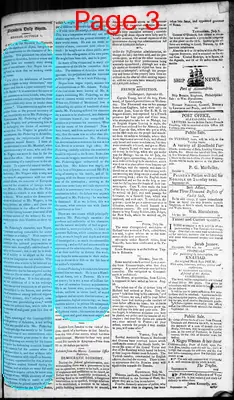
Editorial
October 1, 1810
Alexandria Daily Gazette, Commercial & Political
Alexandria, Virginia
What is this article about?
An editorial defends Timothy Pickering against 'Nepos'' attacks in the National Intelligencer, praising his honesty, solid judgment, and resistance to personal gain, refuting claims of flattery and unfaithfulness to Adams, and blaming enmities on his principled exposure of opponents' flaws.
Clipping
OCR Quality
98%
Excellent
Full Text
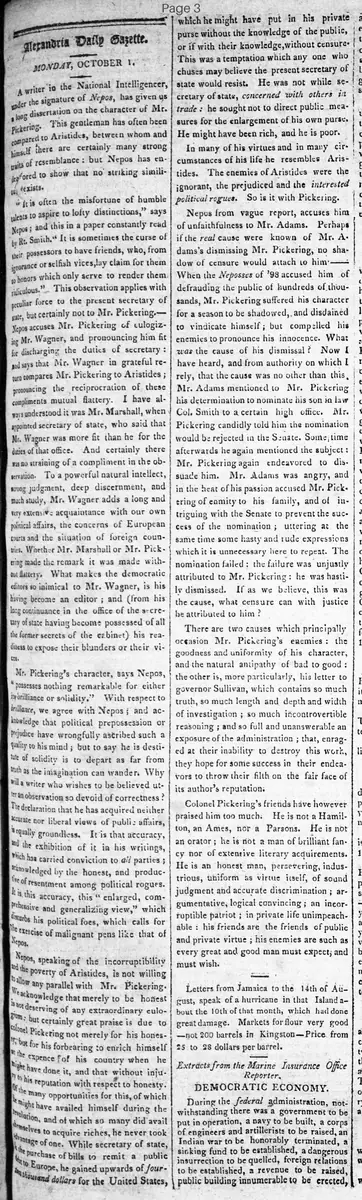
A writer in the National Intelligencer, under the signature of Nepos, has given us a long dissertation on the character of Mr. Pickering. This gentleman has often been compared to Aristides, between whom and himself there are certainly many strong traits of resemblance: but Nepos has endeavored to show that no striking similarity exists.
"It is often the misfortune of humble talents to aspire to lofty distinctions," says Nepos; and this in a paper constantly read by Rt. Smith. It is sometimes the curse of their possessors to have friends, who, from ignorance or selfish vices, lay claim for them to honors which only serve to render them ridiculous. This observation applies with peculiar force to the present secretary of state, but certainly not to Mr. Pickering.
Nepos accuses Mr. Pickering of eulogizing Mr. Wagner, and pronouncing him fit for discharging the duties of secretary: and says that Mr. Wagner in grateful return compares Mr. Pickering to Aristides; pronouncing the reciprocation of these compliments mutual flattery. I have always understood it was Mr. Marshall, when appointed secretary of state, who said that Mr. Wagner was more fit than he for the duties of that office. And certainly there was no straining of a compliment in the observation. To a powerful natural intellect, strong judgment, deep discernment, and much study, Mr. Wagner adds a long and very extensive acquaintance with our own political affairs, the concerns of European courts and the situation of foreign countries. Whether Mr. Marshall or Mr. Pickering made the remark it was made without flattery. What makes the democratic editors so inimical to Mr. Wagner, is his having become an editor: and (from his long continuance in the office of the secretary of state having become possessed of all the former secrets of the cabinet) his readiness to expose their blunders or their vice.
Mr. Pickering's character, says Nepos, possesses nothing remarkable for either its brilliance or solidity. With respect to brilliance, we agree with Nepos; and acknowledge that political prepossession or prejudice have wrongfully ascribed such a quality to his mind; but to say he is destitute of solidity is to depart as far from truth as the imagination can wander. Why will a writer who wishes to be believed utter an observation so devoid of correctness? The declaration that he has acquired neither accurate nor liberal views of public affairs, is equally groundless. It is that accuracy, and the exhibition of it in his writings, which has carried conviction to all parties; acknowledged by the honest, and productive of resentment among political rogues. It is this accuracy, this "enlarged, comprehensive and generalizing view," which disturbs his political foes, which calls for the exercise of malignant pens like that of Nepos.
Nepos, speaking of the incorruptibility and the poverty of Aristides, is not willing to allow any parallel with Mr. Pickering: We acknowledge that merely to be honest is not deserving of any extraordinary eulogium: but certainly great praise is due to colonel Pickering not merely for his honesty, but for his forbearing to enrich himself at the expense of his country when he might have done it, and that without injury to this reputation with respect to honesty. With the many opportunities for this, of which he might have availed himself during the administration, and of which so many did avail themselves to gain riches, he never took advantage from. While secretary of state, the purchase of bills to remit a public sum to Europe he gained upwards of a thousand dollars for the United States,
which he might have put in his private purse without the knowledge of the public, or if with their knowledge, without censure. This was a temptation which any one who chooses may believe the present secretary of state would resist. He was not while secretary of state, concerned with others in trade: he sought not to direct public measures for the enlargement of his own purse. He might have been rich, and he is poor.
In many of his virtues and in many circumstances of his life he resembles Aristides. The enemies of Aristides were the ignorant, the prejudiced and the interested political rogues. So is it with Pickering.
Nepos from vague report, accuses him of unfaithfulness to Mr. Adams. Perhaps if the real cause were known of Mr. Adams's dismissing Mr. Pickering, no shadow of censure would attach to him. When the Neposses of '98 accused him of defrauding the public of hundreds of thousands, Mr. Pickering suffered his character for a season to be shadowed, and disdained to vindicate himself; but compelled his enemies to pronounce his innocence. What was the cause of his dismissal? Now I have heard, and from authority on which I rely, that the cause was no other than this: Mr. Adams mentioned to Mr. Pickering his determination to nominate his son in law Col. Smith to a certain high office. Mr. Pickering candidly told him the nomination would be rejected in the Senate. Some time afterwards he again mentioned the subject: Mr. Pickering again endeavored to dissuade him. Mr. Adams was angry, and in the heat of his passion accused Mr. Pickering of enmity to his family, and of intriguing with the Senate to prevent the success of the nomination; uttering at the same time some hasty and rude expressions which it is unnecessary here to repeat. The nomination failed: the failure was unjustly attributed to Mr. Pickering: he was hastily dismissed. If as we believe, this was the cause, what censure can with justice be attributed to him?
There are two causes which principally occasion Mr. Pickering's enemies: the goodness and uniformity of his character, and the natural antipathy of bad to good: the other is, more particularly, his letter to governor Sullivan, which contains so much truth, so much length and depth and width of investigation; so much incontrovertible reasoning; and so full and unanswerable an exposure of the administration; that, enraged at their inability to destroy this work, they hope for some success in their endeavors to throw their filth on the fair face of its author's reputation:
Colonel Pickering's friends have however praised him too much: He is not a Hamilton, an Ames, nor a Parsons. He is not an orator; he is not a man of brilliant fancy nor of extensive literary acquirements. He is an honest man, persevering, industrious, uniform as virtue itself, of sound judgment and accurate discrimination; argumentative; logical convincing; an incorruptible patriot; in private life unimpeachable: his friends are the friends of public and private virtue; his enemies are such as every great and good man must expect; and must wish.
"It is often the misfortune of humble talents to aspire to lofty distinctions," says Nepos; and this in a paper constantly read by Rt. Smith. It is sometimes the curse of their possessors to have friends, who, from ignorance or selfish vices, lay claim for them to honors which only serve to render them ridiculous. This observation applies with peculiar force to the present secretary of state, but certainly not to Mr. Pickering.
Nepos accuses Mr. Pickering of eulogizing Mr. Wagner, and pronouncing him fit for discharging the duties of secretary: and says that Mr. Wagner in grateful return compares Mr. Pickering to Aristides; pronouncing the reciprocation of these compliments mutual flattery. I have always understood it was Mr. Marshall, when appointed secretary of state, who said that Mr. Wagner was more fit than he for the duties of that office. And certainly there was no straining of a compliment in the observation. To a powerful natural intellect, strong judgment, deep discernment, and much study, Mr. Wagner adds a long and very extensive acquaintance with our own political affairs, the concerns of European courts and the situation of foreign countries. Whether Mr. Marshall or Mr. Pickering made the remark it was made without flattery. What makes the democratic editors so inimical to Mr. Wagner, is his having become an editor: and (from his long continuance in the office of the secretary of state having become possessed of all the former secrets of the cabinet) his readiness to expose their blunders or their vice.
Mr. Pickering's character, says Nepos, possesses nothing remarkable for either its brilliance or solidity. With respect to brilliance, we agree with Nepos; and acknowledge that political prepossession or prejudice have wrongfully ascribed such a quality to his mind; but to say he is destitute of solidity is to depart as far from truth as the imagination can wander. Why will a writer who wishes to be believed utter an observation so devoid of correctness? The declaration that he has acquired neither accurate nor liberal views of public affairs, is equally groundless. It is that accuracy, and the exhibition of it in his writings, which has carried conviction to all parties; acknowledged by the honest, and productive of resentment among political rogues. It is this accuracy, this "enlarged, comprehensive and generalizing view," which disturbs his political foes, which calls for the exercise of malignant pens like that of Nepos.
Nepos, speaking of the incorruptibility and the poverty of Aristides, is not willing to allow any parallel with Mr. Pickering: We acknowledge that merely to be honest is not deserving of any extraordinary eulogium: but certainly great praise is due to colonel Pickering not merely for his honesty, but for his forbearing to enrich himself at the expense of his country when he might have done it, and that without injury to this reputation with respect to honesty. With the many opportunities for this, of which he might have availed himself during the administration, and of which so many did avail themselves to gain riches, he never took advantage from. While secretary of state, the purchase of bills to remit a public sum to Europe he gained upwards of a thousand dollars for the United States,
which he might have put in his private purse without the knowledge of the public, or if with their knowledge, without censure. This was a temptation which any one who chooses may believe the present secretary of state would resist. He was not while secretary of state, concerned with others in trade: he sought not to direct public measures for the enlargement of his own purse. He might have been rich, and he is poor.
In many of his virtues and in many circumstances of his life he resembles Aristides. The enemies of Aristides were the ignorant, the prejudiced and the interested political rogues. So is it with Pickering.
Nepos from vague report, accuses him of unfaithfulness to Mr. Adams. Perhaps if the real cause were known of Mr. Adams's dismissing Mr. Pickering, no shadow of censure would attach to him. When the Neposses of '98 accused him of defrauding the public of hundreds of thousands, Mr. Pickering suffered his character for a season to be shadowed, and disdained to vindicate himself; but compelled his enemies to pronounce his innocence. What was the cause of his dismissal? Now I have heard, and from authority on which I rely, that the cause was no other than this: Mr. Adams mentioned to Mr. Pickering his determination to nominate his son in law Col. Smith to a certain high office. Mr. Pickering candidly told him the nomination would be rejected in the Senate. Some time afterwards he again mentioned the subject: Mr. Pickering again endeavored to dissuade him. Mr. Adams was angry, and in the heat of his passion accused Mr. Pickering of enmity to his family, and of intriguing with the Senate to prevent the success of the nomination; uttering at the same time some hasty and rude expressions which it is unnecessary here to repeat. The nomination failed: the failure was unjustly attributed to Mr. Pickering: he was hastily dismissed. If as we believe, this was the cause, what censure can with justice be attributed to him?
There are two causes which principally occasion Mr. Pickering's enemies: the goodness and uniformity of his character, and the natural antipathy of bad to good: the other is, more particularly, his letter to governor Sullivan, which contains so much truth, so much length and depth and width of investigation; so much incontrovertible reasoning; and so full and unanswerable an exposure of the administration; that, enraged at their inability to destroy this work, they hope for some success in their endeavors to throw their filth on the fair face of its author's reputation:
Colonel Pickering's friends have however praised him too much: He is not a Hamilton, an Ames, nor a Parsons. He is not an orator; he is not a man of brilliant fancy nor of extensive literary acquirements. He is an honest man, persevering, industrious, uniform as virtue itself, of sound judgment and accurate discrimination; argumentative; logical convincing; an incorruptible patriot; in private life unimpeachable: his friends are the friends of public and private virtue; his enemies are such as every great and good man must expect; and must wish.
What sub-type of article is it?
Partisan Politics
What keywords are associated?
Pickering Defense
Political Integrity
Adams Administration
Federalist Character
Nepos Criticism
Aristides Comparison
Cabinet Secrets
Senate Nomination
What entities or persons were involved?
Mr. Pickering
Nepos
Mr. Wagner
Mr. Marshall
Mr. Adams
Col. Smith
Governor Sullivan
Hamilton
Ames
Parsons
Rt. Smith
Editorial Details
Primary Topic
Defense Of Timothy Pickering's Character Against Nepos' Criticisms
Stance / Tone
Strongly Supportive Of Pickering And Critical Of His Political Opponents
Key Figures
Mr. Pickering
Nepos
Mr. Wagner
Mr. Marshall
Mr. Adams
Col. Smith
Governor Sullivan
Hamilton
Ames
Parsons
Rt. Smith
Key Arguments
Pickering Shares Traits With Aristides In Honesty And Forgoing Personal Enrichment
Accusation Of Mutual Flattery With Wagner Is Unfounded; Marshall Likely Made The Compliment
Pickering Possesses Solid Judgment And Accurate Views On Public Affairs, Not Brilliance
Pickering Resisted Temptations To Profit Personally While In Office, Remaining Poor
Dismissal By Adams Stemmed From Disagreement Over Nominating Col. Smith, Not Unfaithfulness
Enemies Arise From Pickering's Integrity And His Critical Letter To Governor Sullivan
Pickering Is An Honest, Persevering Patriot, Though Not An Orator Or Brilliant Mind