Thank you for visiting SNEWPapers!
Sign up free
Editorial
February 4, 1878
Daily Press And Dakotaian
Yankton, Yankton County, South Dakota
What is this article about?
The Chicago Inter-Ocean editorial criticizes the new tariff bill for drastically reducing dutiable articles from over 2,500 to 500, abolishing the free list, and repealing similitude and catch-all provisions, arguing it favors importers and enables fraud, harming U.S. industries and revenue.
Clipping
OCR Quality
95%
Excellent
Full Text
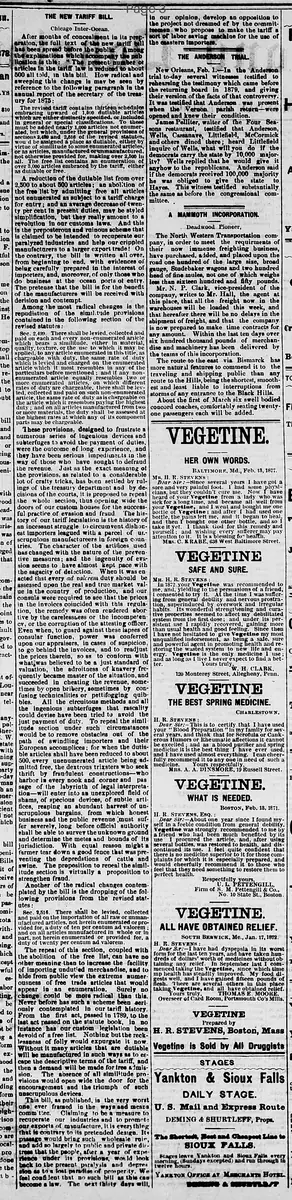
The New Tariff Bill
Chicago Inter-Ocean.
After months of concealment in its preparation, the full text of the new tariff bill has been agreed before the public. Among the explanations which accompany the publication is this: The present number of articles in the tariff law is reduced to about 500 all told. In this bill.
How radical and sweeping this change is may be seen by reference to the following paragraph in the annual report of the secretary of the treasury for 1875:
The revised tariff contains thirteen schedules embracing upward of 1,200 dutiable articles which are either distinctly specified, or included in general or special classifications. To these must be added nearly 1,000 articles not enumerated, but which, under the general provisions of sections 2499 and 2516 of the revised statutes, would be assigned a place as dutiable, either by virtue of similitude to some enumerated articles, or as articles, manufactured or unmanufactured, not otherwise provided for, making over 2,500 in all. The free list contains an enumeration of over 300 articles embraced by the tariff, either as dutiable or free.
A reduction of the dutiable list from over 2,500 to about 500 articles; an abolition of the free list by admitting free all articles not enumerated as subject to a tariff charge for entry; and an average decrease of twenty per cent in present duties, may be styled simplification, but they really amount to a revolution in our customs laws. And this is the preposterous and ruinous scheme that is claimed to be intended to recuperate our paralyzed industries and help our crippled manufacturers to a larger export trade! On the contrary, the bill is written all over, from beginning to end, with evidences of being carefully prepared in the interest of importers, and, moreover, of only those who do business at the ocean ports of entry.
The pretense that the bill is for the benefit of the manufacturers will be received with derision and contempt.
Among the most radical changes is the repudiation of the similitude provisions contained in the following section of the revised statutes:
Sec. 2499. There shall be levied, collected and paid on each and every non-enumerated article which bears a similitude, either in material, quality, texture, or the use to which it may be applied, to any article enumerated in this title, as chargeable with duty, the same rate of duty which is levied and charged on the enumerated article which it most resembles in any of the particulars before mentioned; and if any non-enumerated article equally resembles two or more enumerated articles, on which different rates of duty are chargeable, there shall be levied, collected and paid on such non-enumerated article, the same rate of duty as is chargeable on the article which it resembles paying the highest duty; and on all articles manufactured from two or more materials, the duty shall be assessed at the highest rates at which any of its component parts may be chargeable.
These provisions, designed to frustrate a numerous series of ingenious devices and subterfuges to avoid the payment of duties, were the outcome of long experience, and they have been serious impediments in the way of those who have sought to defraud the revenue. Just as the exact meaning of the provisions, as related to a considerable lot of crafty tricks, has been settled by rulings of the treasury department and by decisions of the courts, it is proposed to repeal the whole section, thus opening wide the doors of our custom houses for the successful practice of evasion and fraud. The history of our tariff legislation is the history of an incessant struggle to circumvent dishonest importers leagued with a parcel of unscrupulous manufacturers in foreign countries. The character of the artifices used has changed with the nature of the preventive measures; and the ingenuity of evasion seems to have almost kept pace with the sagacity of detection. When it was enacted that every ad valorem duty should be assessed upon the real and true market value in the country of production, and our consuls were required to see that the prices in the invoices coincided with this regulation, the remedy was often rendered abortive by the carelessness or the incompetency, or the corruption of the attesting officer. Even when, to guard against these lapses of consular function, power was conferred upon our appraisers, in cases of suspicion, to go behind the invoices, and to readjust the prices therein, so as to conform with what was believed to be a just standard of valuation, the adroitness of knavery frequently became master of the situation, and succeeded in cheating the revenue, sometimes by open bribery, sometimes by confusing technicalities or pettifogging quibbles.
All the circuitous methods and all the ingenious subterfuges that rascality could devise have been tried to avoid the just payment of duty. To repeal the similitude section under such circumstances would be to remove obstacles out of the path of swindling importers and their European accomplices; for when the dutiable articles shall have been reduced to about 500, every unenumerated article being admitted free, the dexterous trixsters who seek thrift by fraudulent constructions—who harbor in every nook and corner and passage of the labyrinth of legal interpretation—will enter into an unexplored field of shams, of specious devices, of subtle artifices, reaping an abundant harvest of unscrupulous bargains, from which honest business and the public revenue must suffer severely, long before official authority shall be able to survey the unknown ground and determine the metes and bounds of its jurisdiction. With equal reason might a farmer tear down a good fence that was preventing the depredations of cattle and swine. The proposition to repeal the similitude section is virtually a proposition to strengthen fraud.
Another of the radical changes contemplated by the bill is the dropping of the following provisions from the revised statutes:
Sec. 2516. There shall be levied, collected and paid on the importation of all raw or unmanufactured articles, not herein enumerated or provided for, a duty of ten per centum ad valorem; and on all articles manufactured in whole or in part, not herein enumerated or provided for, a duty of twenty per centum ad valorem.
The repeal of this section, coupled with the abolition of the free list, can have no other meaning than to increase the facility of importing undutied merchandise, and to hide from public view the extreme numerousness of free trade articles that would appear in an enumeration. Surely no change could be more radical than this. Never before has such a scheme been seriously contemplated in our tariff history. From the first act, passed in 1789, to the last act passed on the statute book, in no instance has our custom legislation been devoid of a free list. Nothing but the recklessness of folly would expurgate it now. Without it many articles that are dutiable will be manufactured in such ways as to escape the descriptive terms of the tariff, and then a demand will be made for free admission. The absence of all similitude provisions would open wide the door for the encouragement and the triumph of such unscrupulous devices.
This bill, as published, is the very worst one ever framed in the ways and means committee. Claiming to be a measure to recuperate our industries and to promote our exports of manufacture, it is everything that is contrary to its pretended design. Its passage would bring such wholesale ruin, and add so largely to public and private distress that the people, after a year of experience under its provisions, would look back to the present paralysis and depression as to a lost paradise of prosperity. We feel confident that no such bill as this can become law. The next thirty days will, in our opinion, develop an opposition to the project not dreamed of by the committee men who propose to make the tariff a sort of labor saving machine for the use of the eastern importers.
Chicago Inter-Ocean.
After months of concealment in its preparation, the full text of the new tariff bill has been agreed before the public. Among the explanations which accompany the publication is this: The present number of articles in the tariff law is reduced to about 500 all told. In this bill.
How radical and sweeping this change is may be seen by reference to the following paragraph in the annual report of the secretary of the treasury for 1875:
The revised tariff contains thirteen schedules embracing upward of 1,200 dutiable articles which are either distinctly specified, or included in general or special classifications. To these must be added nearly 1,000 articles not enumerated, but which, under the general provisions of sections 2499 and 2516 of the revised statutes, would be assigned a place as dutiable, either by virtue of similitude to some enumerated articles, or as articles, manufactured or unmanufactured, not otherwise provided for, making over 2,500 in all. The free list contains an enumeration of over 300 articles embraced by the tariff, either as dutiable or free.
A reduction of the dutiable list from over 2,500 to about 500 articles; an abolition of the free list by admitting free all articles not enumerated as subject to a tariff charge for entry; and an average decrease of twenty per cent in present duties, may be styled simplification, but they really amount to a revolution in our customs laws. And this is the preposterous and ruinous scheme that is claimed to be intended to recuperate our paralyzed industries and help our crippled manufacturers to a larger export trade! On the contrary, the bill is written all over, from beginning to end, with evidences of being carefully prepared in the interest of importers, and, moreover, of only those who do business at the ocean ports of entry.
The pretense that the bill is for the benefit of the manufacturers will be received with derision and contempt.
Among the most radical changes is the repudiation of the similitude provisions contained in the following section of the revised statutes:
Sec. 2499. There shall be levied, collected and paid on each and every non-enumerated article which bears a similitude, either in material, quality, texture, or the use to which it may be applied, to any article enumerated in this title, as chargeable with duty, the same rate of duty which is levied and charged on the enumerated article which it most resembles in any of the particulars before mentioned; and if any non-enumerated article equally resembles two or more enumerated articles, on which different rates of duty are chargeable, there shall be levied, collected and paid on such non-enumerated article, the same rate of duty as is chargeable on the article which it resembles paying the highest duty; and on all articles manufactured from two or more materials, the duty shall be assessed at the highest rates at which any of its component parts may be chargeable.
These provisions, designed to frustrate a numerous series of ingenious devices and subterfuges to avoid the payment of duties, were the outcome of long experience, and they have been serious impediments in the way of those who have sought to defraud the revenue. Just as the exact meaning of the provisions, as related to a considerable lot of crafty tricks, has been settled by rulings of the treasury department and by decisions of the courts, it is proposed to repeal the whole section, thus opening wide the doors of our custom houses for the successful practice of evasion and fraud. The history of our tariff legislation is the history of an incessant struggle to circumvent dishonest importers leagued with a parcel of unscrupulous manufacturers in foreign countries. The character of the artifices used has changed with the nature of the preventive measures; and the ingenuity of evasion seems to have almost kept pace with the sagacity of detection. When it was enacted that every ad valorem duty should be assessed upon the real and true market value in the country of production, and our consuls were required to see that the prices in the invoices coincided with this regulation, the remedy was often rendered abortive by the carelessness or the incompetency, or the corruption of the attesting officer. Even when, to guard against these lapses of consular function, power was conferred upon our appraisers, in cases of suspicion, to go behind the invoices, and to readjust the prices therein, so as to conform with what was believed to be a just standard of valuation, the adroitness of knavery frequently became master of the situation, and succeeded in cheating the revenue, sometimes by open bribery, sometimes by confusing technicalities or pettifogging quibbles.
All the circuitous methods and all the ingenious subterfuges that rascality could devise have been tried to avoid the just payment of duty. To repeal the similitude section under such circumstances would be to remove obstacles out of the path of swindling importers and their European accomplices; for when the dutiable articles shall have been reduced to about 500, every unenumerated article being admitted free, the dexterous trixsters who seek thrift by fraudulent constructions—who harbor in every nook and corner and passage of the labyrinth of legal interpretation—will enter into an unexplored field of shams, of specious devices, of subtle artifices, reaping an abundant harvest of unscrupulous bargains, from which honest business and the public revenue must suffer severely, long before official authority shall be able to survey the unknown ground and determine the metes and bounds of its jurisdiction. With equal reason might a farmer tear down a good fence that was preventing the depredations of cattle and swine. The proposition to repeal the similitude section is virtually a proposition to strengthen fraud.
Another of the radical changes contemplated by the bill is the dropping of the following provisions from the revised statutes:
Sec. 2516. There shall be levied, collected and paid on the importation of all raw or unmanufactured articles, not herein enumerated or provided for, a duty of ten per centum ad valorem; and on all articles manufactured in whole or in part, not herein enumerated or provided for, a duty of twenty per centum ad valorem.
The repeal of this section, coupled with the abolition of the free list, can have no other meaning than to increase the facility of importing undutied merchandise, and to hide from public view the extreme numerousness of free trade articles that would appear in an enumeration. Surely no change could be more radical than this. Never before has such a scheme been seriously contemplated in our tariff history. From the first act, passed in 1789, to the last act passed on the statute book, in no instance has our custom legislation been devoid of a free list. Nothing but the recklessness of folly would expurgate it now. Without it many articles that are dutiable will be manufactured in such ways as to escape the descriptive terms of the tariff, and then a demand will be made for free admission. The absence of all similitude provisions would open wide the door for the encouragement and the triumph of such unscrupulous devices.
This bill, as published, is the very worst one ever framed in the ways and means committee. Claiming to be a measure to recuperate our industries and to promote our exports of manufacture, it is everything that is contrary to its pretended design. Its passage would bring such wholesale ruin, and add so largely to public and private distress that the people, after a year of experience under its provisions, would look back to the present paralysis and depression as to a lost paradise of prosperity. We feel confident that no such bill as this can become law. The next thirty days will, in our opinion, develop an opposition to the project not dreamed of by the committee men who propose to make the tariff a sort of labor saving machine for the use of the eastern importers.
What sub-type of article is it?
Economic Policy
Trade Or Commerce
Taxation
What keywords are associated?
Tariff Bill
Customs Laws
Similitude Provisions
Importers
Fraud Evasion
Free List
Dutiable Articles
Revenue Protection
What entities or persons were involved?
Chicago Inter Ocean
Secretary Of The Treasury
Ways And Means Committee
Importers
Manufacturers
Editorial Details
Primary Topic
Critique Of The New Tariff Bill
Stance / Tone
Strongly Opposed And Critical
Key Figures
Chicago Inter Ocean
Secretary Of The Treasury
Ways And Means Committee
Importers
Manufacturers
Key Arguments
Reduces Dutiable Articles From Over 2,500 To 500, Revolutionizing Customs Laws.
Abolishes Free List, Admitting All Unenumerated Articles Free.
Repeals Similitude Provisions, Enabling Fraud And Evasion.
Drops Catch All Duty Sections, Facilitating Undutied Imports.
Prepared In Interest Of Importers, Not Manufacturers.
Will Harm Industries, Revenue, And Promote Free Trade Fraud.
Worst Bill Ever Framed, Predicts Strong Opposition.