Thank you for visiting SNEWPapers!
Sign up free
Editorial
January 3, 1953
The Key West Citizen
Key West, Monroe County, Florida
What is this article about?
Editorial critiques President Truman's override of the Wage Stabilization Board to grant coal miners a wage increase, leading to resignations and growing opposition from business, labor, and citizens to extending economic controls beyond April 1951 amid the Korean War.
Clipping
OCR Quality
98%
Excellent
Full Text
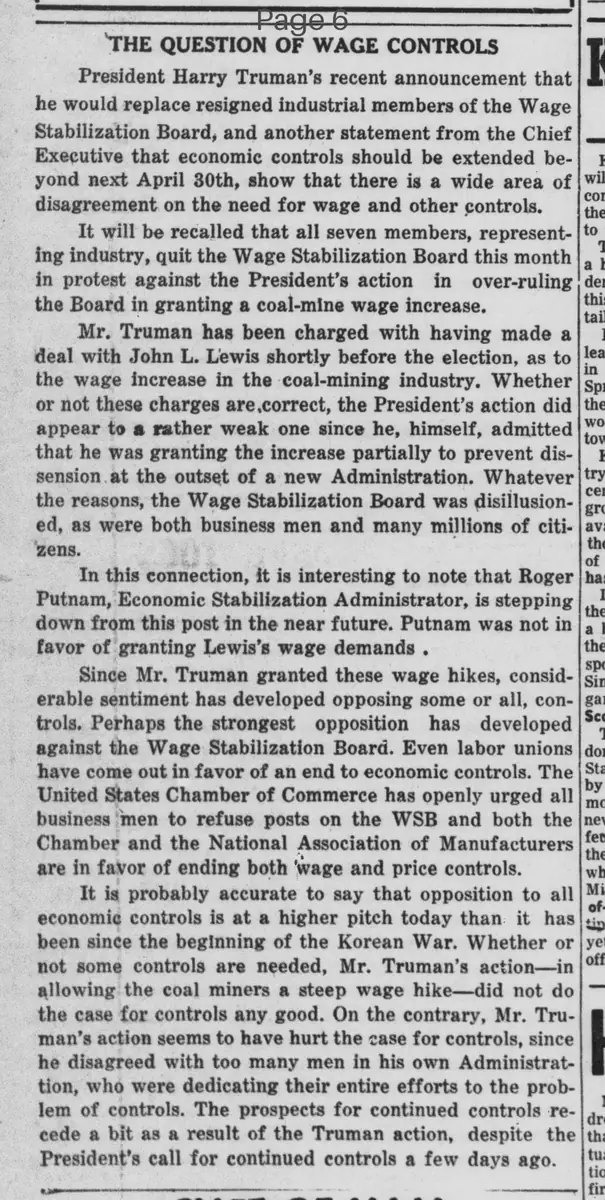
THE QUESTION OF WAGE CONTROLS
President Harry Truman's recent announcement that he would replace resigned industrial members of the Wage Stabilization Board, and another statement from the Chief Executive that economic controls should be extended beyond next April 30th, show that there is a wide area of disagreement on the need for wage and other controls.
It will be recalled that all seven members, representing industry, quit the Wage Stabilization Board this month in protest against the President's action in over-ruling the Board in granting a coal-mine wage increase.
Mr. Truman has been charged with having made a deal with John L. Lewis shortly before the election, as to the wage increase in the coal-mining industry. Whether or not these charges are correct, the President's action did appear to a rather weak one since he himself admitted that he was granting the increase partially to prevent dissension at the outset of a new Administration. Whatever the reasons, the Wage Stabilization Board was disillusioned, as were both business men and many millions of citizens.
In this connection, it is interesting to note that Roger Putnam, Economic Stabilization Administrator, is stepping down from this post in the near future. Putnam was not in favor of granting Lewis's wage demands.
Since Mr. Truman granted these wage hikes, considerable sentiment has developed opposing some or all controls. Perhaps the strongest opposition has developed against the Wage Stabilization Board. Even labor unions have come out in favor of an end to economic controls. The United States Chamber of Commerce has openly urged all business men to refuse posts on the WSB and both the Chamber and the National Association of Manufacturers are in favor of ending both wage and price controls.
It is probably accurate to say that opposition to all economic controls is at a higher pitch today than it has been since the beginning of the Korean War. Whether or not some controls are needed, Mr. Truman's action in allowing the coal miners a steep wage hike did not do the case for controls any good. On the contrary, Mr. Truman's action seems to have hurt the case for controls, since he disagreed with too many men in his own Administration, who were dedicating their entire efforts to the problem of controls. The prospects for continued controls recede a bit as a result of the Truman action, despite the President's call for continued controls a few days ago.
President Harry Truman's recent announcement that he would replace resigned industrial members of the Wage Stabilization Board, and another statement from the Chief Executive that economic controls should be extended beyond next April 30th, show that there is a wide area of disagreement on the need for wage and other controls.
It will be recalled that all seven members, representing industry, quit the Wage Stabilization Board this month in protest against the President's action in over-ruling the Board in granting a coal-mine wage increase.
Mr. Truman has been charged with having made a deal with John L. Lewis shortly before the election, as to the wage increase in the coal-mining industry. Whether or not these charges are correct, the President's action did appear to a rather weak one since he himself admitted that he was granting the increase partially to prevent dissension at the outset of a new Administration. Whatever the reasons, the Wage Stabilization Board was disillusioned, as were both business men and many millions of citizens.
In this connection, it is interesting to note that Roger Putnam, Economic Stabilization Administrator, is stepping down from this post in the near future. Putnam was not in favor of granting Lewis's wage demands.
Since Mr. Truman granted these wage hikes, considerable sentiment has developed opposing some or all controls. Perhaps the strongest opposition has developed against the Wage Stabilization Board. Even labor unions have come out in favor of an end to economic controls. The United States Chamber of Commerce has openly urged all business men to refuse posts on the WSB and both the Chamber and the National Association of Manufacturers are in favor of ending both wage and price controls.
It is probably accurate to say that opposition to all economic controls is at a higher pitch today than it has been since the beginning of the Korean War. Whether or not some controls are needed, Mr. Truman's action in allowing the coal miners a steep wage hike did not do the case for controls any good. On the contrary, Mr. Truman's action seems to have hurt the case for controls, since he disagreed with too many men in his own Administration, who were dedicating their entire efforts to the problem of controls. The prospects for continued controls recede a bit as a result of the Truman action, despite the President's call for continued controls a few days ago.
What sub-type of article is it?
Economic Policy
Labor
What keywords are associated?
Wage Controls
Economic Stabilization
Truman Administration
Coal Miners Strike
Korean War Economy
Labor Unions Opposition
What entities or persons were involved?
President Harry Truman
Wage Stabilization Board
John L. Lewis
Roger Putnam
United States Chamber Of Commerce
National Association Of Manufacturers
Editorial Details
Primary Topic
Opposition To Wage Controls Following Truman's Coal Miners Wage Increase
Stance / Tone
Critical Of Truman's Actions And Highlighting Growing Opposition To Controls
Key Figures
President Harry Truman
Wage Stabilization Board
John L. Lewis
Roger Putnam
United States Chamber Of Commerce
National Association Of Manufacturers
Key Arguments
Truman Overruled The Wage Stabilization Board To Grant Coal Miners A Wage Increase
Industry Members Resigned In Protest Against Truman's Decision
Truman's Action Is Seen As A Weak Deal With Lewis To Prevent Dissension
Opposition To Wage And Economic Controls Is Growing, Including From Labor Unions And Business Groups
Business Organizations Urge Ending Controls And Refusing Wsb Posts
Truman's Wage Hike Decision Has Weakened The Case For Continued Controls