Thank you for visiting SNEWPapers!
Sign up free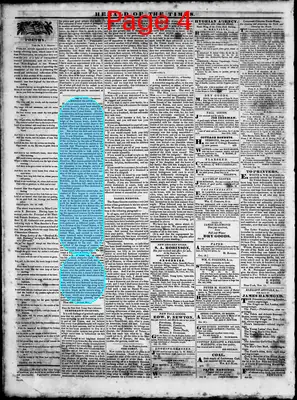
Story
December 27, 1832
Herald Of The Times
Newport, Newport County, Rhode Island
What is this article about?
Biographical account of Aaron Burr's ambitious political rise to Vice-President, his rivalry and fatal duel with Alexander Hamilton, treason trial and acquittal, exile, and later obscure life in New York.
Clipping
OCR Quality
98%
Excellent
Full Text
From the Youth's Companion.
AMBITION BLASTED.
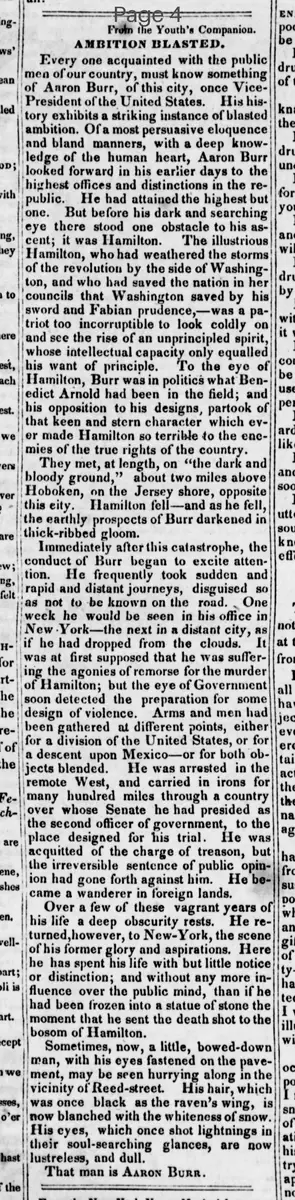
Every one acquainted with the public men of our country, must know something of Aaron Burr, of this city, once Vice-President of the United States. His history exhibits a striking instance of blasted ambition. Of a most persuasive eloquence and bland manners, with a deep knowledge of the human heart, Aaron Burr looked forward in his earlier days to the highest offices and distinctions in the republic. He had attained the highest but one. But before his dark and searching eye there stood one obstacle to his ascent; it was Hamilton. The illustrious Hamilton, who had weathered the storms of the revolution by the side of Washington, and who had saved the nation in her councils that Washington saved by his sword and Fabian prudence,-was a patriot too incorruptible to look coldly on and see the rise of an unprincipled spirit, whose intellectual capacity only equalled his want of principle. To the eye of Hamilton, Burr was in politics what Benedict Arnold had been in the field; and his opposition to his designs, partook of that keen and stern character which ever made Hamilton so terrible to the enemies of the true rights of the country. They met, at length, on "the dark and bloody ground," about two miles above Hoboken, on the Jersey shore, opposite this city. Hamilton fell-and as he fell, the earthly prospects of Burr darkened in thick-ribbed gloom. Immediately after this catastrophe, the conduct of Burr began to excite attention. He frequently took sudden and rapid and distant journeys, disguised so as not to be known on the road. One week he would be seen in his office in New York the next in a distant city, as if he had dropped from the clouds. It was at first supposed that he was suffering the agonies of remorse for the murder of Hamilton; but the eye of Government soon detected the preparation for some design of violence. Arms and men had been gathered at different points, either for a division of the United States, or for a descent upon Mexico-or for both objects blended. He was arrested in the remote West, and carried in irons for many hundred miles through a country over whose Senate he had presided as the second officer of government, to the place designed for his trial. He was acquitted of the charge of treason, but the irreversible sentence of public opinion had gone forth against him. He became a wanderer in foreign lands. Over a few of these vagrant years of his life a deep obscurity rests. He returned, however, to New-York, the scene of his former glory and aspirations. Here he has spent his life with but little notice or distinction; and without any more influence over the public mind, than if he had been frozen into a statue of stone the moment that he sent the death shot to the bosom of Hamilton. Sometimes, now, a little, bowed-down man, with his eyes fastened on the pavement, may be seen hurrying along in the vicinity of Reed-street. His hair, which was once black as the raven's wing, is now blanched with the whiteness of snow. His eyes, which once shot lightnings in their soul-searching glances, are now lustreless, and dull. That man is Aaron Burr.
AMBITION BLASTED.
Every one acquainted with the public men of our country, must know something of Aaron Burr, of this city, once Vice-President of the United States. His history exhibits a striking instance of blasted ambition. Of a most persuasive eloquence and bland manners, with a deep knowledge of the human heart, Aaron Burr looked forward in his earlier days to the highest offices and distinctions in the republic. He had attained the highest but one. But before his dark and searching eye there stood one obstacle to his ascent; it was Hamilton. The illustrious Hamilton, who had weathered the storms of the revolution by the side of Washington, and who had saved the nation in her councils that Washington saved by his sword and Fabian prudence,-was a patriot too incorruptible to look coldly on and see the rise of an unprincipled spirit, whose intellectual capacity only equalled his want of principle. To the eye of Hamilton, Burr was in politics what Benedict Arnold had been in the field; and his opposition to his designs, partook of that keen and stern character which ever made Hamilton so terrible to the enemies of the true rights of the country. They met, at length, on "the dark and bloody ground," about two miles above Hoboken, on the Jersey shore, opposite this city. Hamilton fell-and as he fell, the earthly prospects of Burr darkened in thick-ribbed gloom. Immediately after this catastrophe, the conduct of Burr began to excite attention. He frequently took sudden and rapid and distant journeys, disguised so as not to be known on the road. One week he would be seen in his office in New York the next in a distant city, as if he had dropped from the clouds. It was at first supposed that he was suffering the agonies of remorse for the murder of Hamilton; but the eye of Government soon detected the preparation for some design of violence. Arms and men had been gathered at different points, either for a division of the United States, or for a descent upon Mexico-or for both objects blended. He was arrested in the remote West, and carried in irons for many hundred miles through a country over whose Senate he had presided as the second officer of government, to the place designed for his trial. He was acquitted of the charge of treason, but the irreversible sentence of public opinion had gone forth against him. He became a wanderer in foreign lands. Over a few of these vagrant years of his life a deep obscurity rests. He returned, however, to New-York, the scene of his former glory and aspirations. Here he has spent his life with but little notice or distinction; and without any more influence over the public mind, than if he had been frozen into a statue of stone the moment that he sent the death shot to the bosom of Hamilton. Sometimes, now, a little, bowed-down man, with his eyes fastened on the pavement, may be seen hurrying along in the vicinity of Reed-street. His hair, which was once black as the raven's wing, is now blanched with the whiteness of snow. His eyes, which once shot lightnings in their soul-searching glances, are now lustreless, and dull. That man is Aaron Burr.
What sub-type of article is it?
Biography
Historical Event
Tragedy
What themes does it cover?
Fortune Reversal
Tragedy
Misfortune
What keywords are associated?
Aaron Burr
Alexander Hamilton
Duel
Treason Trial
Blasted Ambition
Political Rivalry
What entities or persons were involved?
Aaron Burr
Hamilton
Washington
Benedict Arnold
Where did it happen?
New York, Jersey Shore Opposite The City, Remote West
Story Details
Key Persons
Aaron Burr
Hamilton
Washington
Benedict Arnold
Location
New York, Jersey Shore Opposite The City, Remote West
Story Details
Aaron Burr's ambitious rise to Vice-President is halted by rivalry with Alexander Hamilton, leading to a fatal duel where Hamilton dies, Burr's suspicious travels, arrest for treason involving plans to divide the US or invade Mexico, acquittal but public condemnation, exile, and return to obscurity in New York.