Thank you for visiting SNEWPapers!
Sign up free
Gazette Of The United States, & Philadelphia Daily Advertiser
Philadelphia, Philadelphia County, Pennsylvania
What is this article about?
In Rome, on February 15, 1798, amid French occupation, locals and French forces planted a liberty tree, declared the city's independence from papal rule, and established the Roman Republic. Pope Pius VI renounced temporal power, supported by French troops.
Merged-components note: Continuation of the report on the Revolution in Rome, with text flowing directly across page break.
Clippings
1 of 2
OCR Quality
Full Text
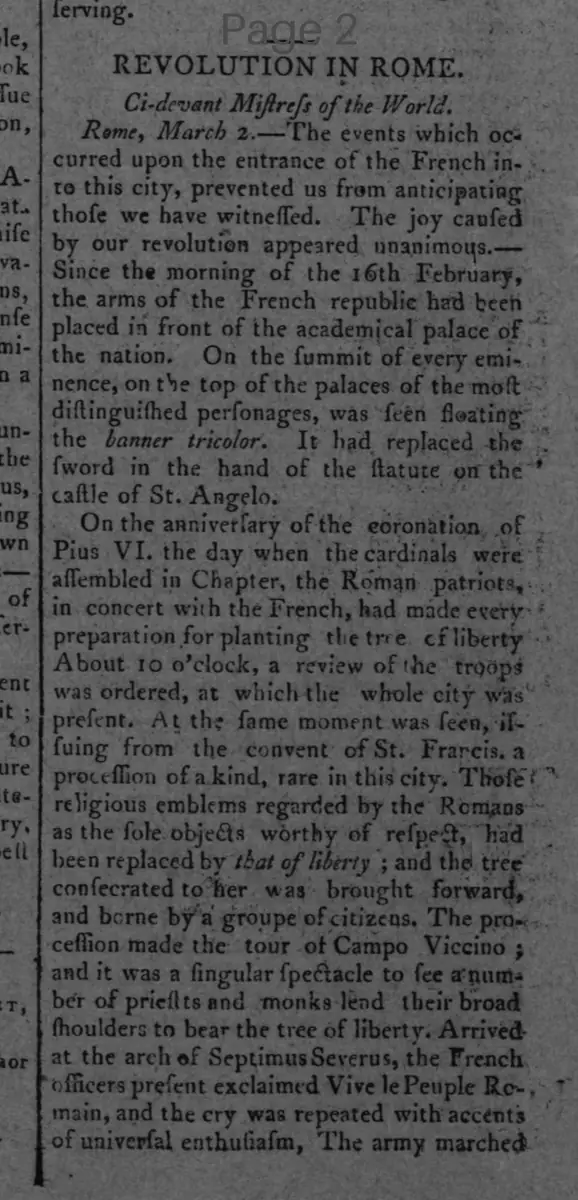
Ci-devant Mitres of the World.
Rome, March 2. The events which occurred upon the entrance of the French into this city, prevented us from anticipating those we have witnessed. The joy caused by our revolution appeared unanimous.--
Since the morning of the 15th February, the arms of the French republic had been placed in front of the academical palace of the nation. On the summit of every eminence, on the top of the palaces of the most distinguished personages, was seen floating the banner tricolor. It had replaced the sword in the hand of the statue on the castle of St. Angelo.
On the anniversary of the coronation of Pius VI. the day when the cardinals were assembled in Chapter, the Roman patriots, in concert with the French, had made every preparation for planting the tree of liberty
About 10 o'clock, a review of the troops was ordered, at which the whole city was present. At the same moment was seen, issuing from the convent of St. Francis. a procession of a kind, rare in this city. Those religious emblems regarded by the Romans as the sole objects worthy of respect, had been replaced by that of liberty; and the tree consecrated to her was brought forward, and borne by a groupe of citizens. The procession made the tour of Campo Vaccino; and it was a singular spectacle to see a number of priests and monks lend their broad shoulders to bear the tree of liberty. Arrived at the arch of Septimus Severus, the French officers present exclaimed Vive le Peuple Romain, and the cry was repeated with accents of universal enthusiasm, The army marched
After the people the procession and the Capitol and the liberty tree was planted before the statue of Marcus Aurelius, which was also ornamented with tricolor ribbands and fringes. Unanimous acclamations attended the triumph of liberty. Every citizen of either sex, by a fraternal sentiment, seemed to have but one voice and one heart.
A deputation was afterwards sent to the camp of the commander in chief for his approbation.
The act by which the city of Rome was regenerated had been digested by four notaries, and it was read aloud. It contained in substance:--That the Roman people detested the crimes of which the priestly government had made itself chargeable against the French Republic--that it resumed its sovereignty, and implored the support of the grand nation.
After which the act was approved by cries of joy, and subscribed by an immense multitude.
The general received the deputation of the people with the utmost affability, and in the name of the French Republic declared ROME, an INDEPENDENT REPUBLIC: at the same time offering 50,000 Frenchmen to defend its liberty. He then returned to the camp amid the acclamations of the people.
Meanwhile the Cardinals, at the close of their meeting, assembled in the hall of the Vatican, and signified their absolute renunciation of temporal government. General Cervone afterwards went in search of the Pope, and announced to him that the people had thought it their duty to resume the sovereignty. "And my dignity," cried the Holy Father: "It is too intimately connected with religion, which the people mean to keep sacred--It has been so declared in the solemn act proclaimed in their name, and you are promised a treatment suitable to your rank."
"And my person," pursued Pius VI. "It is perfectly safe, 120 men are appropriated for its protection."
The Pope then appeared, if not satisfied, at least resigned.
The 18th, it was announced by proclamation that a solemn mass would be celebrated the following day, by the Cardinals, but that for this ceremony a brief from his Holiness was requisite--that afterwards Te Deum would be sung in solemn gratitude for the regeneration of the Roman People--and this Proclamation contained these expressions, so proper to reconcile orthodoxy with liberty.
"That the foundation of every political association was religion, and that God was the author of religion and liberty."
What sub-type of article is it?
What keywords are associated?
What entities or persons were involved?
Where did it happen?
Foreign News Details
Primary Location
Rome
Event Date
15th February To 18th
Key Persons
Outcome
rome declared an independent republic; pope renounces temporal government; french offer 50,000 troops for defense; no casualties reported.
Event Details
French forces entered Rome, leading to a unanimous revolution. On February 15, Roman patriots and French planted the tree of liberty in a procession involving priests and monks. An act was read declaring detestation of papal crimes against France, resumption of sovereignty, and request for French support. The French general declared Rome an independent republic. Cardinals renounced temporal power; Pope assured of safety and dignity. Proclamation announced mass and Te Deum for the regeneration.