Thank you for visiting SNEWPapers!
Sign up free
Domestic News
March 11, 1818
Alexandria Gazette & Daily Advertiser
Alexandria, Virginia
What is this article about?
Maryland enacts a law regulating lotteries, appointing three commissioners to oversee drawings. After existing lotteries, they become state property, with the treasury handling proceeds and prizes, retaining a 5% tax. Commissioners receive $1200 salary each, clerk $1000; two more commissioners added later. Provisions deemed prudent and equitable.
Clipping
OCR Quality
98%
Excellent
Full Text
[Intel.]
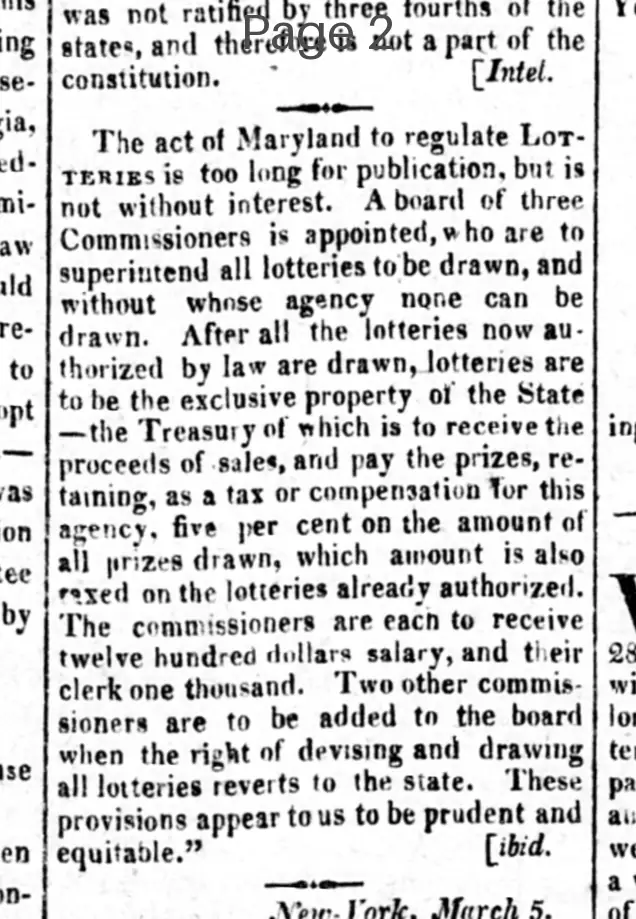
The act of Maryland to regulate Lotteries is too long for publication, but is not without interest. A board of three Commissioners is appointed, who are to superintend all lotteries to be drawn, and without whose agency none can be drawn. After all the lotteries now authorized by law are drawn, lotteries are to be the exclusive property of the State—the Treasury of which is to receive the proceeds of sales, and pay the prizes, retaining, as a tax or compensation for this agency, five per cent on the amount of all prizes drawn, which amount is also taxed on the lotteries already authorized. The commissioners are each to receive twelve hundred dollars salary, and their clerk one thousand. Two other commissioners are to be added to the board when the right of devising and drawing all lotteries reverts to the state. These provisions appear to us to be prudent and equitable.
[ibid.]
The act of Maryland to regulate Lotteries is too long for publication, but is not without interest. A board of three Commissioners is appointed, who are to superintend all lotteries to be drawn, and without whose agency none can be drawn. After all the lotteries now authorized by law are drawn, lotteries are to be the exclusive property of the State—the Treasury of which is to receive the proceeds of sales, and pay the prizes, retaining, as a tax or compensation for this agency, five per cent on the amount of all prizes drawn, which amount is also taxed on the lotteries already authorized. The commissioners are each to receive twelve hundred dollars salary, and their clerk one thousand. Two other commissioners are to be added to the board when the right of devising and drawing all lotteries reverts to the state. These provisions appear to us to be prudent and equitable.
[ibid.]
What sub-type of article is it?
Lottery
Legal Or Court
Politics
What keywords are associated?
Maryland Lottery Act
Lottery Commissioners
State Lottery Regulation
Where did it happen?
Maryland
Domestic News Details
Primary Location
Maryland
Event Details
Act appoints three commissioners to superintend lotteries; after authorized lotteries, they become state property with treasury receiving proceeds, paying prizes, retaining 5% tax; commissioners salaried at $1200 each, clerk $1000; two more commissioners added later.