Thank you for visiting SNEWPapers!
Sign up free
Story
September 11, 1905
New York Tribune
New York, New York County, New York
What is this article about?
Profile of longtime NYC teacher Miss Louis Baurens, detailing her career in the evolving 6th Ward schools amid waves of Irish, German, Jewish, and Italian immigration, highlighting student diversity and lost artistic potential.
Clipping
OCR Quality
92%
Excellent
Full Text
Incurables, Blackwell's Island.
She writes from Liberty, N.Y., about him as follows:
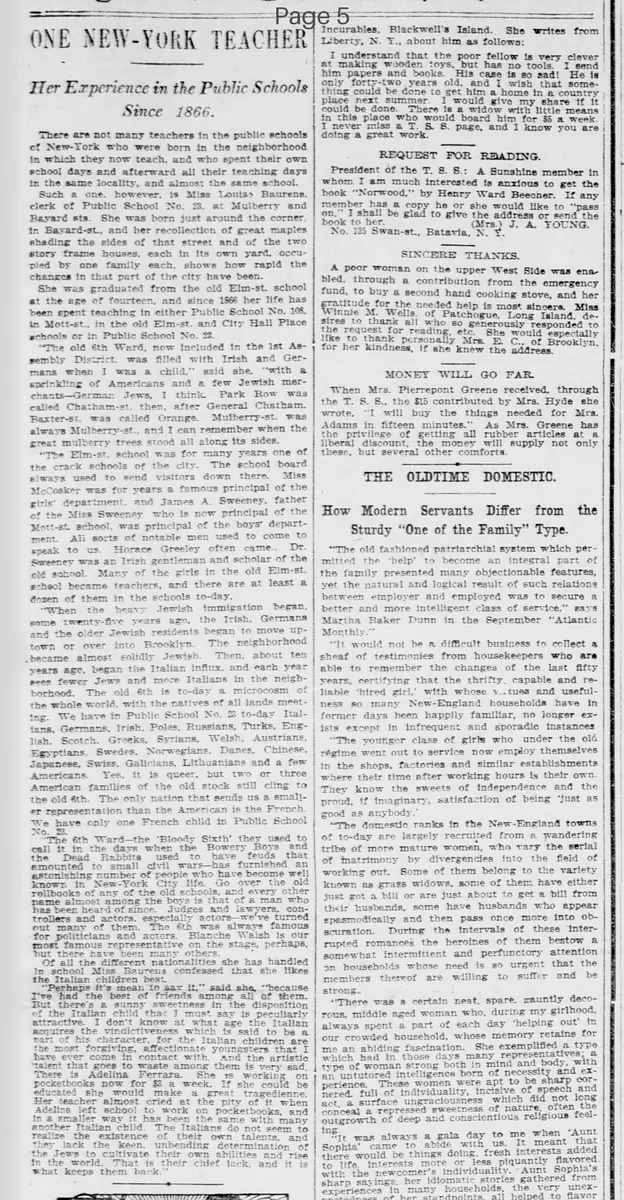
There are not many teachers in the public schools of New-York who were born in the neighborhood in which they now teach, and who spent their own school days and afterward all their teaching days in the same locality, and almost the same school.
Such a one, however, is Miss Louis Baurens, clerk of Public School No. 23, at Mulberry and Bayard sts. She was born just around the corner, in Bayard-st., and her recollection of great maples shading the sides of that street and of the two story frame houses, each in its own yard, occupied by one family each, shows how rapid the changes in that part of the city have been.
She was graduated from the old Elm-st. school at the age of fourteen, and since 1866 her life has been spent teaching in either Public School No. 108, in Mott-st., in the old Elm-st. and City Hall Place schools or in Public School No. 23.
"The old 6th Ward, now included in the 1st Assembly District, was filled with Irish and Germans when I was a child," said she, "with a sprinkling of Americans and a few Jewish merchants--German Jews. I think Park Row was called Chatham-st. then, after General Chatham. Baxter-st. was called Orange. Mulberry-st. was always Mulberry-st, and I can remember when the great mulberry trees stood all along its sides.
"The Elm-st. school was for many years one of the crack schools of the city. The school board always used to send visitors down there. Miss McCosker was for years a famous principal of the girls' department, and James A. Sweeney, father of the Miss Sweeney who is now principal of the Mott-st school, was principal of the boys' department. All sorts of notable men used to come to speak to us. Horace Greeley often came. Dr. Sweeney was an Irish gentleman and scholar of the old school. Many of the girls in the old Elm-st. school became teachers, and there are at least a dozen of them in the schools to-day.
"When the heavy Jewish immigration began, some twenty-five years ago, the Irish, Germans and the older Jewish residents began to move uptown or over into Brooklyn. The neighborhood became almost solidly Jewish. Then, about ten years ago, began the Italian influx, and each year sees fewer Jews and more Italians in the neighborhood. The old 6th is to-day a microcosm of the whole world, with the natives of all lands meeting. We have in Public School No. 23 to-day Italians, Germans, Irish, Poles, Russians, Turks, English, Scotch, Greeks, Syrians, Welsh, Austrians, Egyptians, Swedes, Norwegians, Danes, Chinese, Japanese, Swiss, Galicians, Lithuanians and a few Americans. Yes, it is queer, but two or three American families of the old stock still cling to the old 6th. The only nation that sends us a smaller representation than the American is the French. We have only one French child in Public School No. 23.
The 6th Ward--the 'Bloody Sixth' they used to call it in the days when the Bowery Boys and the Dead Rabbits used to have feuds that amounted to small civil wars--has furnished an astonishing number of people who have become well known in New-York City life. Go over the old rollbooks of any of the old schools, and every other name almost among the boys is that of a man who has been heard of since. Judges and lawyers, controllers and actors, especially actors we've turned out many of them. The 6th was always famous for politicians and actors. Blanche Walsh is our most famous representative on the stage, perhaps, but there have been many others.
Of all the different nationalities she has handled in school Miss Baurens confessed that she likes the Italian children best.
"Perhaps it's mean to say it," said she, "because I've had the best of friends among all of them. But there's a sunny sweetness in the disposition of the Italian child that I must say is peculiarly attractive. I don't know at what age the Italian acquires the vindictiveness which is said to be a part of his character, for the Italian children are the most forgiving, affectionate youngsters that I have ever come in contact with. And the artistic talent that goes to waste among them is very sad. There is Adelina Ferrara. She is working on pocketbooks now for $3 a week. If she could be educated she would make a great tragedienne. Her teacher almost cried at the pity of it when Adelina left school to work on pocketbooks, and in a smaller way it has been the same with many another Italian child. The Italians do not seem to realize the existence of their own talents, and they lack the keen, unbending determination of the Jews to cultivate their own abilities and rise in the world. That is their chief lack, and it is what keeps them back."
She writes from Liberty, N.Y., about him as follows:
There are not many teachers in the public schools of New-York who were born in the neighborhood in which they now teach, and who spent their own school days and afterward all their teaching days in the same locality, and almost the same school.
Such a one, however, is Miss Louis Baurens, clerk of Public School No. 23, at Mulberry and Bayard sts. She was born just around the corner, in Bayard-st., and her recollection of great maples shading the sides of that street and of the two story frame houses, each in its own yard, occupied by one family each, shows how rapid the changes in that part of the city have been.
She was graduated from the old Elm-st. school at the age of fourteen, and since 1866 her life has been spent teaching in either Public School No. 108, in Mott-st., in the old Elm-st. and City Hall Place schools or in Public School No. 23.
"The old 6th Ward, now included in the 1st Assembly District, was filled with Irish and Germans when I was a child," said she, "with a sprinkling of Americans and a few Jewish merchants--German Jews. I think Park Row was called Chatham-st. then, after General Chatham. Baxter-st. was called Orange. Mulberry-st. was always Mulberry-st, and I can remember when the great mulberry trees stood all along its sides.
"The Elm-st. school was for many years one of the crack schools of the city. The school board always used to send visitors down there. Miss McCosker was for years a famous principal of the girls' department, and James A. Sweeney, father of the Miss Sweeney who is now principal of the Mott-st school, was principal of the boys' department. All sorts of notable men used to come to speak to us. Horace Greeley often came. Dr. Sweeney was an Irish gentleman and scholar of the old school. Many of the girls in the old Elm-st. school became teachers, and there are at least a dozen of them in the schools to-day.
"When the heavy Jewish immigration began, some twenty-five years ago, the Irish, Germans and the older Jewish residents began to move uptown or over into Brooklyn. The neighborhood became almost solidly Jewish. Then, about ten years ago, began the Italian influx, and each year sees fewer Jews and more Italians in the neighborhood. The old 6th is to-day a microcosm of the whole world, with the natives of all lands meeting. We have in Public School No. 23 to-day Italians, Germans, Irish, Poles, Russians, Turks, English, Scotch, Greeks, Syrians, Welsh, Austrians, Egyptians, Swedes, Norwegians, Danes, Chinese, Japanese, Swiss, Galicians, Lithuanians and a few Americans. Yes, it is queer, but two or three American families of the old stock still cling to the old 6th. The only nation that sends us a smaller representation than the American is the French. We have only one French child in Public School No. 23.
The 6th Ward--the 'Bloody Sixth' they used to call it in the days when the Bowery Boys and the Dead Rabbits used to have feuds that amounted to small civil wars--has furnished an astonishing number of people who have become well known in New-York City life. Go over the old rollbooks of any of the old schools, and every other name almost among the boys is that of a man who has been heard of since. Judges and lawyers, controllers and actors, especially actors we've turned out many of them. The 6th was always famous for politicians and actors. Blanche Walsh is our most famous representative on the stage, perhaps, but there have been many others.
Of all the different nationalities she has handled in school Miss Baurens confessed that she likes the Italian children best.
"Perhaps it's mean to say it," said she, "because I've had the best of friends among all of them. But there's a sunny sweetness in the disposition of the Italian child that I must say is peculiarly attractive. I don't know at what age the Italian acquires the vindictiveness which is said to be a part of his character, for the Italian children are the most forgiving, affectionate youngsters that I have ever come in contact with. And the artistic talent that goes to waste among them is very sad. There is Adelina Ferrara. She is working on pocketbooks now for $3 a week. If she could be educated she would make a great tragedienne. Her teacher almost cried at the pity of it when Adelina left school to work on pocketbooks, and in a smaller way it has been the same with many another Italian child. The Italians do not seem to realize the existence of their own talents, and they lack the keen, unbending determination of the Jews to cultivate their own abilities and rise in the world. That is their chief lack, and it is what keeps them back."
What sub-type of article is it?
Biography
Historical Event
What themes does it cover?
Social Manners
What keywords are associated?
Teacher Biography
6th Ward History
Immigration Changes
Public Schools New York
Italian Students
What entities or persons were involved?
Miss Louis Baurens
Miss Mccosker
James A. Sweeney
Horace Greeley
Dr. Sweeney
Blanche Walsh
Adelina Ferrara
Where did it happen?
6th Ward, New York City (Mulberry And Bayard Sts., Mott St., Elm St., City Hall Place)
Story Details
Key Persons
Miss Louis Baurens
Miss Mccosker
James A. Sweeney
Horace Greeley
Dr. Sweeney
Blanche Walsh
Adelina Ferrara
Location
6th Ward, New York City (Mulberry And Bayard Sts., Mott St., Elm St., City Hall Place)
Event Date
Since 1866
Story Details
Miss Louis Baurens, born in the neighborhood, has taught in local public schools since 1866, observing rapid changes from Irish and German residents to Jewish and now Italian immigrants in the 6th Ward, noting the diversity of students and the untapped talents of Italian children.