Thank you for visiting SNEWPapers!
Sign up free
Gazette Of The United States, & Philadelphia Daily Advertiser
Philadelphia, Philadelphia County, Pennsylvania
What is this article about?
On June 15, the U.S. House of Representatives debated amendments to a bill authorizing a provisional army, focusing on volunteer corps privileges like arming and service limits compared to militia. Speakers including S. Smith, Brooks, Otis, and others argued for and against; motions on lending arms and officer appointments were voted on, with mixed outcomes.
Merged-components note: Continuation of congressional debate on the provisional army bill across multiple components and pages.
Clippings
1 of 2
OCR Quality
Full Text
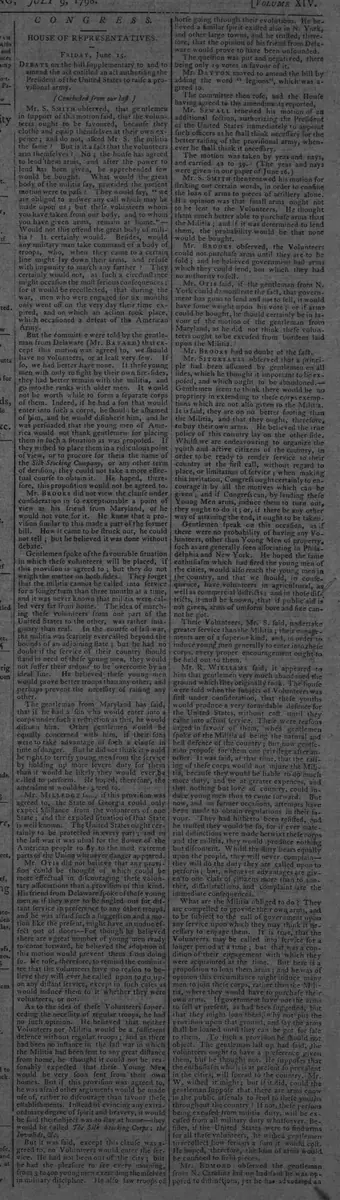
HOUSE OF REPRESENTATIVES.
FRIDAY, June 15.
Debate on the bill supplementary to and to amend the act entitled an act authorizing the President of the United States to raise a provisional army.
(Concluded from our last.)
Mr. S. SMITH observed, that gentlemen in support of this motion said, that the volunteers ought to be favoured, because they clothe and equip themselves at their own expense; and do not, asked Mr S. the militia the same? But is it a fact that the volunteers arm themselves? No; the house has agreed to lend them arms, and after the power to lend has been given, he apprehended few would be bought. What would the great body of the militia say, provided the present motion were to pass? They would say, "we are obliged to answer any call which may be made upon us; but these volunteers whom you have taken from our body, and to whom you have given arms, remain at home."—Would not this offend the great body of militia? It certainly would. Besides, would any military man take command of a body of troops, who, when they came to a certain line might lay down their arms, and refuse with impunity to march any farther? They certainly would not, as such a circumstance might occasion the most serious consequences; for it would be recollected, that during the war, men who were engaged for six months only went off on the very day their time expired, and on which an action took place, which occasioned a defeat of the American Army.
But the committee were told by the gentleman from Delaware (Mr. BAYARD) that except this motion was agreed to, we should have no volunteers, or at least very few. If so, we had better have none. If these young men wish only to fight by their own fire-sides, they had better remain with the militia, and go into the ranks with older men. It would not be worth while to form a separate corps of them. Indeed, if he had a son that would enter into such a corps, he should be ashamed of him, and he would disinherit him, and he was persuaded that the young men of America would not thank gentlemen for placing them in such a situation as was proposed. If they wished to place them in a ridiculous point of view, or to procure for them the name of the Silk Stocking Company, or any other term of derision, they could not take a more effectual course to obtain it. He hoped, therefore, this proposition would not be agreed to.
Mr. Brooks did not view the clause under consideration in so exceptionable a point of view as his friend from Maryland, or he would not vote for it. He knew that a provision similar to this made a part of the former bill. How it came to be struck out, he could not tell; but he believed it was done without debate.
Gentlemen spoke of the favourable situation in which these volunteers will be placed. if this provision is agreed to; but they do not weigh the matter on both sides. They forget that the militia cannot be called into service for a longer term than three months at a time, and it was never known that militia were called very far from home. The idea of marching these volunteers from one part of the United States to the other, was rather imaginary than real. In the course of last war, the militia was scarcely ever called beyond the bounds of an adjoining state; but he had no doubt if the service of their country should stand in need of these young men, they would not suffer their ardour to be overcome by an ideal line. He believed these young men would prove better troops than any other, and perhaps prevent the necessity of raising any other.
The gentleman from Maryland has said, that if he had a son who would enter into a corps under such a restriction as this, he would disown him. Other gentlemen would be equally concerned with him, if their sons were to take advantage of such a clause in time of danger. But he did not think it would be right to terrify young men from the service by holding up more severe duty for them than it would be likely they would ever be called to perform. He hoped, therefore, the amendment would be agreed to.
Mr. MILLEDGE said, if this provision was agreed to, the State of Georgia could only expect assistance from the volunteers of one State; and the exposed Situation of that State is well known. The United States ought certainly to be protected in every part; and in the last war it was usual for the flower of the American people to fly to the most extreme parts of the Union whenever danger appeared.
Mr. Otis did not believe that any provision could be thought of which could be more effectual in discouraging these voluntary associations than a provision of this kind. His friend from Delaware spoke of these young men as if they were to be singled out for distant service in preference to any other troops, and he was afraid such a suggestion and a motion like the present, might have an undue effect out of doors—For though he believed there are a great number of young men ready to come forward, he believed the adoption of this motion would prevent them from doing so. He rose, therefore, to remind the committee that the volunteers have no reason to believe they will ever be called upon to go upon any distant service, except in such cases as would induce them to it whether they were volunteers, or not.
As to the idea of these Volunteers superseding the necessity of regular troops, he had no such opinion. He believed that neither Volunteers nor Militia would be a sufficient defence without regular troops; and as there had been no instance in the last war in which the Militia had been sent to any great distance from home, he thought it could not be reasonably expected that these Young Men would be very soon sent from their own homes. But if this provision was agreed to, he was afraid other arguments would be made use of, rather to discourage than favour these establishments. Instead of evincing any extraordinary degree of spirit and bravery, it would be said their object was to stay at home—they would be called The Silk Stocking Corps: the Invalids, &c.
But it was said, except this clause was agreed to, no Volunteers would enter the service. He had not been out of the city; but he had the pleasure to see every morning, from 300 to 400 young men exercising themselves in military discipline. He also saw troops of horse going through their evolutions.
He believed a similar spirit existed also in N. York, and other large towns, and he trusted, therefore, that the opinion of his friend from Delaware would prove to have been unfounded.
The question was put and negatived, there being only 19 votes in favour of it.
Mr. DAYTON moved to amend the bill by adding the word "legions", which was agreed to.
The committee then rose, and the House having agreed to the amendments reported; Mr. Sewall renewed his motion of an additional section, authorizing the President of the United States immediately to appoint such officers as he shall think necessary for the better raising of the provisional army, whenever he shall think it necessary.
The motion was taken by yeas and nays, and carried 42 to 39. (The yeas and nays were given in our paper of June 16.)
Mr. S. SMITH then renewed his motion for striking out certain words, in order to confine the loan of arms to pieces of artillery alone.
His opinion was that small arms ought not to be lent to the Volunteers. He thought them much better able to purchase arms than the Militia; and if it was determined to lend them, the probability would be that none would be bought.
Mr. Brooks observed, the Volunteers could not purchase arms until they are to be sold; and he believed government had arms which they could lend, but which they had no authority to sell.
Mr. Otis said, if the gentleman from N. York could demonstrate the fact, that government has guns to lend and not to sell, it would have some weight upon his vote; or if arms could be bought, he should certainly be in favour of the motion of the gentleman from Maryland, as he did not think these volunteers ought to be excused from burdens laid upon the Militia.
Mr. BROOKS had no doubt of the fact.
Mr. SITGREAVES observed that a principle had been assumed by gentlemen on all sides, which he thought it important to be exposed, and which ought to be abandoned.— Gentlemen seem to think there would be no propriety in extending to these corps exemptions which are not also given to the Militia. It is said, they are on no better footing than the Militia, and that they ought, therefore, to buy their own arms. He believed the true policy of this country lay on the other side. Whilst we are endeavouring to organize the youth and active citizens of the country, in order to be ready to render service to their country at the first call, without regard to place, or limitation of service; when making this invitation, Congress ought certainly to encourage it by all the motives which can be given; and if Congress can, by lending these Young Men arms, induce them to turn out, they ought to do it; or, if there be any other way of attaining the end, it ought to be taken.
Gentlemen speak on this occasion, as if there were no probability of having any Volunteers, other than Young Men of property, such as are generally seen associating in Philadelphia and New York. He hoped the same enthusiasm which had fired the young men of the cities, would also reach the young men in the country, and that we should, in consequence, have volunteers in agricultural, as well as commercial districts; and in those districts, it must be known, that if public aid is not given, arms of uniform bore and size cannot be got.
These Volunteers, Mr. S. said, undertake greater service than the Militia; their engagements are of a superior kind, and, in order to induce young men generally to enter into these corps, every proper encouragement ought to be held out to them.
Mr. R. WILLIAMS said, it appeared to him that gentlemen very much abandoned the ground which they originally took. The house were told when the subject of Volunteers was first under consideration, that these youths would produce a very formidable defence for the United States, without cost. until they came into actual service. These were reasons urged in favour of them, when gentlemen spoke of the Militia as being the natural and best defence of the country; but now gentlemen propose for them one privilege after another. It was said, at that time, that the raising of these corps would not injure the Militia, because they would be liable to do much more duty, and be at greater expences, and that nothing but love of country, could induce young men thus to come forward. But now, and on former occasions, attempts have been made to obtain regulations in their favour. They had hitherto been resisted, and he trusted they would be so, for if ever material distinctions were made betwixt these corps and the militia, they would produce nothing but discontent. Whilst the duty bears equally upon the people, they will never complain— they will do the duty they are called upon to perform; but, whenever advantages are given to one class of citizens more than to another, dissatisfactions and complaint are the immediate consequences.
What are the Militia obliged to do? They are compelled to provide their own arms, and to be subject to the call of government upon any service upon which they may think it necessary to engage them. It is true, that the Volunteers may be called into service for a longer period at a time; but that was a condition of their engagement with which they were acquainted at the time. But here is a proposition to loan them arms; and he was of opinion this circumstance might induce many men to join these corps, rather than the Militia, where they would have to purchase their own arms. If government have not the arms to sell at present, as had been suggested, but that they might loan them, why not put the provision upon that ground, and say the arms shall be loaned until they can be got for sale to them. To such a provision he should not object. The gentleman last up had said, the volunteers ought to have a preference given them, but he thought not. He supposes that the enthusiasm which is at present so prevalent in the cities; will spread to the country. Mr. W. wished it might; but if it did, could the gentleman suppose that, there are arms enow in the public arsenals to lend to these youths throughout the country? If not, these persons being excused from militia duty, will be excused from all military duty whatsoever. Besides, if the United States were to find arms for all these volunteers, he wished gentlemen to recollect how serious a sum it would cost.
He hoped, therefore, the loan of arms would be confined to field pieces.
Mr. EDMOND observed the gentleman from N. Carolina last up had said he was opposed to distinctions, yet he has advocated an
amendment which will go to create them,
Thus morning a bill had been passed for supplying the Militia with arms, and if neither the State Governments, nor individuals, will purchase them, they are to be loaned to the people. He himself opposed that measure, because he believed it would discourage persons from purchasing arms, when they had a prospect of borrowing them, though he believed the gentleman from N. Carolina was in favour of it.
The Volunteers stand upon a very different ground from that on which the original bill proposed to place them. It was there proposed that they should not go beyond the limits of an adjoining state. And in that case multitudes would have come forward, provided they should not be called to serve as a Standing Army, whilst their families were left destitute. Men might then have been tempted to have left the Militia, in order to have joined these corps; but if Congress goes so far as to say they will depend solely for the defence of the country upon the ardour and patriotism of these young men, what will these gentlemen say? Each will say to himself. "I am now exempt from military duty, there is no law to compel me to it ; but if I go into these Volunteer Corps, I must equip and arm myself; I may be marched to the extreme parts of the Union, and not return for two years. If I do not join this corps, I can stay at home, and when called upon, do Militia duty with my neighbours." Where, then, he asked, was the inducement to become Volunteers? There is none, and it can only be a pure sentiment of Patriotism which could induce Young Men to enter these corps. He hoped, therefore, the law would not be trammelled, but that the encouragement held out by this clause would, at least, be agreed to ; especially as men beyond the age of 45, who are excused from Militia duty, might join these corps.
Mr. S. SMITH said the arguments of the gentleman last up go to this, that there are no arms to be bought. His amendment said no such thing. He wished the volunteers to purchase their arms at once. If the gentleman from Connecticut could show, that the government could loan arms, but could not sell them, his arguments would have some weight. With respect to the bill passed this morning, it did not originally contemplate any loan of arms; but an amendment had been introduced into it, providing that in case of any emergency, and any of the arms shall remain unsold, they shall be loaned to such persons as may stand in need of them.
Supposing that 5000 stand of arms were only to be lent to these Volunteers, it would create a draft on the Treasury for 80,000 dollars, and he thought it would be much better to suffer individuals, who would generally be very able to do it, each of them to pay 14 or 16 dollars for their own.
Mr. DANA supposed, as a military man, the gentleman from Maryland, would admit the propriety of retaining a considerable quantity of arms in the arsenals of the United States. Would it not, then, be folly and madness to sell all the arms out of the Arsenals of the United States? Ought we not to have sufficient for an army, in case of invasion? Admitting we have only this quantity at present, if we loan them, and take receipts for them from confidential officers, they might be at any time returned in better condition, probably, than they were lent, so that no expense would be incurred. And these arms cannot be purchased of a proper calibre any where else. And what was the amount, Mr. D. asked, of the elegant harangue of the gentleman from N. Carolina, on the odiousness of distinctions. Does he mean to say there ought to be no distinctions in the community? When men are distinguished by their burdens, ought they not to be distinguished also by their privileges.
The Yeas and Nays were called and taken (as given in a former paper.) The question on the amendment was negatived 46 to 35.
The bill was then ordered to be read a third time to morrow.
Mr. HARPER called up the two resolutions which he yesterday laid upon the table; the one for appropriating a sum of money for the support of the new regiment of Artillery for this year; and the other to authorize the President to borrow a sum of money for the service of Government for the current year, which were agreed to.
Mr. VAN ALEN asked and obtained leave of absence for the remainder of the session, for his colleague Mr. J. Williams, on account of the indisposition of his family.
Adjourned.
What sub-type of article is it?
What themes does it cover?
What keywords are associated?
What entities or persons were involved?
Where did it happen?
Story Details
Key Persons
Location
House Of Representatives
Event Date
Friday, June 15
Story Details
Debate on amendments to provisional army bill concerning volunteer corps service limits, arming via loans, and officer appointments; arguments balanced privileges between volunteers and militia, patriotism of youth, and national defense needs; several motions voted on with narrow margins.