Thank you for visiting SNEWPapers!
Sign up free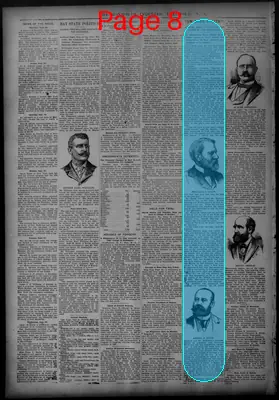
The Monmouth Inquirer
Freehold, Monmouth County, New Jersey
What is this article about?
On September 29, the Republican city convention in New York nominated General Benjamin F. Tracy for mayor of Greater New York, Ashbel P. Fitch for comptroller, and R. Ross Appleton for president of the municipal council, after resolving contested seats and adopting a platform endorsing McKinley and local Republican achievements.
Clipping

OCR Quality
Full Text
GENERAL TRACY NOMINATED FOR MAYOR OF THE METROPOLIS.
The Republicans Place a Ticket In the Field—Ashbel I. Fitch Named For Comptroller, R. Ross Appleton For President of the Council.
New York, Sept. 29.—The Republican city convention for Greater New York, which met in Carnegie hall, has placed the following ticket in the field:
For mayor—General Benjamin F. Tracy of the borough of Manhattan.
For comptroller—Ashbel P. Fitch of the borough of Manhattan.
For president of the municipal council—R. Ross Appleton of the borough of Brooklyn.
Lieutenant Governor Timothy L. Woodruff was chosen chairman and delivered the keynote speech of the convention, after which the usual committees were named.
Lieutenant Governor Woodruff, as chairman, called for committee reports, and Joseph M. Deuel reported for the committee on contested seats in favor of dividing the vote in the First and Second districts in Brooklyn so as to give each side a half vote.
Hugo Hirsch moved as an amendment that the committee be discharged and that the sitting delegates be allowed to retain their seats. Mr. Hirsch insisted that the statement of Mr. Deuel that each side had been given an opportunity to be heard was not correct. The Low people, he said, had not been given a fair show, while Lieutenant Governor Woodruff had been allowed to present the case of the opposition at great length and was not limited as to time. The delegations headed by Messrs. Chittenden and Buttling had been honestly elected and were entitled to the whole vote and no half vote.
"I was not born a twin, and I cannot divide myself," said Mr. Hirsch. "We were instructed to work and vote for Seth Low for mayor, and I cannot divide myself. I believe that the men who hoot him now will vote for him on election day."
Mr. Quigg moved that Mr. Hirsch's motion be laid on the table. Messrs. Buttling and Worth jumped up and demanded a roll call. When the borough of Manhattan was reached, Mr. Quigg said he was instructed to cast 191 votes in the affirmative.
Mr. Woodruff instructed the secretary not to call the roll of the First and Second districts of Brooklyn, where the contests were. Sheriff Buttling demanded that his name be called. Cries of "Sit down, sit down!" greeted Mr. Buttling.
"I will when I get through," said Mr. Buttling.
When Worth's name was called, he arose and denounced the ruling of the chairman. "I do not care about being cheered," he said when the cheers of his friends had subsided. "I have been hissed as often as I have been cheered, and I do not know of anything I have done to deserve one more than the other." He went on to denounce the report of the committee as unfair. He spoke of Platt as the man who presses the button, and all obey the orders of the button. At this point the Platt men yelled, "Sit down!" but Worth kept on.
He said that the delegates had been regularly elected, and when a dispute was sprung he had expected the committee to do just what it had done. He understood that they had assembled to hold a convention to nominate candidates and not to elect new delegates.
When the roll call was finished, the vote was announced as 301 to 46, and the motion of Mr. Hirsch was laid on the table. The report of the committee on contested seats was then adopted.
The platform was presented and adopted. It indorsed the St. Louis platform and Mr. McKinley's administration as president, also Governor Black and the last Republican legislature. It sets forth the work done by the Republicans in accomplishing the consolidation of the Greater New York and urges the fitness of electing a Republican mayor for the city. It commends the provisions in regard to the letting of public franchises and praises the principles embodied in the law regulating the sale of liquor. It finally rehearses the work done by the Republican party for the good of the city.
After the adoption of the platform Mr. Quigg moved that the convention proceed to the nomination of a candidate for the office of mayor of Greater New York.
District Attorney Olcott nominated for mayor General Benjamin F. Tracy.
BENJAMIN F. TRACY.
Jacob Worth, in a speech continually interrupted by cheers and groans, nominated Seth Low.
Before the nominations closed Frederick A. Schroeder's name was also brought before the convention. Balloting then began.
Mr. Quigg cast the entire vote of the boroughs of Manhattan and Bronx, 191 votes, for General Tracy. S. B. Chittenden cast 6 half votes for Low, and Buttling 4 half votes for Low. Mr. Hurley cast 4 votes for General Tracy.
The vote finally was as follows: Tracy, 297; Low, 49; Schroeder, 2.
Sheriff Buttling, when the vote was announced, said, "In view of the fact that the gentleman from New York says Tracy will stick, I move to make the nomination unanimous." He added that the candidate of the convention would receive the loyal support of Mr. Worth and his faction. General Tracy's nomination was then made unanimous, and a committee consisting of Delegates Bidwell, Worth, Prall, McRoberts and Hurley was appointed to notify General Tracy of his nomination.
Chauncey M. Depew nominated the Hon. Ashbel P. Fitch for comptroller, and on motion of Delegate Hirsch the nomination was made unanimous.
Jesse Johnson of Kings county then nominated R. Ross Appleton for president of the council. This was also a unanimous nomination.
ASHBEL P. FITCH.
What sub-type of article is it?
What keywords are associated?
What entities or persons were involved?
Where did it happen?
Domestic News Details
Primary Location
New York
Event Date
Sept. 29
Key Persons
Outcome
nominations made unanimous for tracy, fitch, and appleton after balloting and resolving contested delegates from brooklyn districts.
Event Details
The Republican convention met in Carnegie Hall, resolved contested seats by dividing votes in Brooklyn's First and Second districts, adopted a platform endorsing McKinley's administration and Greater New York consolidation, nominated and elected Tracy for mayor over Low and Schroeder, and unanimously nominated Fitch and Appleton for other positions.