Thank you for visiting SNEWPapers!
Sign up free
Story
March 16, 1893
The Advance
Jamesburg, Middlesex County, New Jersey
What is this article about?
Account of the origin of 'Lynch Law,' derived from Colonel Charles Lynch and associates in Campbell County, Virginia, who flogged Tories during the Revolutionary War to expel them, bypassing legal trials. Webster's Dictionary is cited as the source.
Clipping
OCR Quality
98%
Excellent
Full Text
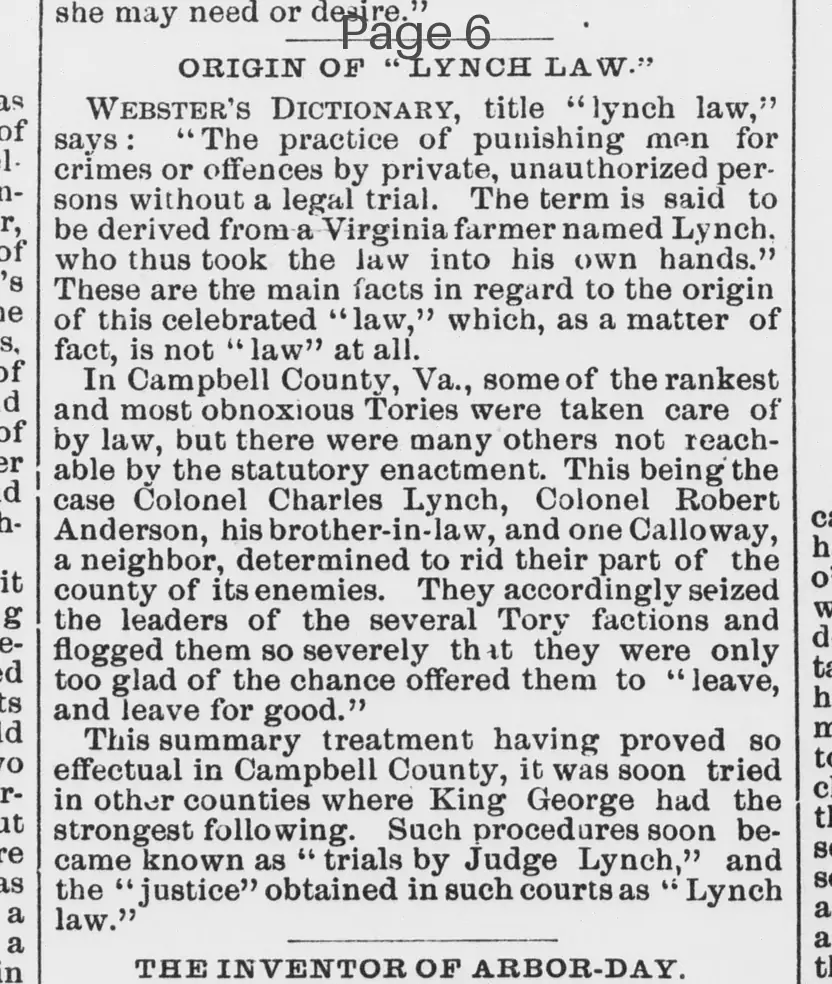
ORIGIN OF "LYNCH LAW."
Webster's Dictionary, title "lynch law," says:
"The practice of punishing men for crimes or offences by private, unauthorized persons without a legal trial. The term is said to be derived from a Virginia farmer named Lynch, who thus took the law into his own hands."
These are the main facts in regard to the origin of this celebrated "law," which, as a matter of fact, is not "law" at all. In Campbell County, Va., some of the rankest and most obnoxious Tories were taken care of by law, but there were many others not reachable by the statutory enactment. This being the case Colonel Charles Lynch, Colonel Robert Anderson, his brother-in-law, and one Calloway, a neighbor, determined to rid their part of the county of its enemies. They accordingly seized the leaders of the several Tory factions and flogged them so severely that they were only too glad of the chance offered them to "leave," and leave for good. This summary treatment having proved so effectual in Campbell County, it was soon tried in other counties where King George had the strongest following. Such procedures soon became known as "trials by Judge Lynch," and the "justice" obtained in such courts as "Lynch law."
Webster's Dictionary, title "lynch law," says:
"The practice of punishing men for crimes or offences by private, unauthorized persons without a legal trial. The term is said to be derived from a Virginia farmer named Lynch, who thus took the law into his own hands."
These are the main facts in regard to the origin of this celebrated "law," which, as a matter of fact, is not "law" at all. In Campbell County, Va., some of the rankest and most obnoxious Tories were taken care of by law, but there were many others not reachable by the statutory enactment. This being the case Colonel Charles Lynch, Colonel Robert Anderson, his brother-in-law, and one Calloway, a neighbor, determined to rid their part of the county of its enemies. They accordingly seized the leaders of the several Tory factions and flogged them so severely that they were only too glad of the chance offered them to "leave," and leave for good. This summary treatment having proved so effectual in Campbell County, it was soon tried in other counties where King George had the strongest following. Such procedures soon became known as "trials by Judge Lynch," and the "justice" obtained in such courts as "Lynch law."
What sub-type of article is it?
Historical Event
Curiosity
What themes does it cover?
Justice
Crime Punishment
What keywords are associated?
Lynch Law
Origin
Charles Lynch
Tories
Virginia
Vigilante Justice
Revolutionary War
What entities or persons were involved?
Colonel Charles Lynch
Colonel Robert Anderson
Calloway
Where did it happen?
Campbell County, Va.
Story Details
Key Persons
Colonel Charles Lynch
Colonel Robert Anderson
Calloway
Location
Campbell County, Va.
Story Details
Colonel Charles Lynch, his brother-in-law Colonel Robert Anderson, and neighbor Calloway in Campbell County, Virginia, seized and flogged Tory leaders to force them to leave during the Revolutionary War, as legal measures were insufficient. This vigilante practice spread and became known as 'Lynch Law,' per Webster's Dictionary.