Thank you for visiting SNEWPapers!
Sign up free
Story
March 27, 1935
Red Lodge Daily News Combined With Carbon County News
Red Lodge, Carbon County, Montana
What is this article about?
Article on the history of the thermometer, from Galileo's early invention in 1592 to scales by Fahrenheit in 1714 and Celsius in 1742, highlighting scientific cooperation in its development.
Clipping
OCR Quality
98%
Excellent
Full Text
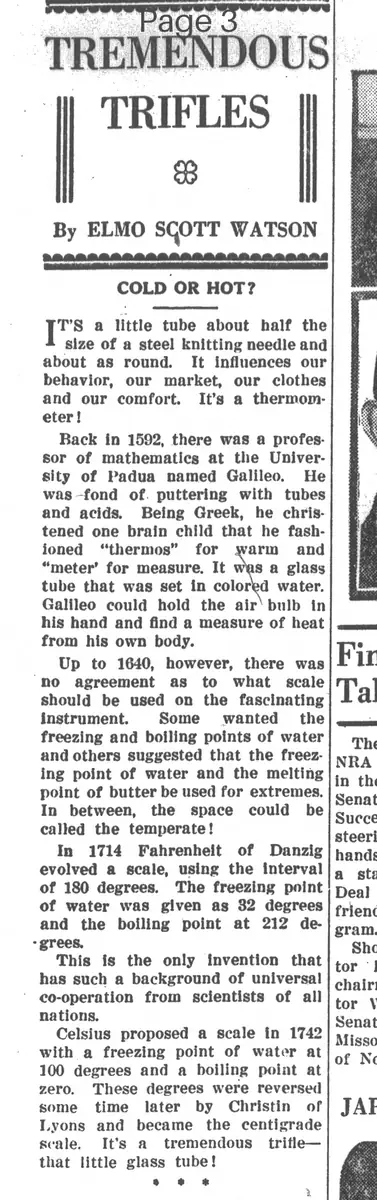
TREMENDOUS TRIFLES
By ELMO SCOTT WATSON
COLD OR HOT?
It's a little tube about half the size of a steel knitting needle and about as round. It influences our behavior, our markets, our clothes and our comfort. It's a thermometer!
Back in 1592, there was a professor of mathematics at the University of Padua named Galileo. He was fond of puttering with tubes and acids. Being Greek, he christened one brain child that he fashioned "thermos" for warm and "meter" for measure. It was a glass tube that was set in colored water. Galileo could hold the air bulb in his hand and find a measure of heat from his own body.
Up to 1640, however, there was no agreement as to what scale should be used on the fascinating instrument.
Some wanted the freezing and boiling points of water and others suggested that the freezing point of water and the melting point of butter be used for extremes. In between, the space could be called the temperate!
In 1714 Fahrenheit of Danzig evolved a scale, using the interval of 180 degrees. The freezing point of water was given as 32 degrees and the boiling point at 212 degrees.
This is the only invention that has such a background of universal co-operation from scientists of all nations.
Celsius proposed a scale in 1742 with a freezing point of water at 100 degrees and a boiling point at zero. These degrees were reversed some time later by Christin of Lyons and became the centigrade scale. It's a tremendous trifle—that little glass tube!
By ELMO SCOTT WATSON
COLD OR HOT?
It's a little tube about half the size of a steel knitting needle and about as round. It influences our behavior, our markets, our clothes and our comfort. It's a thermometer!
Back in 1592, there was a professor of mathematics at the University of Padua named Galileo. He was fond of puttering with tubes and acids. Being Greek, he christened one brain child that he fashioned "thermos" for warm and "meter" for measure. It was a glass tube that was set in colored water. Galileo could hold the air bulb in his hand and find a measure of heat from his own body.
Up to 1640, however, there was no agreement as to what scale should be used on the fascinating instrument.
Some wanted the freezing and boiling points of water and others suggested that the freezing point of water and the melting point of butter be used for extremes. In between, the space could be called the temperate!
In 1714 Fahrenheit of Danzig evolved a scale, using the interval of 180 degrees. The freezing point of water was given as 32 degrees and the boiling point at 212 degrees.
This is the only invention that has such a background of universal co-operation from scientists of all nations.
Celsius proposed a scale in 1742 with a freezing point of water at 100 degrees and a boiling point at zero. These degrees were reversed some time later by Christin of Lyons and became the centigrade scale. It's a tremendous trifle—that little glass tube!
What sub-type of article is it?
Curiosity
Historical Event
What themes does it cover?
Triumph
Exploration
What keywords are associated?
Thermometer
Invention
Galileo
Fahrenheit Scale
Celsius Scale
Scientific Cooperation
What entities or persons were involved?
Galileo
Fahrenheit
Celsius
Christin Of Lyons
Where did it happen?
University Of Padua
Story Details
Key Persons
Galileo
Fahrenheit
Celsius
Christin Of Lyons
Location
University Of Padua
Event Date
1592
Story Details
History of the thermometer invention by Galileo in 1592, development of scales amid debates until Fahrenheit's in 1714 and Celsius's in 1742, reversed by Christin, noted for international scientific cooperation.