Thank you for visiting SNEWPapers!
Sign up free
Literary
March 30, 1759
The New Hampshire Gazette
Portsmouth, Rockingham County, New Hampshire
What is this article about?
Newspaper excerpt from Rollin's Ancient History presents Paulus Aemilius's speech to Romans, expressing confidence in ending the Macedonian war, urging restraint from baseless rumors and armchair strategizing, and stressing counsel from experienced on-site advisors only. (248 characters)
Clipping
OCR Quality
95%
Excellent
Full Text
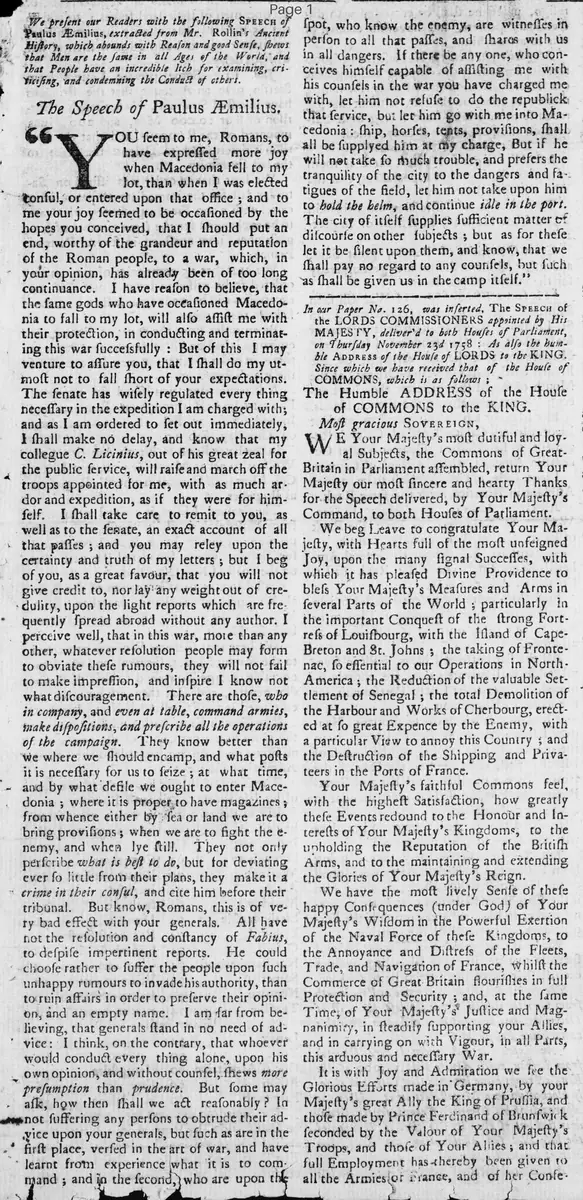
We present our Readers with the following Speech of Paulus Aemilius, extracted from Mr. Rollin's Ancient History, which abounds with Reason and good Sense, here that Men are the Same in all Ages of the World, and that People have an incredible Itch for examining, criticizing, and condemning the Conduct of others.
The Speech of Paulus Aemilius.
You seem to me, Romans, to have expressed more joy when Macedonia fell to my lot, than when I was elected consul, or entered upon that office; and to me your joy seemed to be occasioned by the hopes you conceived, that I should put an end, worthy of the grandeur and reputation of the Roman people, to a war, which, in your opinion, has already been of too long continuance. I have reason to believe, that the same gods who have occasioned Macedonia to fall to my lot, will also assist me with their protection, in conducting and terminating this war successfully: But of this I may venture to assure you, that I shall do my utmost not to fall short of your expectations.
The senate has wisely regulated every thing necessary in the expedition I am charged with; and as I am ordered to set out immediately; I shall make no delay, and know that my colleague C. Licinius, out of his great zeal for the public service, will raise and march off the troops appointed for me, with as much ardor and expedition, as if they were for himself. I shall take care to remit to you, as well as to the senate, an exact account of all that passes; and you may rely upon the certainty and truth of my letters; but I beg of you, as a great favour, that you will not give credit to, nor lay any weight out of credulity, upon the light reports which are frequently spread abroad without any author. I perceive well, that in this war, more than any other, whatever resolution people may form to obviate these rumours, they will not fail to make impression, and inspire I know not what discouragement. There are those, who in company, and even at table, command armies, make dispositions, and prescribe all the operations of the campaign. They know better than we where we should encamp, and what posts it is necessary for us to seize; at what time, and by what defile we ought to enter Macedonia; where it is proper to have magazines; from whence either by sea or land we are to bring provisions; when we are to fight the enemy, and when lie still. They not only prescribe what is best to do, but for deviating ever so little from their plans, they make it a crime in their consul, and cite him before their tribunal. But know, Romans, this is of very bad effect with your generals. All have not the resolution and constancy of Fabius, to despise impertinent reports. He could choose rather to suffer the people upon such unhappy rumours to invade his authority, than to ruin affairs in order to preserve their opinion, and an empty name. I am far from believing, that generals stand in no need of advice: I think, on the contrary, that whoever would conduct every thing alone, upon his own opinion, and without counsel, shews more presumption than prudence. But some may ask, how then shall we act reasonably? In not suffering any persons to obtrude their advice upon your generals, but such as are in the first place, versed in the art of war, and have learnt from experience what it is to command; and in the second, who are upon the spot, who know the enemy, are witnesses in person to all that passes, and shares with us in all dangers. If there be any one, who conceives himself capable of assisting me with his counsels in the war you have charged me with, let him not refuse to do the republic that service, but let him go with me into Macedonia: ship, horses, tents, provisions, shall all be supplied him at my charge. But if he will not take so much trouble, and prefers the tranquility of the city to the dangers and fatigues of the field, let him not take upon him to hold the helm, and continue idle in the port. The city of itself supplies sufficient matter of discourse on other subjects: but as for these let it be silent upon them, and know, that we shall pay no regard to any counsels, but such as shall be given us in the camp itself.
The Speech of Paulus Aemilius.
You seem to me, Romans, to have expressed more joy when Macedonia fell to my lot, than when I was elected consul, or entered upon that office; and to me your joy seemed to be occasioned by the hopes you conceived, that I should put an end, worthy of the grandeur and reputation of the Roman people, to a war, which, in your opinion, has already been of too long continuance. I have reason to believe, that the same gods who have occasioned Macedonia to fall to my lot, will also assist me with their protection, in conducting and terminating this war successfully: But of this I may venture to assure you, that I shall do my utmost not to fall short of your expectations.
The senate has wisely regulated every thing necessary in the expedition I am charged with; and as I am ordered to set out immediately; I shall make no delay, and know that my colleague C. Licinius, out of his great zeal for the public service, will raise and march off the troops appointed for me, with as much ardor and expedition, as if they were for himself. I shall take care to remit to you, as well as to the senate, an exact account of all that passes; and you may rely upon the certainty and truth of my letters; but I beg of you, as a great favour, that you will not give credit to, nor lay any weight out of credulity, upon the light reports which are frequently spread abroad without any author. I perceive well, that in this war, more than any other, whatever resolution people may form to obviate these rumours, they will not fail to make impression, and inspire I know not what discouragement. There are those, who in company, and even at table, command armies, make dispositions, and prescribe all the operations of the campaign. They know better than we where we should encamp, and what posts it is necessary for us to seize; at what time, and by what defile we ought to enter Macedonia; where it is proper to have magazines; from whence either by sea or land we are to bring provisions; when we are to fight the enemy, and when lie still. They not only prescribe what is best to do, but for deviating ever so little from their plans, they make it a crime in their consul, and cite him before their tribunal. But know, Romans, this is of very bad effect with your generals. All have not the resolution and constancy of Fabius, to despise impertinent reports. He could choose rather to suffer the people upon such unhappy rumours to invade his authority, than to ruin affairs in order to preserve their opinion, and an empty name. I am far from believing, that generals stand in no need of advice: I think, on the contrary, that whoever would conduct every thing alone, upon his own opinion, and without counsel, shews more presumption than prudence. But some may ask, how then shall we act reasonably? In not suffering any persons to obtrude their advice upon your generals, but such as are in the first place, versed in the art of war, and have learnt from experience what it is to command; and in the second, who are upon the spot, who know the enemy, are witnesses in person to all that passes, and shares with us in all dangers. If there be any one, who conceives himself capable of assisting me with his counsels in the war you have charged me with, let him not refuse to do the republic that service, but let him go with me into Macedonia: ship, horses, tents, provisions, shall all be supplied him at my charge. But if he will not take so much trouble, and prefers the tranquility of the city to the dangers and fatigues of the field, let him not take upon him to hold the helm, and continue idle in the port. The city of itself supplies sufficient matter of discourse on other subjects: but as for these let it be silent upon them, and know, that we shall pay no regard to any counsels, but such as shall be given us in the camp itself.
What sub-type of article is it?
Essay
What themes does it cover?
Political
War Peace
Moral Virtue
What keywords are associated?
Roman Speech
Macedonia War
Public Criticism
Military Advice
Roman Generals
What entities or persons were involved?
Paulus Aemilius, Extracted From Mr. Rollin's Ancient History
Literary Details
Title
The Speech Of Paulus Aemilius
Author
Paulus Aemilius, Extracted From Mr. Rollin's Ancient History
Subject
Address To Romans Before Expedition To Macedonia
Key Lines
You Seem To Me, Romans, To Have Expressed More Joy When Macedonia Fell To My Lot, Than When I Was Elected Consul, Or Entered Upon That Office;
There Are Those, Who In Company, And Even At Table, Command Armies, Make Dispositions, And Prescribe All The Operations Of The Campaign.
But Know, Romans, This Is Of Very Bad Effect With Your Generals.
I Am Far From Believing, That Generals Stand In No Need Of Advice: I Think, On The Contrary, That Whoever Would Conduct Every Thing Alone, Upon His Own Opinion, And Without Counsel, Shews More Presumption Than Prudence.
The City Of Itself Supplies Sufficient Matter Of Discourse On Other Subjects: But As For These Let It Be Silent Upon Them, And Know, That We Shall Pay No Regard To Any Counsels, But Such As Shall Be Given Us In The Camp Itself.