Thank you for visiting SNEWPapers!
Sign up free
Editorial
October 5, 1954
Atlanta Daily World
Atlanta, Fulton County, Georgia
What is this article about?
Gordon B. Hancock reverses his stance to support subsidizing college athletes, arguing benefits to education and society outweigh harms from a few failures, citing examples like Duke Slater and institutions like Harvard.
Clipping
OCR Quality
95%
Excellent
Full Text
Between The Lines
BY GORDON B. HANCOCK
PAID FOOTBALL PLAYERS
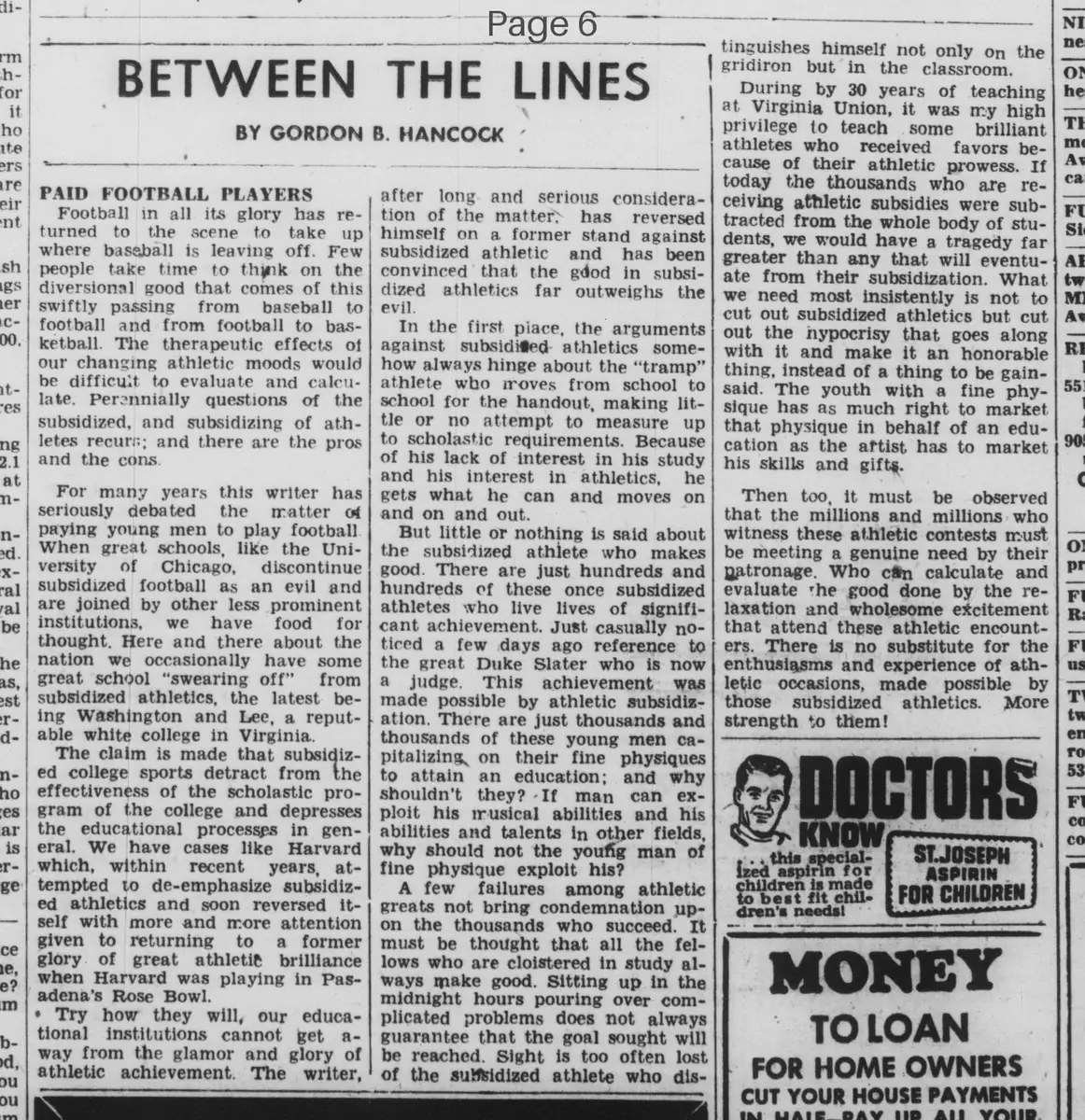
Football in all its glory has returned to the scene to take up where baseball is leaving off. Few people take time to think on the diversionary good that comes of this swiftly passing from baseball to football and from football to basketball. The therapeutic effects of our changing athletic moods would be difficult to evaluate and calculate. Perennially questions of the subsidized and subsidizing of athletes recur; and there are the pros and the cons
For many years this writer has seriously debated the matter of paying young men to play football. When great schools like the University of Chicago discontinue subsidized football as an evil and are joined by other less prominent institutions, we have food for thought. Here and there about the nation we occasionally have some great school "swearing off" from subsidized athletics, the latest being Washington and Lee, a reputable white college in Virginia.
The claim is made that subsidized college sports detract from the effectiveness of the scholastic program of the college and depresses the educational processes in general. We have cases like Harvard which, within recent years, attempted to de-emphasize subsidized athletics and soon reversed itself with more and more attention given to returning to a former glory of great athletic brilliance when Harvard was playing in Pasadena's Rose Bowl.
Try how they will, our educational institutions cannot get away from the glamor and glory of athletic achievement. The writer, after long and serious consideration of the matter, has reversed himself on a former stand against subsidized athletics and has been convinced that the good in subsidized athletics far outweighs the evil.
In the first place, the arguments against subsidized athletics somehow always hinge about the "tramp" athlete who moves from school to school for the handout, making little or no attempt to measure up to scholastic requirements. Because of his lack of interest in his study and his interest in athletics, he gets what he can and moves on and on and out.
But little or nothing is said about the subsidized athlete who makes good. There are just hundreds and hundreds of these once subsidized athletes who live lives of significant achievement. Just casually noticed a few days ago reference to the great Duke Slater who is now a judge. This achievement was made possible by athletic subsidization. There are just thousands and thousands of these young men capitalizing on their fine physiques to attain an education; and why shouldn't they? If man can exploit his musical abilities and his abilities and talents in other fields, why should not the young man of fine physique exploit his?
A few failures among athletic greats not bring condemnation upon the thousands who succeed. It must be thought that all the fellows who are cloistered in study always make good. Sitting up in the midnight hours pouring over complicated problems does not always guarantee that the goal sought will be reached. Sight is too often lost of the subsidized athlete who distinguishes himself not only on the gridiron but in the classroom.
During my 30 years of teaching at Virginia Union, it was my high privilege to teach some brilliant athletes who received favors because of their athletic prowess. If today the thousands who are receiving athletic subsidies were subtracted from the whole body of students, we would have a tragedy far greater than any that will eventuate from their subsidization. What we need most insistently is not to cut out subsidized athletics but cut out the hypocrisy that goes along with it and make it an honorable thing, instead of a thing to be gainsaid. The youth with a fine physique has as much right to market that physique in behalf of an education as the artist has to market his skills and gifts.
Then too, it must be observed that the millions and millions who witness these athletic contests must be meeting a genuine need by their patronage. Who can calculate and evaluate the good done by the relaxation and wholesome excitement that attend these athletic encounters. There is no substitute for the enthusiasms and experience of athletic occasions, made possible by those subsidized athletics. More strength to them!
BY GORDON B. HANCOCK
PAID FOOTBALL PLAYERS
Football in all its glory has returned to the scene to take up where baseball is leaving off. Few people take time to think on the diversionary good that comes of this swiftly passing from baseball to football and from football to basketball. The therapeutic effects of our changing athletic moods would be difficult to evaluate and calculate. Perennially questions of the subsidized and subsidizing of athletes recur; and there are the pros and the cons
For many years this writer has seriously debated the matter of paying young men to play football. When great schools like the University of Chicago discontinue subsidized football as an evil and are joined by other less prominent institutions, we have food for thought. Here and there about the nation we occasionally have some great school "swearing off" from subsidized athletics, the latest being Washington and Lee, a reputable white college in Virginia.
The claim is made that subsidized college sports detract from the effectiveness of the scholastic program of the college and depresses the educational processes in general. We have cases like Harvard which, within recent years, attempted to de-emphasize subsidized athletics and soon reversed itself with more and more attention given to returning to a former glory of great athletic brilliance when Harvard was playing in Pasadena's Rose Bowl.
Try how they will, our educational institutions cannot get away from the glamor and glory of athletic achievement. The writer, after long and serious consideration of the matter, has reversed himself on a former stand against subsidized athletics and has been convinced that the good in subsidized athletics far outweighs the evil.
In the first place, the arguments against subsidized athletics somehow always hinge about the "tramp" athlete who moves from school to school for the handout, making little or no attempt to measure up to scholastic requirements. Because of his lack of interest in his study and his interest in athletics, he gets what he can and moves on and on and out.
But little or nothing is said about the subsidized athlete who makes good. There are just hundreds and hundreds of these once subsidized athletes who live lives of significant achievement. Just casually noticed a few days ago reference to the great Duke Slater who is now a judge. This achievement was made possible by athletic subsidization. There are just thousands and thousands of these young men capitalizing on their fine physiques to attain an education; and why shouldn't they? If man can exploit his musical abilities and his abilities and talents in other fields, why should not the young man of fine physique exploit his?
A few failures among athletic greats not bring condemnation upon the thousands who succeed. It must be thought that all the fellows who are cloistered in study always make good. Sitting up in the midnight hours pouring over complicated problems does not always guarantee that the goal sought will be reached. Sight is too often lost of the subsidized athlete who distinguishes himself not only on the gridiron but in the classroom.
During my 30 years of teaching at Virginia Union, it was my high privilege to teach some brilliant athletes who received favors because of their athletic prowess. If today the thousands who are receiving athletic subsidies were subtracted from the whole body of students, we would have a tragedy far greater than any that will eventuate from their subsidization. What we need most insistently is not to cut out subsidized athletics but cut out the hypocrisy that goes along with it and make it an honorable thing, instead of a thing to be gainsaid. The youth with a fine physique has as much right to market that physique in behalf of an education as the artist has to market his skills and gifts.
Then too, it must be observed that the millions and millions who witness these athletic contests must be meeting a genuine need by their patronage. Who can calculate and evaluate the good done by the relaxation and wholesome excitement that attend these athletic encounters. There is no substitute for the enthusiasms and experience of athletic occasions, made possible by those subsidized athletics. More strength to them!
What sub-type of article is it?
Education
What keywords are associated?
Subsidized Athletics
College Football
Educational Benefits
Athlete Success
Sports Subsidization
What entities or persons were involved?
University Of Chicago
Washington And Lee
Harvard
Duke Slater
Virginia Union
Editorial Details
Primary Topic
Support For Subsidized College Athletics
Stance / Tone
Supportive Reversal In Favor Of Subsidized Athletics
Key Figures
University Of Chicago
Washington And Lee
Harvard
Duke Slater
Virginia Union
Key Arguments
Subsidized Athletics Provide Diversion And Therapeutic Effects
Arguments Against Focus On 'Tramp' Athletes But Ignore Successful Ones
Many Subsidized Athletes Achieve Significant Lives And Education
Athletes Should Exploit Physique Like Artists Exploit Talents
Few Failures Do Not Condemn The System
Subsidized Athletes Often Excel In Classroom Too
Removing Subsidies Would Cause Greater Tragedy
Need To End Hypocrisy And Honor Subsidized Athletics
Public Patronage Meets Genuine Needs For Relaxation And Excitement