Thank you for visiting SNEWPapers!
Sign up free
Literary
November 24, 1939
Glacier County Chief
Browning, Glacier County, Montana
What is this article about?
In colonial India, Captain Norwood surveys a disputed diamond mine in Kadur amid temple-priest and maharajah tensions. His servant O'Leary spies for information. Norwood glimpses a beautiful young woman in a zenana carriage, possibly a visiting princess. Meanwhile, American widow Mrs. Deborah Harding and niece explore ruins, encounter a cobra, and are rescued by Prince Rundhia.
Clipping
OCR Quality
95%
Excellent
Full Text
EAST AND WEST
BY TALBOT MUNDY
SYNOPSIS
Captain Carl Norwood has been sent from his native England to the Kadur River district in India, along with his indispensable manservant, Moses O'Leary, soldier of fortune. Norwood's job is to survey the district to determine whether a valuable secret diamond mine belongs to the temple priests or to the ruler, the Maharajah of Kadur.
CHAPTER I—Continued
Noor Mahlam chuckled. It was like the gurgle of dirty water and it swallowed the silk of his voice. Even his gesture changed. He became as hoarse as an auctioneer encouraging a doubtful bidder:
"Sahib, there is newness at the palace such as never before was! There is a godsend in the guest-house. She has money, and a niece worth more than money. Oh, such loveliness! And oh, such ill-temper! The aunt is never satisfied unless she is humiliating someone. She humiliates even His Highness. And the niece is never happy unless she can be as kind as her aunt is cruel."
"Why are they there?" asked O'Leary.
"It is a mystery. Nobody knows."
"Who wants to know?"
"Ah, sahib, you must not ask what I may not tell you."
"I'll bet a month's pay," said O'Leary, "that the temple Brahmins have sent out a call for information."
"Would it make any difference to you, Mr. O'Leary, where the two hundred rupees came from, supposing you had it?"
"Two fifty might tempt me. I'd think it over."
"Even that price might not be too high for exact information as to why Captain Norwood is in Kadur; and also why Mrs. Harding and Miss Lynn Harding are here at the same time. There is some connection. What is it?"
"I'll find out," said O'Leary.
"And you will sell me the information?"
"I'll think it over. If I can't find a higher bidder, maybe you and I can do business. You'd better watch out for me. I'll take a stroll through the bazaar later on."
"Very well, Mr. O'Leary. My office is—"
"What do I care where your office is. D'you think I'd let myself be seen calling on you? You keep a dekko lifting. You've plenty o' spies. Find out where I go, and follow, and bring your money with you. Three hundred."
"But sahib, we agreed to—"
"I said three hundred. You'd better go before I'm seen talking to you. Captain Norwood might be back any minute. If he should ask me who you are I'd have to tell him, and it wouldn't sound nice. Him and me never lie to each other."
CHAPTER II
Captain Carl Norwood was in nothing yet that he or anyone could recognize as trouble. On horseback, followed by a mounted native orderly, he was entering the ancient gate of Kadur City. A good-looking fellow, young to be a Captain of Royal Engineers. He looked more like a cavalryman. Inside the city gates, there was a stinking herd of loaded camels. They blocked the street. Norwood's horse that wasn't used to camels went into a panic. When he had calmed the horse he dismounted, gave the reins to the orderly, and told him to let the horse get used to the smell of camels and follow as soon as the camels were out of the way. He wanted to stretch his legs anyhow. It was only a mile walk to the Residency, on the far side of the city. The swarming streets were interesting, just before sunset, with the night life just beginning.
The Residency stood in a vast compound amid neem trees. Guard-house—flagpole—Union Jack. The Residency guard of native Indian infantry was turning out to pay the customary honors to the flag at sunset. The Resident was on the front steps, middle-aged and military looking. Norwood had to wait until the brief ceremony was over. His reception was not cordial. The invitation to dinner was perfunctory, so phrased that it was easy to refuse.
"I'm tired, sir. Long march. I would like to turn in early."
"Very well, Captain Norwood. Don't let me inconvenience you. I was informed, of course, that you were coming. Can't say that I approve of this survey of the Kadur River. The priests will resent it bitterly. There may be trouble enough as it is over the temple boundary dispute. The Maharajah claims ownership of certain buildings, beneath which it has been an open secret for centuries that the priests have a diamond mine."
"That's why I'm here, sir. I was told that Prince Rundhia started the argument."
"Yes, he's heir to the throne. He tried to start it in the Maharajah's name, but it was Rundhia's idea
The Maharajah is a quiet old gentleman, thank heaven. No initiative. Satisfied to let things take their course. I believe the quarrel would settle itself, if we would let it alone. The diamond mine is one of those open secrets that do no harm until they're aired by busybodies. The arrangement has worked perfectly well all these years. The priests don't win many diamonds from the mine. Sometimes years go by without their finding any stones worth putting on the market. But they make an occasional find. They turn over a certain percentage to the Maharajah, and sell the remainder for temple revenue.
"Yes. There's a rumor the mine is dangerous."
"Good God, man! They don't let anyone near the mine—not even the Maharajah!"
"Provision has been made for that, sir."
The Resident squirmed.
"Well, take care that your—" he selected a word; he used it tartly: "—spies don't make trouble."
Norwood returned to the city. The new street lights had been turned on. There was a swarm of homing traffic—bullock carts, camels, droves of pedestrians, scandalously noisy and decrepit autos. Norwood stood on a sort of traffic island in mid-street—an oasis of palms with an ancient fountain and one big glaring arc-light. He could see the orderly bringing the horses; he might just as well wait for them.
Threading its way through the traffic in the direction of the palace, there came one of those old-fashioned carriages in which zenana ladies take the air. It was magnificently horsed. Two mounted men rode ahead to clear the way, and they were followed by two runners armed with sticks. Two men in splendid livery on the box. Two footmen on a platform behind the carriage. Two more horsemen bringing up the rear.
As the carriage drew near Norwood, a terrifically noisy truck frightened the horses. Almost at the same moment, two elephants loomed into view from a side street. The horses plunged. The driver had hard work to control them. The carriage swayed violently. The right front wheel struck the curb, close to Norwood. The shock jerked open the door. The electric arc-light shone in, revealing the occupants. The coachman reined the horses to a standstill, shouting to the footmen to seize their heads.
Diamonds, pearls, zephyry silken saris of the hue of Himalayan dawn. Two women. The older, stout one raised a fan to hide her face. It was the other who held Norwood spellbound.
She was young. She was full of laughter. She had mocking, excitable, generous eyes that looked wild to lose their innocence and revel in what shouldn't be, but is, and is amusing. She saw no evil, only humor in being stared at by a man who shouldn't see her, and hadn't expected to. Indian zenana ladies are supposed to shrink from men's eyes. Hers met Norwood's full, and full of laughter.
Norwood, of course, recovered self-possession. He was in uniform, so he saluted. He was about to speak; he had thought of a properly gallant remark that would sound almost like a quotation from the "Arabian Nights," when the palace servants took the situation in hand. The driver recovered command of his horses. The carriage moved on. The footmen jumped up behind. Norwood was left wondering He had had a vision. He had never seen such a beautiful girl.
The older, stouter woman, who had used the fan to hide her face, should be the Maharanee of Kadur. But Norwood knew she was childless; otherwise Prince Rundhia, the Maharajah's nephew, would not be heir to the throne. The ladies of Kadur have black, not golden hair.
so the younger girl could hardly be a relative. She might be a princess on a visit from some northern Indian State.
The blood-red sunrays confused her vision. She was one of those people who always believe what they see but nothing that they don't see. She saw a cobra. She did not see that the stone, on which she set her foot, was loose, curved on its under side and resting insecurely on a flat rock. So she twisted her ankle and sat down hard. It jolted every bone in her corpulent body. Two hundred and eight pounds of widow with bankers' references and one hundred per cent opinions, can sit down harder than a crate of groceries.
"I never saw such people—such a country. I have travelled all around the world from America. I have visited numbers of countries. I have not seen your equals anywhere for inefficiency and lack of human intelligence. What shall I do now? I am in pain. Have you no ideas? Can't you suggest something?"
One of them mounted the pony and cantered away for assistance.
Mrs. Deborah Harding sat fanning herself and making impotently harsh remarks about the swarms of flies that were looking for a last, lazy meal before going to sleep.
The cantering servant drew rein at an outlying police thana and, after a heatedly uncomplimentary debate with the policeman in charge, phoned the palace. The Maharanee was out. It entered no one's head to consult the Maharajah; it was his hour of the day to study postage stamps, so he was incommunicado, except to the physician who should bring him his evening tonic. However. Prince Rundhia had returned that afternoon, from a visit to Delhi. Someone phoned him. Things happened.
There are two palaces. Rundhia's it separated from the Maharajah's only by a high wall and two widths of glorious garden. Rundhia's imported patent automatic garage-door swung open. His imported ex-Czarist chauffeur whirled a Rolls-Royce to the front door. Rundhia took the wheel. They opened the front gate just in time. Another split second and he would have crashed it, sacked the lot of them, and bummed a new car from his aunt.
There was a whirl of dust, a din of tooting. Headlights flooded the narrow roads with blinding glare. Three dogs and some belated chickens died the death. Three villages gasped and called on thirty gods to witness their piety. Rundhia rammed on the brakes and got out of the car to bow to Mrs. Harding just as calmly, as blandly, as amusedly courteous as if he were entering her drawing room.
"Well, I am glad to see you," said Mrs. Deborah Harding. "I don't know who you are, but—"
"Prince Rundhia, your host's nephew."
"How d'you do. You took your own time, didn't you? I had begun to think no one was coming."
The garden guesthouse was a copy of a cottage at Juan les Pins. It had been Rundhia's idea. The Prince had persuaded his aunt the Maharanee to go thoroughly modern for once. The Maharanee almost worshiped Rundhia, but she had compelled him to return from Europe by cutting off the supplies of cash. She wanted him to learn to be fit for the throne. But Rundhia was always threatening to go to Europe again unless she made things tolerable; so she had to make good his gambling losses and to humor his whims.
No one had stayed at the guesthouse until Mrs. Deborah Harding heard about it during her tour of India. She knew exactly how to contrive invitations. She considered she conferred a favor on the rulers of Kadur by accepting their hospitality for herself and her niece.
It was close on sunset. Mrs. Deborah Harding's goggles were dusty. She looked like authority. She had authoritative gestures, and a notebook. She was being an authority on ruins.
Two palace servants danced attendance on her, doing their obsequious utmost to prevent calamity.
"Sahiba! Not good! Much too many cobra—kerait—scorpions—too bad. Come, look this way. Plenty ruins this way."
But Mrs. Deborah Harding wasn't in the habit of taking the advice of anyone less than a Supreme Court Justice; nor would she hesitate to question that if it didn't agree with her own convictions. She was dynamic, opulent, willful dignity personified. As honorary special correspondent to The Woman Citizen, of Aaronville, Clarendon County, Ohio, she was wearing leggings, a short skirt, and a wide pith helmet, with goggles, and with a camera suspended somehow from her portly figure, prodded ruins with the ferrule of a green silk sunshade.
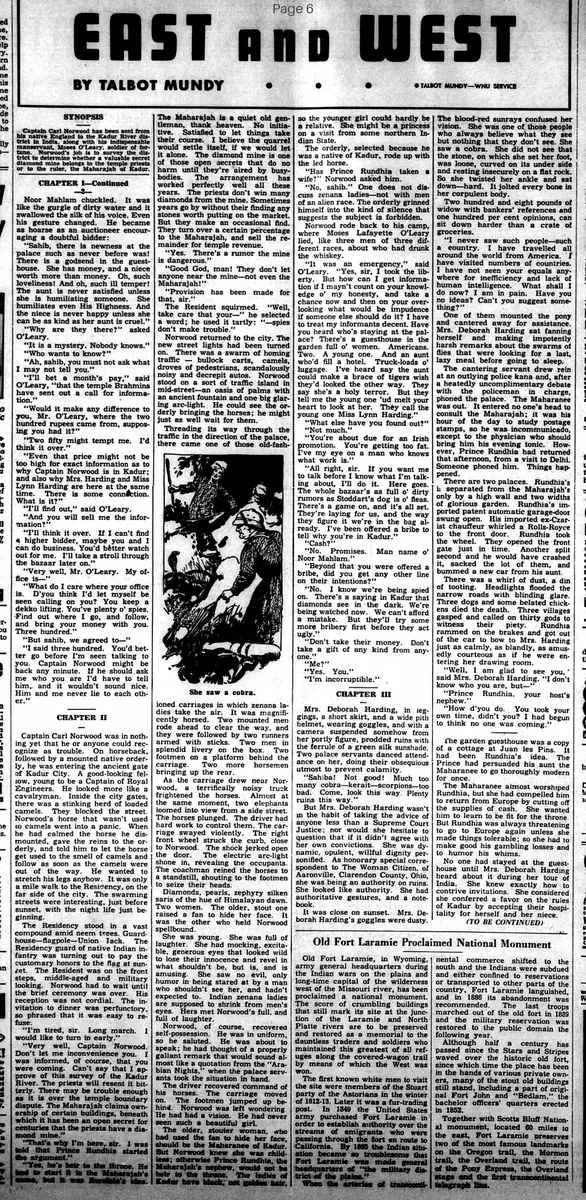
(SHE SAW A COBRA)
"Prince Rundhia. your host's nephew."
Mrs. Deborah Harding, in leggings, a short skirt, and a wide pith helmet, wearing goggles, and with a camera suspended somehow from her portly figure, prodded ruins with the ferrule of a green silk sunshade.
Two palace servants danced attendance on her, doing their obsequious utmost to prevent calamity.
"Sahiba! Not good! Much too many cobra—kerait—scorpions—too bad. Come, look this way. Plenty ruins this way."
But Mrs. Deborah Harding wasn't in the habit of taking the advice of anyone less than a Supreme Court Justice; nor would she hesitate to question that if it didn't agree with her own convictions. She was dynamic, opulent, willful dignity personified. As honorary special correspondent to The Woman Citizen, of Aaronville, Clarendon County, Ohio, she was wearing leggings, a short skirt, and a wide pith helmet, with goggles, and with a camera suspended somehow from her portly figure, prodded ruins with the ferrule of a green silk sunshade.
(TO BE CONTINUED)
BY TALBOT MUNDY
SYNOPSIS
Captain Carl Norwood has been sent from his native England to the Kadur River district in India, along with his indispensable manservant, Moses O'Leary, soldier of fortune. Norwood's job is to survey the district to determine whether a valuable secret diamond mine belongs to the temple priests or to the ruler, the Maharajah of Kadur.
CHAPTER I—Continued
Noor Mahlam chuckled. It was like the gurgle of dirty water and it swallowed the silk of his voice. Even his gesture changed. He became as hoarse as an auctioneer encouraging a doubtful bidder:
"Sahib, there is newness at the palace such as never before was! There is a godsend in the guest-house. She has money, and a niece worth more than money. Oh, such loveliness! And oh, such ill-temper! The aunt is never satisfied unless she is humiliating someone. She humiliates even His Highness. And the niece is never happy unless she can be as kind as her aunt is cruel."
"Why are they there?" asked O'Leary.
"It is a mystery. Nobody knows."
"Who wants to know?"
"Ah, sahib, you must not ask what I may not tell you."
"I'll bet a month's pay," said O'Leary, "that the temple Brahmins have sent out a call for information."
"Would it make any difference to you, Mr. O'Leary, where the two hundred rupees came from, supposing you had it?"
"Two fifty might tempt me. I'd think it over."
"Even that price might not be too high for exact information as to why Captain Norwood is in Kadur; and also why Mrs. Harding and Miss Lynn Harding are here at the same time. There is some connection. What is it?"
"I'll find out," said O'Leary.
"And you will sell me the information?"
"I'll think it over. If I can't find a higher bidder, maybe you and I can do business. You'd better watch out for me. I'll take a stroll through the bazaar later on."
"Very well, Mr. O'Leary. My office is—"
"What do I care where your office is. D'you think I'd let myself be seen calling on you? You keep a dekko lifting. You've plenty o' spies. Find out where I go, and follow, and bring your money with you. Three hundred."
"But sahib, we agreed to—"
"I said three hundred. You'd better go before I'm seen talking to you. Captain Norwood might be back any minute. If he should ask me who you are I'd have to tell him, and it wouldn't sound nice. Him and me never lie to each other."
CHAPTER II
Captain Carl Norwood was in nothing yet that he or anyone could recognize as trouble. On horseback, followed by a mounted native orderly, he was entering the ancient gate of Kadur City. A good-looking fellow, young to be a Captain of Royal Engineers. He looked more like a cavalryman. Inside the city gates, there was a stinking herd of loaded camels. They blocked the street. Norwood's horse that wasn't used to camels went into a panic. When he had calmed the horse he dismounted, gave the reins to the orderly, and told him to let the horse get used to the smell of camels and follow as soon as the camels were out of the way. He wanted to stretch his legs anyhow. It was only a mile walk to the Residency, on the far side of the city. The swarming streets were interesting, just before sunset, with the night life just beginning.
The Residency stood in a vast compound amid neem trees. Guard-house—flagpole—Union Jack. The Residency guard of native Indian infantry was turning out to pay the customary honors to the flag at sunset. The Resident was on the front steps, middle-aged and military looking. Norwood had to wait until the brief ceremony was over. His reception was not cordial. The invitation to dinner was perfunctory, so phrased that it was easy to refuse.
"I'm tired, sir. Long march. I would like to turn in early."
"Very well, Captain Norwood. Don't let me inconvenience you. I was informed, of course, that you were coming. Can't say that I approve of this survey of the Kadur River. The priests will resent it bitterly. There may be trouble enough as it is over the temple boundary dispute. The Maharajah claims ownership of certain buildings, beneath which it has been an open secret for centuries that the priests have a diamond mine."
"That's why I'm here, sir. I was told that Prince Rundhia started the argument."
"Yes, he's heir to the throne. He tried to start it in the Maharajah's name, but it was Rundhia's idea
The Maharajah is a quiet old gentleman, thank heaven. No initiative. Satisfied to let things take their course. I believe the quarrel would settle itself, if we would let it alone. The diamond mine is one of those open secrets that do no harm until they're aired by busybodies. The arrangement has worked perfectly well all these years. The priests don't win many diamonds from the mine. Sometimes years go by without their finding any stones worth putting on the market. But they make an occasional find. They turn over a certain percentage to the Maharajah, and sell the remainder for temple revenue.
"Yes. There's a rumor the mine is dangerous."
"Good God, man! They don't let anyone near the mine—not even the Maharajah!"
"Provision has been made for that, sir."
The Resident squirmed.
"Well, take care that your—" he selected a word; he used it tartly: "—spies don't make trouble."
Norwood returned to the city. The new street lights had been turned on. There was a swarm of homing traffic—bullock carts, camels, droves of pedestrians, scandalously noisy and decrepit autos. Norwood stood on a sort of traffic island in mid-street—an oasis of palms with an ancient fountain and one big glaring arc-light. He could see the orderly bringing the horses; he might just as well wait for them.
Threading its way through the traffic in the direction of the palace, there came one of those old-fashioned carriages in which zenana ladies take the air. It was magnificently horsed. Two mounted men rode ahead to clear the way, and they were followed by two runners armed with sticks. Two men in splendid livery on the box. Two footmen on a platform behind the carriage. Two more horsemen bringing up the rear.
As the carriage drew near Norwood, a terrifically noisy truck frightened the horses. Almost at the same moment, two elephants loomed into view from a side street. The horses plunged. The driver had hard work to control them. The carriage swayed violently. The right front wheel struck the curb, close to Norwood. The shock jerked open the door. The electric arc-light shone in, revealing the occupants. The coachman reined the horses to a standstill, shouting to the footmen to seize their heads.
Diamonds, pearls, zephyry silken saris of the hue of Himalayan dawn. Two women. The older, stout one raised a fan to hide her face. It was the other who held Norwood spellbound.
She was young. She was full of laughter. She had mocking, excitable, generous eyes that looked wild to lose their innocence and revel in what shouldn't be, but is, and is amusing. She saw no evil, only humor in being stared at by a man who shouldn't see her, and hadn't expected to. Indian zenana ladies are supposed to shrink from men's eyes. Hers met Norwood's full, and full of laughter.
Norwood, of course, recovered self-possession. He was in uniform, so he saluted. He was about to speak; he had thought of a properly gallant remark that would sound almost like a quotation from the "Arabian Nights," when the palace servants took the situation in hand. The driver recovered command of his horses. The carriage moved on. The footmen jumped up behind. Norwood was left wondering He had had a vision. He had never seen such a beautiful girl.
The older, stouter woman, who had used the fan to hide her face, should be the Maharanee of Kadur. But Norwood knew she was childless; otherwise Prince Rundhia, the Maharajah's nephew, would not be heir to the throne. The ladies of Kadur have black, not golden hair.
so the younger girl could hardly be a relative. She might be a princess on a visit from some northern Indian State.
The blood-red sunrays confused her vision. She was one of those people who always believe what they see but nothing that they don't see. She saw a cobra. She did not see that the stone, on which she set her foot, was loose, curved on its under side and resting insecurely on a flat rock. So she twisted her ankle and sat down hard. It jolted every bone in her corpulent body. Two hundred and eight pounds of widow with bankers' references and one hundred per cent opinions, can sit down harder than a crate of groceries.
"I never saw such people—such a country. I have travelled all around the world from America. I have visited numbers of countries. I have not seen your equals anywhere for inefficiency and lack of human intelligence. What shall I do now? I am in pain. Have you no ideas? Can't you suggest something?"
One of them mounted the pony and cantered away for assistance.
Mrs. Deborah Harding sat fanning herself and making impotently harsh remarks about the swarms of flies that were looking for a last, lazy meal before going to sleep.
The cantering servant drew rein at an outlying police thana and, after a heatedly uncomplimentary debate with the policeman in charge, phoned the palace. The Maharanee was out. It entered no one's head to consult the Maharajah; it was his hour of the day to study postage stamps, so he was incommunicado, except to the physician who should bring him his evening tonic. However. Prince Rundhia had returned that afternoon, from a visit to Delhi. Someone phoned him. Things happened.
There are two palaces. Rundhia's it separated from the Maharajah's only by a high wall and two widths of glorious garden. Rundhia's imported patent automatic garage-door swung open. His imported ex-Czarist chauffeur whirled a Rolls-Royce to the front door. Rundhia took the wheel. They opened the front gate just in time. Another split second and he would have crashed it, sacked the lot of them, and bummed a new car from his aunt.
There was a whirl of dust, a din of tooting. Headlights flooded the narrow roads with blinding glare. Three dogs and some belated chickens died the death. Three villages gasped and called on thirty gods to witness their piety. Rundhia rammed on the brakes and got out of the car to bow to Mrs. Harding just as calmly, as blandly, as amusedly courteous as if he were entering her drawing room.
"Well, I am glad to see you," said Mrs. Deborah Harding. "I don't know who you are, but—"
"Prince Rundhia, your host's nephew."
"How d'you do. You took your own time, didn't you? I had begun to think no one was coming."
The garden guesthouse was a copy of a cottage at Juan les Pins. It had been Rundhia's idea. The Prince had persuaded his aunt the Maharanee to go thoroughly modern for once. The Maharanee almost worshiped Rundhia, but she had compelled him to return from Europe by cutting off the supplies of cash. She wanted him to learn to be fit for the throne. But Rundhia was always threatening to go to Europe again unless she made things tolerable; so she had to make good his gambling losses and to humor his whims.
No one had stayed at the guesthouse until Mrs. Deborah Harding heard about it during her tour of India. She knew exactly how to contrive invitations. She considered she conferred a favor on the rulers of Kadur by accepting their hospitality for herself and her niece.
It was close on sunset. Mrs. Deborah Harding's goggles were dusty. She looked like authority. She had authoritative gestures, and a notebook. She was being an authority on ruins.
Two palace servants danced attendance on her, doing their obsequious utmost to prevent calamity.
"Sahiba! Not good! Much too many cobra—kerait—scorpions—too bad. Come, look this way. Plenty ruins this way."
But Mrs. Deborah Harding wasn't in the habit of taking the advice of anyone less than a Supreme Court Justice; nor would she hesitate to question that if it didn't agree with her own convictions. She was dynamic, opulent, willful dignity personified. As honorary special correspondent to The Woman Citizen, of Aaronville, Clarendon County, Ohio, she was wearing leggings, a short skirt, and a wide pith helmet, with goggles, and with a camera suspended somehow from her portly figure, prodded ruins with the ferrule of a green silk sunshade.
(SHE SAW A COBRA)
"Prince Rundhia. your host's nephew."
Mrs. Deborah Harding, in leggings, a short skirt, and a wide pith helmet, wearing goggles, and with a camera suspended somehow from her portly figure, prodded ruins with the ferrule of a green silk sunshade.
Two palace servants danced attendance on her, doing their obsequious utmost to prevent calamity.
"Sahiba! Not good! Much too many cobra—kerait—scorpions—too bad. Come, look this way. Plenty ruins this way."
But Mrs. Deborah Harding wasn't in the habit of taking the advice of anyone less than a Supreme Court Justice; nor would she hesitate to question that if it didn't agree with her own convictions. She was dynamic, opulent, willful dignity personified. As honorary special correspondent to The Woman Citizen, of Aaronville, Clarendon County, Ohio, she was wearing leggings, a short skirt, and a wide pith helmet, with goggles, and with a camera suspended somehow from her portly figure, prodded ruins with the ferrule of a green silk sunshade.
(TO BE CONTINUED)
What sub-type of article is it?
Prose Fiction
What themes does it cover?
Political
Commerce Trade
What keywords are associated?
India
Diamond Mine
Colonial Survey
Intrigue
American Tourists
Prince Rundhia
Kadur Palace
What entities or persons were involved?
Talbot Mundy
Literary Details
Title
East And West
Author
Talbot Mundy
Subject
Diamond Mine Dispute In Kadur, India
Key Lines
"Sahib, There Is Newness At The Palace Such As Never Before Was! There Is A Godsend In The Guest House. She Has Money, And A Niece Worth More Than Money. Oh, Such Loveliness! And Oh, Such Ill Temper!"
She Was Young. She Was Full Of Laughter. She Had Mocking, Excitable, Generous Eyes That Looked Wild To Lose Their Innocence And Revel In What Shouldn't Be, But Is, And Is Amusing.
"I Never Saw Such People—Such A Country. I Have Travelled All Around The World From America. I Have Visited Numbers Of Countries. I Have Not Seen Your Equals Anywhere For Inefficiency And Lack Of Human Intelligence."