Thank you for visiting SNEWPapers!
Sign up free
The Virginia Gazette
Richmond, Williamsburg, Richmond County, Virginia
What is this article about?
An anonymous letter critiques Rev. Thomas Gwatkin's defense of a protest against an American Episcopate in colonial Virginia, refuting claims of jurisdictional overreach, attacks on religious liberty, and potential unrest, while citing historical commissions and precedents for episcopal authority over clergy.
Merged-components note: These two components form a single continuous letter to the editor spanning pages 2 and 3, with sequential reading orders and text that directly continues from one to the next.
Clippings
1 of 2
OCR Quality
Full Text
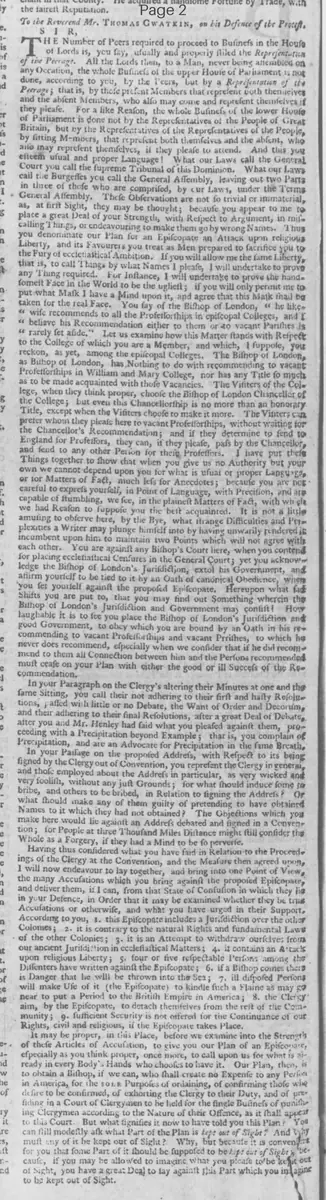
SIR,
The Number of Peers required to proceed to Business in the House of Lords is, you say, usually and properly styled the Representation of the Peerage. All the Lords then, to a Man, never being assembled on any Occasion, the whole Business of the upper House of Parliament is not done, according to you, by the Peers, but by a Representation of the Peerage; that is, by those present Members that represent both themselves and the absent Members, who also may come and represent themselves if they please. For a like Reason, the whole Business of the lower House of Parliament is done not by the Representatives of the People of Great Britain, but by the Representatives of the Representatives of the People, by sitting Members, that represent both themselves and the absent, who also may represent themselves, if they please to attend. And this you esteem usual and proper Language! What our Laws call the General Court you call the supreme Tribunal of this Dominion. What our Laws call the Burgesses you call the General Assembly, leaving out two Parts in those who are comprised, by our Laws, under the Terms General Assembly. These Observations are not so trivial or immaterial, as, at first Sight, they may be thought; because you appear to me to place a great Deal of your Strength, with Respect to Argument, in mis-calling Things, or endeavouring to make them go by wrong Names. Thus you denominate our Plan for an Episcopate an Attack upon religious Liberty, and its Favourers you treat as Men prepared to sacrifice you to the Fury of ecclesiastical Ambition. If you will allow me the same Liberty, that is, to call Things by what Names I please, I will undertake to prove any Thing required. For Instance, I will undertake to prove the handsomest Face in the World to be the ugliest; if you will only permit me to put what Mask I have a Mind upon it, and agree that this Mask shall be taken for the real Face. You say of the Bishop of London, "he likewise recommends to all the Professorships in episcopal Colleges, and I believe his Recommendation either to them or to vacant Parishes is rarely set aside." Let us examine how this Matter stands with Respect to the College of which you are a Member, and which, I suppose, you reckon, as yet, among the episcopal Colleges. The Bishop of London, as Bishop of London, has Nothing to do with recommending to vacant Professorships in William and Mary College, nor has any Title to such as to be made acquainted with those Vacancies. The Visitors of the College, when they think proper, choose the Bishop of London Chancellor of the College; but even this Chancellorship is no more than an honorary Title, except when the Visitors choose to make it more. The Visitors can prefer whom they please here to vacant Professorships, without waiting for the Chancellor's Recommendation; and if they determine to send to England for Professors, they can, if they please, pass by the Chancellor, and send to any other Person for those Professors. I have put the Things together to show that when you give us no Authority but your own we cannot depend upon you for what is usual or proper Language, or for Matters of Fact, much less for Anecdotes; because you are not careful to express yourself, in Point of Language, with Precision, and are capable of stumbling, we see, in the plainest Matters of Fact, with which we had Reason to suppose you the best acquainted. It is not a little amusing to observe here, by the Bye, what strange Difficulties and Perplexities a Writer may plunge himself into by having unwarily rendered it incumbent upon him to maintain two Points which will not agree with each other. You are against any Bishop's Court here, when you contend for placing ecclesiastical Censures in the General Court; yet you acknowledge the Bishop of London's Jurisdiction, extol his Government, and affirm yourself to be tied to it by an Oath of canonical Obedience, when you set yourself against the proposed Episcopate. Hereupon what odd Shifts you are put to, that you may find out Something wherein the Bishop of London's Jurisdiction and Government may consist! How laughable it is to see you place the Bishop of London's Jurisdiction and good Government, to obey which you are bound by an Oath in his recommending to vacant Professorships and vacant Parishes, to which he never does recommend, especially when we consider that if he did recommend to them all Connection between him and the Persons recommended must cease on your Plan with either the good or ill Success of the Recommendation.
In your Paragraph on the Clergy's altering their Minutes at one and the same Sitting, you call their not adhering to their first and hasty Resolutions, made with little or no Debate, the Want of Order and Decorum; and their adhering to their final Resolutions, after a great Deal of Debate after you and Mr. Henley had said what you pleased against them, proceeding with a Precipitation beyond Example; that is, you complain of Precipitation, and are an Advocate for Precipitation in the same Breath.
In your Passage on the proposed Address, with Respect to its being signed by the Clergy out of Convention, you represent the Clergy in general, and those employed about the Address in particular, as very wicked and very foolish, without any just Grounds; for what should induce some to bribe, and others to be bribed, in Relation to signing the Address? Of what should make any of them guilty of pretending to have obtained Names to it which they had not obtained? The Objections which you make here would lie against an Address debated and signed in a Convention; for People at three Thousand Miles Distance might still consider the Whole as a Forgery, if they had a Mind to be so perverse.
Having thus considered what you have said in Relation to the Proceedings of the Clergy at the Convention, and the Measure then agreed upon, I will now endeavour to lay together, and bring into one Point of View the many Accusations which you bring against the proposed Episcopate, and deliver them, if I can, from that State of Confusion in which they lie in your Defence, in Order that it may be examined whether they be true Accusations or otherwise, and what you have urged in their Support.
According to you, I. this Episcopate includes a Jurisdiction over the other Colonies; 2. it is contrary to the natural Rights and fundamental Laws of the other Colonies; 3. it is an Attempt to withdraw ourselves from our ancient Jurisdiction in ecclesiastical Matters; 4. it contains an Attack upon religious Liberty; 5. four or five respectable Persons among the Dissenters have written against the Episcopate; 6. if a Bishop comes here is Danger that he will be thrown into the Sea; 7. ill disposed Persons will make Use of it (the Episcopate) to kindle such a Flame as may go near to put a Period to the British Empire in America; 8. the Clergy aim, by the Episcopate, to detach themselves from the rest of the Community; 9. sufficient Security is not offered for the Continuance of our Rights, civil and religious, if the Episcopate takes Place.
It may be proper, in this Place, before we examine into the Strength of these Articles of Accusation, to give you our Plan of an Episcopate, especially as you think proper, once more, to call upon us for what is already in every Body's Hands who chooses to have it. Our Plan, then, is to obtain a Bishop, if we can, who shall create no Expense to any Person in America, for the sole Purposes of ordaining, of confirming those who desire to be confirmed, of exhorting the Clergy to their Duty, and of presiding in a Court of Clergymen to be held for the single Business of punishing Clergymen according to the Nature of their Offence, as it shall appear to this Court. But what signifies it now to have told you this Plan? You can still modestly ask what Part of the Plan is kept out of Sight; And why must any of it be kept out of Sight? Why, but because it is convenient for you that some Part of it should be supposed to be kept out of Sight because, if you may be allowed to imagine what you please to be kept out of Sight, you have a great Deal to say against this Part which you imagine to be kept out of Sight.
With Respect to the first Article, you say "The Expression American Episcopate must include a Jurisdiction over the other Colonies;
for if it include a Jurisdiction over the Clergy of the said Colonies, it
must, in some Measure, include a Jurisdiction over the Colonies them-
selves." Notwithstanding this, the Episcopate, if the King pleases,
may be confined to the Clergy of this Colony. If other Clergymen be in-
cluded, it will be because they have desired it. It includes no jurisdiction
over any Body but Clergymen: Just as a Surveyor Generalship includes no
Jurisdiction over any Body but certain of the King's Officers; and why the
King may not appoint a proper Superintendent over the Clergy, as he is
Head of the Church, as well as appoint proper Superintendents over other
Sets of Men, in Quality of Head of the State, I cannot understand. In
Regard to the second Article, you urge, "The Manner wherein the na-
tural Rights and fundamental Laws of the other Colonies may be
affected by an American Episcopate I am not obliged to point out. The
Protesters intimated their Suspicion of its being productive of these bad
Consequences, which was not without Reason; for the general Opposition
the Scheme meets with from almost all Ranks of Men to the North-
ward, the Endeavours that have been made Use of to defeat it at
Home, the express Application of Doctor Mayhew, and others, for
that Purpose, afford sufficient Grounds for such Apprehensions." Here
you tell us, in express Terms, that you are not obliged to make out a
very material Proposition in the Protest; which, if it mean any Thing,
is a bold Assertion. Then you endeavour to sink this bold Assertion into
an Intimation of a Suspicion; then this Intimation of a Suspicion be-
comes an Apprehension; and, finally, this Apprehension is proved to be
reasonable and well grounded, not by any Thing which you have to say
of your own Knowledge, but by the Opposition of some, and the Ap-
plication of others, the Particulars of which we are left in the Dark
about. Is this, now, maintaining, or giving up, a great Point in Ques-
tion? Is it demonstrating, or retracting, nay is it not retracting with a
very ill Grace, more like a pertinacious Wrangler than a Man of Candour?
Let the Reader judge. In Relation to the third Article, which consists
in your affirming that the proposed Episcopate is an Attempt to withdraw
ourselves from our ancient jurisdiction in ecclesiastical Matters, let us
inquire. A Commission was granted by George the first, and renewed by
George the second in the first Year of his Reign, as may be seen on our
Records, to Doctor Gibson, Bishop of London, to put the Clergy of the
Church of England in America under the Jurisdiction of the said Bishop.
The Clergy in America, as appears by the Commission, had, before this,
been annexed to none of the Bishopricks in England; which also agrees
with an old Law of this Dominion, requiring our Clergy to consist of
such as have been ordained by a Bishop in England. The Commission
empowers the Bishop, either in his own Person, or by his Commissaries,
to visit the Clergy, to call them before him, to hear Witnesses against
Them, and to inflict various Degrees of ecclesiastical Censures upon them;
Such as Suspension, Removal, and Excommunication. The same Commis-
sion not only confers these Powers for governing the Clergy, but restrains
the Bishop from concerning himself with all other Persons whatsoever;
and the Commission claims to the King the Power of doing all this by
Virtue of his being Head of the Church in America. In Consequence of
this Commission, the Bishop's Commissary held a Court in this Dominion,
which consisted of himself and four grave Clergymen, agreeable to the
Constitutions of the Church of England; from which Court there lies
an Appeal, by the Commission under which it acted to his Majesty's
Privy Council in England, which accords with the established Method of
Proceeding in our civil Courts. The Remarks which I have to make
hereupon are these; I. that in our proposed Address we desire the King
to grant no more than has been already granted by his Royal Grandfa-
ther and Great Grandfather; for there is no Difference, we think, be-
tween granting certain Powers to the Bishop of London and granting
the same to an appropriated Bishop, except that in granting them to the
Latter they will be granted to the Person best able to carry them into
Execution, as acting in his own Person, and not through the Mediation
of Commissaries, who will become unnecessary; 2. that Gibson, and
his Commissaries, never attempted to exceed the above Commission; 3.
that no good Reason can be assigned why we should wish to part with
such a Court as the above, for the Sake of putting the Business that
belonged to it into the Hands of the General Court; 4. that what the
Favourers of an American Episcopate desire agrees with both the most
ancient and the only ecclesiastical Establishment respecting the Govern-
ment of the Clergy, as Clergymen, that ever yet took Place in this
Colony; 5. that the Bishop of London's Jurisdiction over the Clergy
here, being none before the above Commission, expired also with the above
Commission, which has not been renewed since the Death of Doctor
Gibson, and lastly, that Commissions granted in quiet Times by such
Kings as George the first and George the second, for the very Purpose
of erecting a regular and standing Government over the Clergy in Ameri-
ca, are surely better Precedents to be followed, at this juncture, than
Commissions granted in very unsettled Times, and on very extraordinary
Occasions, that had no Relation to our present Case, by either King
Henry the eighth or Queen Elizabeth. This fourth Accusation which you
bring against our American Episcopate is that it contains an Attack upon
religious Liberty, or will be looked upon to be such an Attack by the
Dissenters. The Country Clergyman denies that Bishops are of Apostolical
Institution, in Hopes, I suppose, to draw us into that as well as
other Controversies which subsist between the established Church and
the Dissenters. But there is no Need for entering into all these Disputes
on the present Occasion. The Defenders of the Church of England
maintain Bishops to be of Apostolical institution. The Defenders of
Calvinistical Establishments take the other Side of the Question. Neither
Party have a Right to determine the Point for the other, neither of them
acknowledge any infallible Judge of Controversy. Religious Liberty does
not therefore consist in the Settlement of Points which never can be
settled, at least to the Satisfaction of both Parties; but religious Liberty
consists in this, that they who maintain Bishops to be of Apostolical
Institution shall have their Bishop, and they who maintain the Presbytery
to be of Apostolical Institution shall have their Presbytery. Now if any
Dissenters will be so unreasonable as to call our Use of our own reli-
gious Liberty an Attack upon theirs, will insist upon that to be the Denial
of religious Liberty which is indeed the Exercise of it, we cannot help
it; nor ought they, I think, in such a Case, to be heard or regarded.
With Respect to the fifth, sixth, and seventh articles or Impeachments,
concerning a few respectable Persons among the Dissenters that have
written against our Episcopate, an Anecdote about tossing the Bishop
when he comes into the Sea, and your Dreams of a Flame to be
kindled on his Arrival that will go near to put an End to the British
Empire in America, not to pass by what the Country Clergyman says
about moistening the Soil with Blood, what does all this prove, but
that if you, and some others, had the Elements at Command, you would
have no Occasion to call down Fire from Heaven! If Fire and Water
will obey you, it seems you will no longer stand reasoning with us; you
will not appeal to Argument, but to Violence, or to one of the severest
Methods of Persecution, namely, that of letting loose the inflamed Mob
upon the Person devoted to Destruction. And what is all this Conjur-
ation, this Blood, and Water, and Fire, to be employed for? To oppose
the landing of a Bishop who comes with no other Powers but such as
have been exercised here long ago by Doctor Gibson and his Commissaries,
and have been found to be perfectly harmless; to oppose a Man who
comes to take no Money out of any Body's Pocket, who comes to hurt
no Body but Clergymen, at whose Desire he comes, and none of those
but such as shall have been adjudged, by a Court of their Brethren, to be
incorrigible by milder Treatment. I hope, for the Honour of America, it
will require more Firebrands to kindle the Flame you mention than you
imagine. When you get into such Fermentations as these, on Occasions
that have Nothing in them which ought to provoke your Resentment, sure-
ly a little Bathing in salt Water, I mean not to hurt you, might properly
be prescribed to you by your Physician, as equally salutary in your Case
and in that of a Person's being bit by a mad Animal. I cannot quit this
Topic without observing that you ought to show a Resemblance between
the proposed Episcopate and those Acts of Government which have caus-
ed Disturbances in America, and thence deduce the Probability of its
raising the like Disturbances; instead of which, you take the Distur-
bances for granted, and thence are willing to infer a Resemblance between
the Episcopate and such Acts of Government as have caused such Distur-
bances. This, in my humble Opinion, is just as if you should fire at a
Mark with the wrong End of the Fowling Piece foremost, by which the
Fowler is more in Danger than the Animal whose Life is intended to be
taken away. The eighth Article is, that the Clergy aim, by the Episco-
pate, to detach themselves from the rest of the Community. You are
pleased to say, on this Head, that the Gentlemen of the Law, and Phy-
sicians, might as well desire such a Distinction as the Clergy. I will then
tell you what I conceive the Distinction to be which the Clergy desire; it
is no other than what is common to other Men who act in different
Capacities. Candidates for a License to plead have their Examiners here;
and would think it hard, no Doubt, to be obliged to take a Voyage to the
Temple, whatever Improvement they might receive from such a Voyage,
for the Sake of obtaining the said License. In this Respect, the Clergy,
or rather they who intend to be Clergymen, wish to be on a Footing
with the Gentlemen designed for the Law, and with the Gentlemen
designed for the Faculty, who are not compelled to go to Europe for a
License to practise. Our Militiamen are not, therefore, detached from the
What sub-type of article is it?
What themes does it cover?
What keywords are associated?
What entities or persons were involved?
Letter to Editor Details
Recipient
Reverend Mr. Thomas Gwatkin
Main Argument
the proposed american episcopate is justified by historical precedents like commissions to the bishop of london, poses no threat to religious liberty or colonial rights, and is limited to clerical oversight without expense or broad jurisdiction.
Notable Details