Thank you for visiting SNEWPapers!
Sign up free
The Rhode Island American, And General Advertiser
Providence, Providence County, Rhode Island
What is this article about?
A.C. Hanson defends his attempt to revive the Federal Republican press in Baltimore against mob violence, justifying arming friends for self-defense as legal and patriotic. He appeals to voters in Montgomery and Frederick districts for congressional support, providing legal opinions affirming his eligibility despite indictment.
Merged-components note: Continuation of the same long editorial article from the Federal Republican across page break.
Clippings
1 of 2
OCR Quality
Full Text
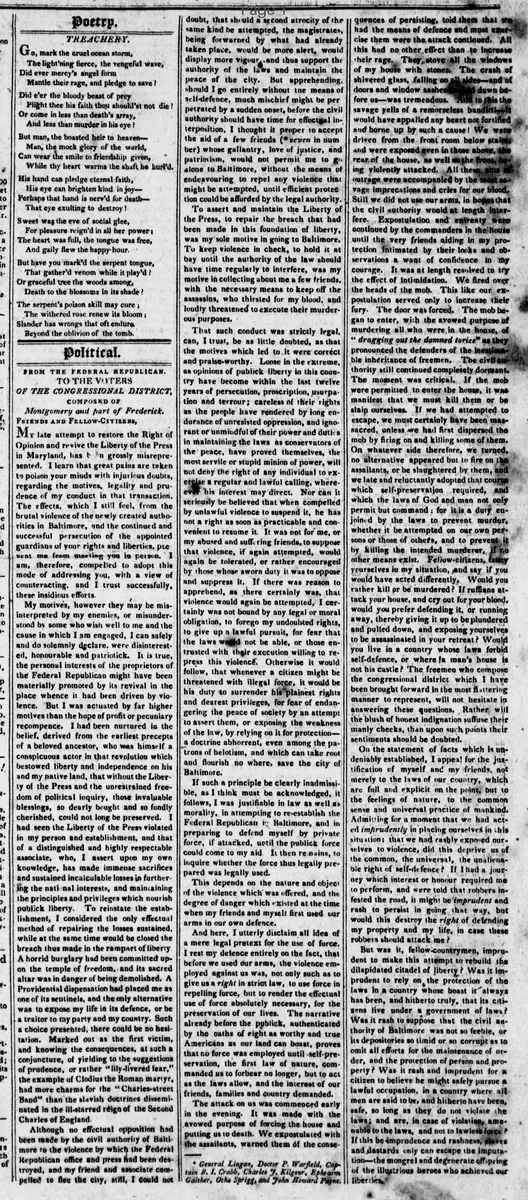
FROM THE FEDERAL REPUBLICAN.
TO THE VOTERS
OF THE CONGRESSIONAL DISTRICT,
COMPOSED OF
Montgomery and part of Frederick.
Friends and Fellow-Citizens,
My late attempt to restore the Right of
Opinion and revive the Liberty of the Press
in Maryland, has been grossly misrepresented. I learn that great pains are taken
to poison your minds with injurious doubts,
regarding the motives, legality and prudence of my conduct in that transaction.
The effects, which I still feel, from the
brutal violence of the newly created authorities in Baltimore, and the continued and
successful persecution of the appointed
guardians of your rights and liberties, prevent me from meeting you in person. I
am, therefore, compelled to adopt this
mode of addressing you, with a view of
counteracting, and I trust successfully,
these insidious efforts.
My motives, however they may be misinterpreted by my enemies, or misunderstood by some who wish well to me and the
cause in which I am engaged, I can safely
and do solemnly declare, were disinterested,
honourable and patriotick. It is true,
the personal interests of the proprietors of
the Federal Republican might have been
materially promoted by its revival in the
place whence it had been driven by violence. But I was actuated by far higher
motives than the hope of profit or pecuniary
recompence. I had been nurtured in the
belief, derived from the earliest precepts
of a beloved ancestor, who was himself a
conspicuous actor in that revolution which
bestowed liberty and independence on his
and my native land, that without the Liberty
of the Press and the unrestrained freedom
of political inquiry, those invaluable
blessings, so dearly bought and so fondly
cherished, could not long be preserved. I
had seen the Liberty of the Press violated
in my person and establishment, and that
of a distinguished and highly respectable
associate, who, I assert upon my own
knowledge, has made immense sacrifices
and sustained incalculable losses in furthering
the national interests, and maintaining
the principles and privileges which nourish
publick liberty.
To reinstate the establishment, I considered the only effectual
method of repairing the losses sustained,
while at the same time would be closed the
breach thus made in the rampart of liberty.
A horrid burglary had been committed upon the temple of freedom, and its sacred
altar was in danger of being demolished. A
Providential dispensation had placed me as
one of its sentinels, and the only alternative
was to expose my life in its defence, or be
a traitor to my party and my country. Such
a choice presented, there could be no hesitation, Marked out as the first victim,
and knowing the consequences, at such a
conjuncture, of yielding to the suggestions
of prudence, or rather "lily-livered fear,"
the example of Clodius the Roman martyr,
had more charms for the "Charles-street
Band" than the slavish doctrines disseminated in the ill-starred reign of the Second
Charles of England.
Although no effectual opposition had
been made by the civil authority of Baltimore to the violence by which the Federal
Republican office and press had been destroyed, and my friend and associate compelled to flee the city, still, I could not
doubt, that should a second atrocity of the
same kind be attempted, the magistrates,
being forewarned by what had already
taken place, would be more alert, would
display more vigour—and thus support the
authority of the laws and maintain the
peace of the city. But apprehending,
should I go entirely without the means of
self-defence, much mischief might be perpetrated by a sudden onset, before the civil
authority should have time for effectual interposition, I thought it proper to accept
the aid of a few friends (seventeen in number) whose gallantry, love of justice, and
patriotism, would not permit me to go
alone to Baltimore, without the means of
endeavouring to repel any violence that
might be attempted, until efficient protection could be afforded by the legal authority.
To assert and maintain the Liberty of
the Press, to repair the breach that had
been made in this foundation of liberty.
was my sole motive in going to Baltimore.
To keep violence in check, to hold it at
bay until the authority of the law should
have time regularly to interfere, was my
motive in collecting about me a few friends,
with the necessary means to keep off the
assassins, who thirsted for my blood, and
loudly threatened to execute their murderous purposes.
That such conduct was strictly legal,
can, I trust, be as little doubted, as that
the motives which led to it were correct
and praise-worthy. Loose in the extreme,
as opinions of publick liberty in this country have become within the last twelve
years of persecution, proscription, usurpation and terrour; careless of their rights
as the people have rendered by long endurance of unresisted oppression, and ignorant or unmindful of their power and duties
in maintaining the laws as conservators of
the peace, have proved themselves, the
most servile or stupid minion of power, will
not deny the right of any individual to exercise a regular and lawful calling, wherever his interest may direct. Nor can it
seriously be believed that when compelled
by unlawful violence to suspend it, he has
not a right as soon as practicable and convenient to resume it. It was not for me, or
my abused and suffering friends, to suppose
that violence, if again attempted, would
again be tolerated, or rather encouraged
by those whose sworn duty it was to oppose
and suppress it. If there was reason to
apprehend, as there certainly was, that
violence would again be attempted, I certainly was not bound by any legal or moral
obligation, to forego my undoubted rights,
to give up a lawful pursuit, for fear that
the laws would not be able, or those entrusted with their execution willing to repress this violence. Otherwise it would
follow, that whenever a citizen might be
threatened with illegal force, it would be
his duty to surrender his plainest rights
and dearest privileges, for fear of endangering the peace of society by an attempt
to assert them, or exposing the weakness
of the law, by relying on it for protection—a
doctrine abhorrent, even among the patrons of helotism, and which can take root
and flourish no where, save the city of
Baltimore.
If such a principle be clearly inadmissible, as I think must be acknowledged, it
follows, I was justifiable in law as well as
morality, in attempting to re-establish the
Federal Republican in Baltimore, and in
preparing to defend myself by private
force, if attacked, until the publick force
could come to my aid. It then remains, to
inquire whether the force thus legally prepared was legally used.
This depends on the nature and object
of the violence which was offered, and the
degree of danger which existed at the time
when my friends and myself first used our
arms in our own defence.
And here, I utterly disclaim all idea of
a mere legal pretext for the use of force.
I rest my defence entirely on the fact, that
before we used our arms, the violence employed against us was, not only such as to
give us a right in strict law, to use force in
repelling force, but to render the effectual
use of force absolutely necessary, for the
preservation of our lives. The narrative
already before the publick, authenticated
by the oaths of eight as worthy and true
Americans as our land can boast, proves
that no force was employed until self-preservation, the first law of nature, commanded us to forbear no longer, but to act
as the laws allow, and the interest of our
friends, families and country demanded.
The attack on us was commenced early
in the evening. It was made with the
avowed purpose of forcing the house and
putting us to death. We expostulated with
the assailants, warned them of the consequences of persisting, told them that we
had the means of defence and must exercise them were the attack continued. All
this had no other effect than to increase
their rage. They stoved all the windows
of my house with stones. The crash of
shivered glass, falling on all sides—and of
doors and window sashes dashed down before us—was tremendous. Add to this the
savage yells of a remorseless banditti cit-
would have appalled any heart not fortified
and borne up by such a cause! We were
driven from the front room below stairs
and were exposed even in those above, the
rear of the house, as well as the front, being
violently attacked. All these acts
of outrage were accompanied by the most savage imprecations and cries for our blood.
Still we did not use our arms, in hopes that
the civil authority would at length interfere. Expostulation and entreaty were
continued by the commanders in the house
until the very friends aiding in my protection intimated by their looks and observations a want of confidence in my
courage. It was at length resolved to try
the effect of intimidation. We fired over
the heads of the mob. This like our expostulation served only to increase their
fury. The door was forced. The mob began to enter, with the avowed purpose of
murdering all who were in the house, of
"dragging out the damned tories" as they
pronounced the defenders of the inestimable
inheritance of freemen. The civil authority still continued completely dormant.
The moment was critical. If the mob
were permitted to enter the house, it was
manifest that we must kill them or be
slain ourselves. If we had attempted to
escape, we must certainly have been massacred, unless we had first dispersed the
mob by firing on and killing some of them.
On whatever side therefore, we turned,
no alternative appeared but to fire on the
assailants, or be slaughtered by them, and
we late and reluctantly adopted that course
which self-preservation required, and
which the laws of God and man not only
permit but command: for it is a duty enjoined by the laws to prevent murder
whether it be attempted on our own persons or those of others, and to prevent it
by killing the intended murderer, if no
other means exist. Fellow-citizens, fancy
yourselves in my situation, and say if you
would have acted differently. Would you
rather kill or be murdered? If ruffians attack your house, and cry out for your blood,
would you prefer defending it, or running
away, thereby giving it up to be plundered
and pulled down, and exposing yourselves
to be assassinated in your retreat? Would
you live in a country whose laws forbid
self-defence, or where a man's house is
not his castle? The freemen who compose
the congressional district which I have
been brought forward in the most flattering
manner to represent, will not hesitate in
answering these questions. Rather will
the blush of honest indignation suffuse their
manly cheeks, than upon such points their
sentiments should be doubted.
On the statement of facts which is undeniably established, I appeal for the justification of myself and my friends, not
merely to the laws of our country, which
are full and explicit on the point, but to
the feelings of nature, to the common
sense and universal practice of mankind.
Admitting for a moment that we had acted imprudently in placing ourselves in this
situation; that we had rashly exposed ourselves to violence, did this deprive us of
the common, the universal, the unalienable right of self-defence? If I had a journey which interest or honour required me
to perform, and were told that robbers infested the road, it might be imprudent and
rash to persist in going that way, but
would this destroy the right of defending
my property and my life, in case these
robbers should attack me?
But was it, fellow-countrymen, imprudent to make this attempt to rebuild the
dilapidated citadel of liberty? Was it imprudence to rely on the protection of the
laws in a country whose boast it always
has been, and hitherto truly, that its citizens live under a government of laws?
Was it rash to suppose that the civil authority of Baltimore was not so feeble, or
its depositories so timid or so corrupt as to
omit all efforts for the maintenance of order, and the protection of person and property? Was it rash and imprudent for a
citizen to believe he might safely pursue
lawful occupation, in a country where all
men are said to be, and hitherto have been,
safe, so long as they do not violate the
laws; and are, in case of violation, amenable to the laws, and not to lawless force?
If this be imprudence and rashness, slaves
and dastards only can escape the imputation—the mongrel and degenerate offspring
of the illustrious heroes who achieved our
liberties.
General Lingan, Doctor P. Warfield, Captain R. I. Crabb, Charles J. Kilgour, Ephraim
Gaither, Otho Sprigg, and John Howard Payne.
Another view of the election, my fellow-citizens, which will better accord with your feelings and my own, as well as with the dictates of generous and manly courage, enlightened patriotism and disinterested devotion to the public good. To resist oppression is a duty, because unresisted it grows strong, and at length becomes triumphant. To repel the first attacks on the liberty of the press is a duty, because if not repelled, they are renewed with increased and increasing vigour till this great bulwark of liberty is battered down. To save our country from impending danger, so far as may depend on individual exertions is also a duty, and what danger more terrible than when the sentinels who guard the citadel of freedom are destroyed or intimidated by its enemies. These are sacred duties, which in my humble way I was called on to fulfil, and I am yet to learn when duty calls, that the cold calculating suggestions of what is called prudence are to outweigh imperious obligations—not that enlarged and exalted wisdom which having resolved on noble and honourable or necessary purposes, wisely scans the best means for its attainment, but that little, short-sighted policy, which cloaks fear under the disguise of discretion, and weighs the injunctions of duty against the danger of performance. This was not the prudence of Washington, Hamilton, Hancock, Pickering, and the other worthies who achieved our revolution. It would have been more conformable to the dictates of this kind of prudence for our indiscreet forefathers to pay an inconsiderable duty on painter's colours, tea, and stamps, than to risk their lives and fortunes in a contest with a nation possessing ten times their force. But had they been thus prudent, the right of the British Parliament to bind us in all cases whatsoever would have been quietly and firmly established. The people of the United States would have lost their own liberty, and their resources thus placed at the disposal of the British government, would speedily have been converted into instruments in the hands of a despotick administration, for crushing the liberties of the English themselves. It would have been more prudent in the immortal Hampden, according to this idea of prudence, to pay quietly the tax of twenty shillings illegally demanded of him, under the name of ship money, than to spend his fortune in a law suit with the Crown, and to expose his life to the vengeance and power of an arbitrary and irritated Monarch. But had Hampden been thus prudent, the right of the Crown to tax the people, without the consent of their representatives, would have been silently established in England; and that nation, like the rest of Europe, would have bent under arbitrary government. It is by slow and cautious approaches, that usurpation unresisted grows into law, and if the calm of despotism be preferred to the storms of liberty, tyranny will be easily fastened upon a people. But the sacred fire of liberty which England kept alive till our ancestors snatched a spark from the altar, and bore it to the desert wilds of a new world, would have been extinguished forever, and the dark and chilling gloom of despotism would again have settled on the whole human race. Far be it from me, to place my name, my humble name, and my feeble endeavours, on a level with those illustrious patriots, I have been taught to look up to for examples of virtue, and who, spurning the dictates of a low and sordid prudence, bravely, wisely, and successfully resisted, at every hazard, the first encroachments of tyranny. But though I dare not hope ever to emulate their glory, much less to equal their usefulness, I may be allowed to act upon their principles whenever fit occasions may be presented. It is too true, these occasions have abounded within the last few years, and such an occasion too remarkable to pass off without a struggle, I did think had occurred, when in my person, and that of my friend, the liberty of the press had been invaded in Baltimore. This invasion, regardless of all minor considerations and interests, I believed it my duty, and did not hesitate to resist. That I did resist, as far as circumstances would permit, is my pride and my boast. Defeat, I knew in its effects, would be a victory, because the nation would be benefited, and the good of our country was the object in view. The lives of the whole band would have been a cheap price for the regeneration of the people, and the salvation of our union. My effort, though it led to the death of one of my dearest and best friends, at every fresh recollection of whose sufferings my heart bleeds anew; though it had nearly ended in the destruction of myself, and the generous and heroick companions of my dangers and wrongs, has not been without its good effects. The nation has said their blood did not flow in vain. The struggle and the horrible catastrophe in which it terminated, have awakened a large portion of our fellow-citizens to the common danger. They are roused from their stupor, and have proclaimed that liberty must be abandoned, or the freedom of the press steadily and firmly supported. Thus awakened to the danger, they will ward off the dreadful events which threatened to whelm the empire in one prodigious ruin. To all those who have been instruments in thus awakening them, it must ever be a source of comfort and joy, and approving consciences have already bestowed the only rewards they desired. Such, my fellow-citizens, are my sentiments and principles on this subject. By them I wish you to judge me. If you approve them, if you feel them, if you wish to give them your countenance and support, I shall be proud to become your representative. But if you are prepared, which I cannot and will not believe, to calculate the cost when your liberties are to be defended; if you mean to submit to the first and the successive encroachments of tyranny, for fear of the inconvenience, or hazard of resistance, I am free to declare, that I am not a fit object for your choice. Bestow your suffrages on some person, if such can be found, who will be dependent enough to truckle to power, to yield to violence, and to barter the dignified and lofty independence of a freeman for the quiet and submissive safety of a slave. As an attempt has been made to spread an impression among you, that I have violated the laws of my country, and have rendered myself ineligible to Congress, I lay before you the following opinions of some of the most eminent counsellors of law in the union. They cannot fail to remove every doubt from minds open to conviction, and strip the insidious and insincere of every pretext for persisting in erroneous impressions. It was not to be presumed that a party comprising age, experience, reflection and intelligence would embark in an enterprise without first satisfying their judgements upon the law, but in order effectually to silence all doubts upon this point, I submit to the perusal of the people, the following opinions, which no legal character, who deserves or values reputation, will venture to controvert. Your obedient servant, A. C. HANSON. Our opinion is requested upon the following points: I. Whether Mr. Hanson and his friends under the circumstances in which they found themselves in Baltimore on the 27th of July last, were justifiable in law in repelling by force the attack made upon them, and in killing the assailants upon the ground of self-defence. II. Whether the presentment against Mr. Hanson for manslaughter, and the indictment which will be found on it, can disqualify him in law for a seat in Congress. On the first point we hold it to be clear law: I. That Mr. Hanson had a complete legal right to exercise in Baltimore the business of publishing a news-paper, or to distribute it there, when published elsewhere; being liable to indictment if he published any thing contrary to law. II. That every man, in the prosecution of his lawful business has a right to defend his house and person by force if necessary against unlawful violence, and to provide himself beforehand with the means of defence, if he should have good reason to apprehend such violence. III. That consequently, as Mr. Hanson had good reason from what had happened to his office to apprehend such violence, he was justifiable in law in furnishing himself with the means of repelling this violence, should it be attempted. IV. That the attack on Mr. Hanson's house having been made with stones and other dangerous weapons, and with the avowed purpose of breaking and entering it, for an unlawful object; and the house having been actually broken, and in part entered before any resistance was made or any provocation given from within, he and those with him had a legal right to kill the assailants in self-defence; that being the sole remaining mean of protecting their own persons from violence, and indeed of saving their own lives. The second point is too clear to admit of the least doubt. The constitution is explicit. It prescribes the qualifications for a seat in Congress, and consequently the disqualifications. To those found in the constitution none can be added; and to be under presentment or indictment for any crime whatever, is not one of the disqualifications to be found in the constitution. Even conviction for an infamous crime would not be a disqualification; though if the crime were committed, and perhaps if the conviction took place, after the election, it would be a good ground of expulsion. But an indictment is only an accusation, the truth or falsehood of which is to be established at the trial. To admit a mere accusation, which may on trial appear to be false, as a disqualification for a citizen to be elected as a member of Congress, would be equally contrary to every principle of justice, law, and common sense. It would be also of most dangerous tendency. Very slight testimony will often induce a grand jury, and properly too, to put a man on his trial, by finding a bill against him. No defence can be made before them. The party accused cannot appear or produce his witnesses. Consequently, the grand jury, for the most part, can hear but one side. Even where they send for witnesses to explain the matter more fully, it will often remain doubtful: and if the facts or the law appear doubtful to them, they have a right, and perhaps it is their duty, to find a bill; to the end that a more complete investigation of both may take place, in the trial before the court and petty jury. It is easy therefore to perceive, how readily a candidate might be excluded by a profligate competitor, if an indictment were a disqualification. A single false witness, fabricating a plausible tale, might induce a grand jury very honestly to find a bill; and this bill would disqualify the candidate. Nothing of this sort has taken place, or can be suspected in the present case, but a principle so liable to abuse ought not to be admitted. It is however sufficient to state, which we do with confidence, that the constitution and the laws preclude every idea of such a disqualification. ROBERT G. HARPER, PHILIP B. KEY, WALTER DORSEY. THOMAS BUCHANAN. Baltimore, September 3d, 1812. Baltimore, 31st August, 1812. Dear Sir,—You inform me, that an assertion has been made, that the affair in Charles-street would render you ineligible to Congress, that this assertion, should it gain ground, may injure your election, and request from me my legal opinion on the subject. While the grand jury were inquiring into the transactions, which happened in Charles-street, and the consequent events, I avoided unnecessarily expressing my opinion relative thereto, considering it improper that sentiments, on one side or the other should be published, which might influence the conduct of the grand jury in cases under their investigation. But on the present occasion, as a misapprehension of the law might perhaps prevent your election, to the prejudice of the constitutional elective rights of yourself and the citizens of your district, I feel no objection to give you my opinion on the subject. The proprietors of the Federal Republican had a clear constitutional right to print or publish, or to print and publish, their newspaper, without obtaining the permission of any person for that purpose; of this no person can possibly doubt. They had no right, it is certain, to force any person to take, or to read their paper, but this they never have attempted. They had a right to procure a house in which they, or any of them should dwell, as long as was thought proper, for the purpose of distributing their papers therefrom; this no man of common sense and common candour can deny. If in their newspaper they published any thing illegal and criminal, the editors were answerable in a legal mode of proceeding against them, but in no other manner. No principle of law is, or can be made, more clear and certain, than that, if you apprehended your house would be illegally attacked, or that, while residing therein, your person would be in danger of illegal violence, you had a right, nay, it was your duty to collect your friends in defence of your house, and of your person; and they had an undoubted right to assemble in your house for the defence of it and of you, nay, in so doing, they acted meritoriously. And that you and they acted justifiably in opposing those who riotously made the attack upon your house, even though it was attended with the death of some of them, will never be denied but by those whose passions and prejudices have got the better of their good sense and legal knowledge. Nor can any but such ever think that your conduct in Charles-street, where you were supporting your and their essential rights, can render you less worthy to represent them in Congress. But there is a presentment against you for manslaughter. And what then? Can this be an objection? Neither the constitution, the laws, reason, nor common sense, prevents a person from being chosen member of Congress on account of his being presented for any crime. Otherwise the political enemies of a candidate would have nothing more to do, than to obtain a presentment against him, however unjust it might be, and thereby deprive him of his constitutional right to be elected; and the citizens of his district of their constitutional right to be represented by him. I am, dear sir, sincerely yours, LUTHER MARTIN. A man may defend his house, as his castle, against any unlawful assailant, and may assemble his friends to aid him in the defence. The extent of the means which may be used in the defence, depends upon the nature and urgency of the assault. If the assailant persist in his unlawful efforts, the means of defence may be increased with the violence of the attack, even to the taking of life. It is without question absolutely justifiable to kill one who assaults the dwelling of another with intent to commit a felony; and it is not necessary to wait until the felony be committed, but the assailant may be killed in the attempt. Thus, for example, if a man is in the act of breaking a house in the night, to commit a burglary or other felony, the owner may kill him before the burglary, or other felony be completed. So if a man assault my house with intent to take my life, which may be inferred from his conduct, his declarations, and the weapons and numbers employed—I may lawfully kill him in my defence. If a tumultuous assembly of people attack my house, with weapons and in a manner which endanger not only the safety of the property but of my life, if I persist in retaining the house, I am not bound to avoid the danger to myself by giving up my house to their fury, but may keep and defend it at the expense of the lives of those who thus assault me. E. TILGHMAN, W. LEWIS, W. RAWLE, JOS. HOPKINSON, HOR. BINNEY. Philadelphia, August 15, 1812.
What sub-type of article is it?
What keywords are associated?
What entities or persons were involved?
Editorial Details
Primary Topic
Defense Of Press Liberty And Right To Self Defense In Baltimore Press Revival Attempt
Stance / Tone
Strongly Patriotic And Defensive, Justifying Actions As Legal And Moral Imperatives For Liberty
Key Figures
Key Arguments