Thank you for visiting SNEWPapers!
Sign up free
The New Hampshire Gazette And General Advertiser
Portsmouth, Exeter, Rockingham County, New Hampshire
What is this article about?
Benjamin Mifflin shares his 1776 experiment in Kent County, Delaware, using oven heat to kill wheat flies and prevent crop loss. He also republishes 1773 London Magazine experiments by Christopher Gullet on using elder plants to repel insects from crops like cabbage, wheat, and turnips.
Merged-components note: Direct continuation of the letter to the editor across pages, describing agricultural experiments against insects; original literary label incorrect for this context.
Clippings
1 of 2
OCR Quality
Full Text
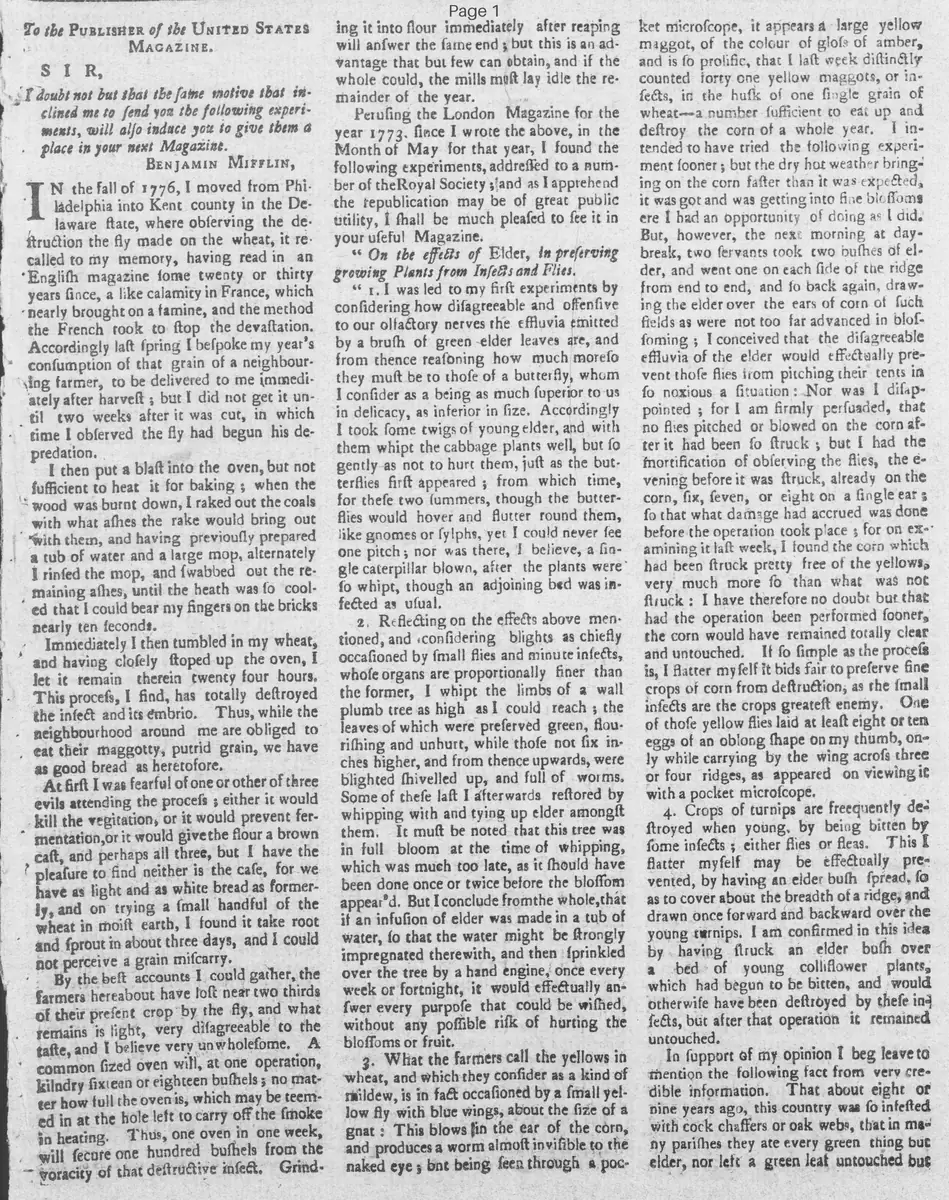
SIR,
I doubt not but that the same motive that inclined me to send you the following experiments, will also induce you to give them a place in your next Magazine.
BENJAMIN MIFFLIN,
In the fall of 1776, I moved from Philadelphia into Kent county in the Delaware state, where observing the destruction the fly made on the wheat, it recalled to my memory, having read in an English magazine some twenty or thirty years since, a like calamity in France, which nearly brought on a famine, and the method the French took to stop the devastation. Accordingly last spring I bespoke my year's consumption of that grain of a neighbouring farmer, to be delivered to me immediately after harvest; but I did not get it until two weeks after it was cut, in which time I observed the fly had begun his depredation.
I then put a blast into the oven, but not sufficient to heat it for baking; when the wood was burnt down, I raked out the coals with what ashes the rake would bring out with them, and having previously prepared a tub of water and a large mop, alternately I rinsed the mop, and swabbed out the remaining ashes, until the hearth was so cooled that I could bear my fingers on the bricks nearly ten seconds.
Immediately I then tumbled in my wheat, and having closely stopped up the oven, I let it remain therein twenty four hours.
This process, I find, has totally destroyed the insect and its embryo. Thus, while the neighbourhood around me are obliged to eat their maggoty, putrid grain, we have as good bread as heretofore.
At first I was fearful of one or other of three evils attending the process; either it would kill the vegetation, or it would prevent fermentation, or it would give the flour a brown cast, and perhaps all three, but I have the pleasure to find neither is the case, for we have as light and as white bread as formerly, and on trying a small handful of the wheat in moist earth, I found it take root and sprout in about three days, and I could not perceive a grain miscarry.
By the best accounts I could gather, the farmers hereabout have lost near two thirds of their present crop by the fly, and what remains is light, very disagreeable to the taste, and I believe very unwholesome. A common sized oven will, at one operation, kiln dry sixteen or eighteen bushels; no matter how full the oven is, which may be steamed in at the hole left to carry off the smoke in heating. Thus, one oven in one week, will secure one hundred bushels from the voracity of that destructive insect. Grinding it into flour immediately after reaping will answer the same end: but this is an advantage that but few can obtain, and if the whole could, the mills most lay idle the remainder of the year.
Perusing the London Magazine for the year 1773, since I wrote the above, in the Month of May for that year, I found the following experiments, addressed to a number of the Royal Society; and as I apprehend the republication may be of great public utility, I shall be much pleased to see it in your useful Magazine.
On the effects of Elder, in preserving growing Plants from Insects and Flies.
1. I was led to my first experiments by considering how disagreeable and offensive to our olfactory nerves the effluvia emitted by a brush of green elder leaves are, and from thence reasoning how much more so they must be to those of a butterfly, whom I consider as a being as much superior to us in delicacy, as inferior in size. Accordingly I took some twigs of young elder, and with them whipped the cabbage plants well, but so gently as not to hurt them, just as the butterflies first appeared: from which time, for these two summers, though the butterflies would hover and flutter round them, like gnomes or sylphs, yet I could never see one alight; nor was there, I believe, a single caterpillar blown, after the plants were so whipped, though an adjoining bed was infected as usual.
2. Reflecting on the effects above mentioned, and considering blights as chiefly occasioned by small flies and minute insects, whose organs are proportionally finer than the former, I whipped the limbs of a wall plumb tree as high as I could reach; the leaves of which were preserved green, flourishing and unhurt, while those not six inches higher, and from thence upwards, were blighted, shrivelled up, and full of worms. Some of these last I afterwards restored by whipping with and tying up elder amongst them. It must be noted that this tree was in full bloom at the time of whipping, which was much too late, as it should have been done once or twice before the blossom appeared. But I conclude from the whole, that if an infusion of elder was made in a tub of water, so that the water might be strongly impregnated therewith, and then sprinkled over the tree by a hand engine, once every week or fortnight, it would effectually answer every purpose that could be wished, without any possible risk of hurting the blooms or fruit.
3. What the farmers call the yellows in wheat, and which they consider as a kind of mildew, is in fact occasioned by a small yellow fly with blue wings, about the size of a gnat: This blows in the ear of the corn, and produces a worm almost invisible to the naked eye; but being seen through a pocket microscope, it appears a large yellow maggot, of the colour of gloss of amber, and is so prolific, that I last week distinctly counted forty one yellow maggots, or insects, in the husk of one single grain of wheat—a number sufficient to eat up and destroy the corn of a whole year. I intended to have tried the following experiment sooner; but the dry hot weather bringing on the corn faster than it was expected, it was got and was getting into fine blooms ere I had an opportunity of doing as I did. But, however, the next morning at day-break, two servants took two bushes of elder, and went one on each side of the ridge from end to end, and so back again, drawing the elder over the ears of corn of such fields as were not too far advanced in blossoming; I conceived that the disagreeable effluvia of the elder would effectually prevent those flies from pitching their tents in so noxious a situation: Nor was I disappointed; for I am firmly persuaded, that no flies pitched or blowed on the corn after it had been so struck: but I had the mortification of observing the flies, the evening before it was struck, already on the corn, six, seven, or eight on a single ear; so that what damage had accrued was done before the operation took place: for on examining it last week, I found the corn which had been struck pretty free of the yellows, very much more so than what was not struck: I have therefore no doubt but that had the operation been performed sooner, the corn would have remained totally clear and untouched. If so simple as the process is, I flatter myself it bids fair to preserve fine crops of corn from destruction, as the small insects are the crops greatest enemy. One of those yellow flies laid at least eight or ten eggs of an oblong shape on my thumb, only while carrying by the wing across three or four ridges, as appeared on viewing it with a pocket microscope.
4. Crops of turnips are frequently destroyed when young, by being bitten by some insects; either flies or fleas. This I flatter myself may be effectually prevented, by having an elder bush spread so as to cover about the breadth of a ridge, and drawn once forward and backward over the young turnips. I am confirmed in this idea by having struck an elder bush over a bed of young cauliflower plants, which had begun to be bitten, and would otherwise have been destroyed by these insects, but after that operation it remained untouched.
In support of my opinion I beg leave to mention the following fact from very credible information. That about eight or nine years ago, this country was so infested with cock chafers or oak weevils, that in many parishes they ate every green thing but elder, nor left a green leaf untouched but
Elder bushes, which alone remained green and unhurt amid the general devastation of so voracious a multitude.
On reflecting on these several circumstances, a thought suggested itself to me, whether an elder, now esteemed noxious and offensive, may not be one day seen planted with, and entwining its branches amongst fruit trees, in order to preserve the fruit from destruction of insects: and whether the same means which produced these several effects, may not be extended to a great variety of other cases in the preservation of the vegetable kingdom.
The dwarf elder (sambucus ebulus) I apprehend, emits more offensive effluvia than common elder, therefore must be preferable to it in the several experiments.
§ A bush of elder laid on fresh meat or fish in the summer, prevents the fly from blowing on it. And it is not improbable, from the foregoing experiments, by Christopher Gullet, that water strongly impregnated therewith, and once a week or fortnight sprinkled over cabbages, will preserve them from being lousy.
What sub-type of article is it?
What themes does it cover?
What keywords are associated?
What entities or persons were involved?
Letter to Editor Details
Author
Benjamin Mifflin
Recipient
Publisher Of The United States Magazine
Main Argument
describes a method using mild oven heat to kill wheat flies without damaging the grain and republishes experiments showing elder plants repel insects from various crops, recommending their use for agricultural protection.
Notable Details