Thank you for visiting SNEWPapers!
Sign up free
Story
October 5, 1801
The National Intelligencer And Washington Advertiser
Washington, District Of Columbia
What is this article about?
Article from the Aurora describes George Clymer's improved printing press in Philadelphia, fixing mechanical defects for easier, more even impressions and reduced maintenance, with one in use at H. Maxwell's office.
Clipping
OCR Quality
97%
Excellent
Full Text
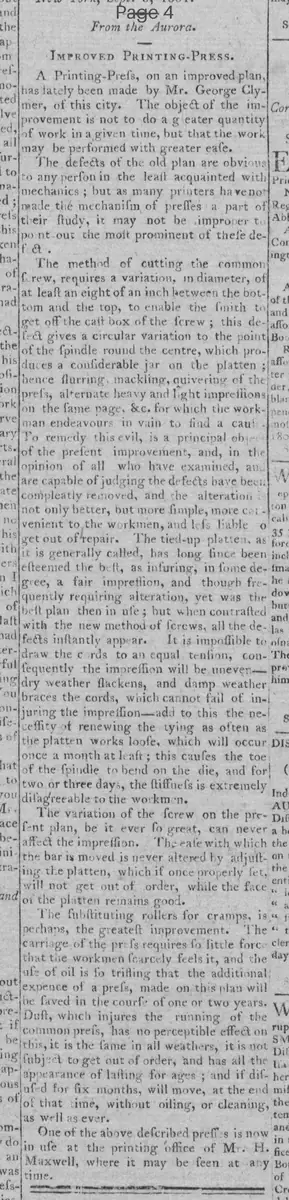
From the Aurora.
IMPROVED PRINTING-PRESS.
A Printing-Press, on an improved plan, has lately been made by Mr. George Clymer, of this city. The object of the improvement is not to do a greater quantity of work in a given time, but that the work may be performed with greater ease.
The defects of the old plan are obvious to any person in the least acquainted with mechanics; but as many printers have not made the mechanism of presses a part of their study, it may not be improper to point out the most prominent of these defects.
The method of cutting the common screw, requires a variation, in diameter, of at least an eighth of an inch between the bottom and the top, to enable the finisher to get off the cast box of the screw; this defect gives a circular variation to the point of the spindle round the centre, which produces a considerable jar on the platten; hence slurring, mackling, quivering of the press, alternate heavy and light impressions on the same page, &c. for which the workman endeavours in vain to find a cause
To remedy this evil, is a principal object of the present improvement, and, in the opinion of all who have examined, and are capable of judging the defects have been completely removed, and the alteration not only better, but more simple, more convenient to the workmen, and less liable to get out of repair. The tied-up platten, as it is generally called, has long since been esteemed the best, as insuring, in some degree, a fair impression, and though frequently requiring alteration, yet was the best plan then in use; but when contrasted with the new method of screws, all the defects instantly appear. It is impossible to draw the cords to an equal tension, consequently the impression will be uneven—dry weather slackens, and damp weather braces the cords, which cannot fail of injuring the impression—add to this the necessity of renewing the tying as often as the platten works loose, which will occur once a month at least; this causes the toe of the spindle to bend on the die, and for two or three days, the stiffness is extremely disagreeable to the workmen.
The variation of the screw on the present plan, be it ever so great, can never affect the impression. The ease with which the bar is moved is never altered by adjusting the platten, which if once properly set, will not get out of order, while the face of the platten remains good.
The substituting rollers for cramps, is perhaps, the greatest improvement. The carriage of the press requires so little force that the workmen scarcely feels it, and the use of oil is so trifling that the additional expense of a press, made on this plan will be saved in the course of one or two years. Dust, which injures the running of the common press, has no perceptible effect on this, it is the same in all weathers, it is not subject to get out of order, and has all the appearance of lasting for ages; and if used for six months, will move, at the end of that time, without oiling, or cleaning, as well as ever.
One of the above described presses is now in use at the printing office of Mr. H. Maxwell, where it may be seen at any time.
IMPROVED PRINTING-PRESS.
A Printing-Press, on an improved plan, has lately been made by Mr. George Clymer, of this city. The object of the improvement is not to do a greater quantity of work in a given time, but that the work may be performed with greater ease.
The defects of the old plan are obvious to any person in the least acquainted with mechanics; but as many printers have not made the mechanism of presses a part of their study, it may not be improper to point out the most prominent of these defects.
The method of cutting the common screw, requires a variation, in diameter, of at least an eighth of an inch between the bottom and the top, to enable the finisher to get off the cast box of the screw; this defect gives a circular variation to the point of the spindle round the centre, which produces a considerable jar on the platten; hence slurring, mackling, quivering of the press, alternate heavy and light impressions on the same page, &c. for which the workman endeavours in vain to find a cause
To remedy this evil, is a principal object of the present improvement, and, in the opinion of all who have examined, and are capable of judging the defects have been completely removed, and the alteration not only better, but more simple, more convenient to the workmen, and less liable to get out of repair. The tied-up platten, as it is generally called, has long since been esteemed the best, as insuring, in some degree, a fair impression, and though frequently requiring alteration, yet was the best plan then in use; but when contrasted with the new method of screws, all the defects instantly appear. It is impossible to draw the cords to an equal tension, consequently the impression will be uneven—dry weather slackens, and damp weather braces the cords, which cannot fail of injuring the impression—add to this the necessity of renewing the tying as often as the platten works loose, which will occur once a month at least; this causes the toe of the spindle to bend on the die, and for two or three days, the stiffness is extremely disagreeable to the workmen.
The variation of the screw on the present plan, be it ever so great, can never affect the impression. The ease with which the bar is moved is never altered by adjusting the platten, which if once properly set, will not get out of order, while the face of the platten remains good.
The substituting rollers for cramps, is perhaps, the greatest improvement. The carriage of the press requires so little force that the workmen scarcely feels it, and the use of oil is so trifling that the additional expense of a press, made on this plan will be saved in the course of one or two years. Dust, which injures the running of the common press, has no perceptible effect on this, it is the same in all weathers, it is not subject to get out of order, and has all the appearance of lasting for ages; and if used for six months, will move, at the end of that time, without oiling, or cleaning, as well as ever.
One of the above described presses is now in use at the printing office of Mr. H. Maxwell, where it may be seen at any time.
What sub-type of article is it?
Curiosity
What themes does it cover?
Triumph
What keywords are associated?
Printing Press
Improvement
Screw Defects
Rollers
Invention
What entities or persons were involved?
George Clymer
H. Maxwell
Where did it happen?
This City
Story Details
Key Persons
George Clymer
H. Maxwell
Location
This City
Event Date
Lately
Story Details
Mr. George Clymer has invented an improved printing press that addresses defects in the traditional design, such as screw variations causing uneven impressions, by simplifying the mechanism, using rollers instead of cramps, and ensuring ease of use and durability.