Thank you for visiting SNEWPapers!
Sign up free
Foreign News
May 6, 1870
Oxford Democrat
Paris, South Paris, Oxford County, Maine
What is this article about?
A midshipman's letter describes visiting Naples' Museum with Egyptian mummies and Pompeian remains, the Catacombs with ancient Christian burial sites, and the Campo Santo cemetery, detailing the gruesome daily burial pit ritual attended by a curious, indifferent crowd.
Clipping
OCR Quality
95%
Excellent
Full Text
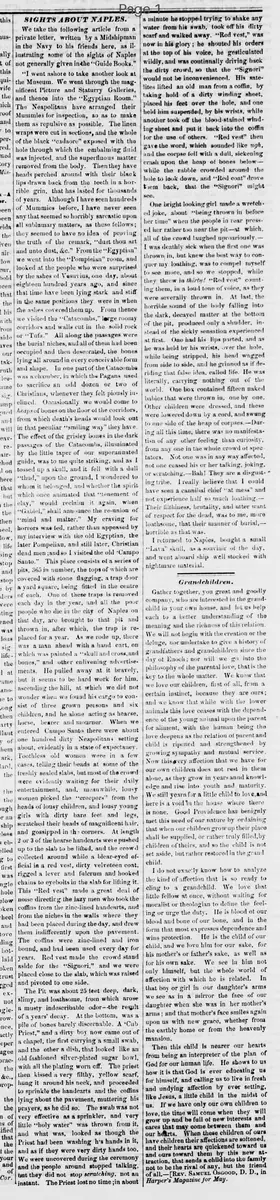
SIGHTS ABOUT NAPLES.
We take the following article from a private letter, written by a Midshipman in the Navy to his friends here, as illustrating some of the sights of Naples not generally given in the "Guide Books."
"I went ashore to take another look at the Museum. We went through the magnificent Picture and Statuary Galleries, and thence into the "Egyptian Room." The Neapolitans have arranged their Mummies for inspection, so as to make them as repulsive as possible. The linen wraps were cut in sections, and the whole of the black "cadaver" exposed with the hole through which the embalming fluid was injected, and the superfluous matter removed from the body. Then they have heads perched around with their black lips drawn back from the teeth in a horrible grin, that has lasted for thousands of years. Although I have seen hundreds of Mummies before, I have never seen any that seemed so horribly sarcastic upon all sublunary matters, as these fellows; they seemed to have no idea of proving the truth of the remark, "dust thou art and unto dust, &c." From the "Egyptian" we went into the "Pompeian" room, and looked at the people who were surprised by the ashes of Vesuvius, one day, about eighteen hundred years ago, and since that time have been lying stark and stiff in the same positions they were in when the ashes covered them up. From thence we visited the "Catacombs," large roomy corridors and walls cut in the solid rock or "Tufa." All along the passages were the burial niches, and all of them had been occupied and then desecrated, the bones lying all around in every conceivable form and shape. In one part of the Catacombs was a chamber, in which the Pagans used to sacrifice an odd dozen or two of Christians, whenever they felt piously inclined. Occasionally we would come to heaps of bones on the floor of the corridors, from which death's heads would look out in that peculiar "smiling way" they have. The effect of the grisly bones in the dark passages of the Catacombs, illuminated by the little taper of our superannuated guide, was to me quite striking, and as I tossed up a skull, and it fell with a dull "thud," upon the ground, I wondered to whom it belonged, and whether the spirit which once animated that "tenement of clay," would reclaim it again, when "Gabriel" shall announce the re-union of "mind and matter." My craving for horrors was fed, rather than appeased by my interview with the old Egyptian, the later Pompeian, and still later, Christian dead men; and so I visited the old "Campo Santo." This place consists of a series of pits, 365 in number, the tops of which are covered with stone flagging, a trap door a yard square, being fitted in the centre of each. One of these traps is removed each day in the year, and all the poor people who die in the city of Naples on that day, are brought to that pit and thrown in, after which, the trap is replaced for a year. As we rode up, there was a man ahead with a hand cart, on which was painted a "skull and cross, and bones," and other enlivening advertisements. He pulled away at it bravely, but it seems to be hard work for him, ascending the hill, at which we did not wonder when we found his cargo to consist of three grown persons and six children, and he alone acting as hearse, horse, bearer and mourner. When we entered Campo Santo there were about one hundred dirty Neapolitans setting about, evidently in a state of expectancy. Toothless old women were in a few cases, telling their beads at some of the freshly sealed slabs, but most of the crowd were evidently waiting for their daily entertainment, and, meanwhile, lousy women picked the "creepers" from the heads of lousy children, and lousy young girls with dirty bare feet and legs, scratched their heads of magnificent hair, and gossiped in the corners. At length 2 or 3 of the hearse handcarts were pushed up to the slab to be lifted, and the crowd collected around while a blear-eyed official in a red vest, dirty velveteen coat rigged a lever and fulcrum and hooked chains to eyebolts in the slab for lifting it. This "Red vest" made a great deal of noise directing the lazy men who took the coffins from the zinc-lined hand carts, and from the niches in the walls where they had been placed during the day, and drew them indifferently upon the pavement. The coffins were zinc-lined and iron bound, and had been used every day for years. Red vest made the crowd stand aside for the "Signori," and we were placed close to the slab, which was raised and pivoted to one side.
The Pit was about 25 feet deep, dark, slimy, and loathsome, from which arose a musty indescribable odor—the result of a year's decay. At the bottom, was a pile of bones barely discernable. A "Curate Priest," and a dirty boy now came out of a chapel, the first carrying a small swab, and the other a dish, that looked like an old fashioned silver-plated sugar bowl, with all the plating worn off. The priest then kissed a very filthy, yellow scarf hung it around his neck, and proceeded to sprinkle the handcarts and the coffins lying about the pavement, muttering his prayers, as he did so. The swab was not very effective as a sprinkler, and very little "holy water" was thrown from it, and what was, looked as though the Priest had been washing his hands in it, and as if they were very dirty hands too. We were uncovered during the ceremony and the people around stopped talking, but they did not stop scratching, not an instant. The Priest lost no time; in about a minute he stopped trying to shake any water from his swab, took off his dirty scarf and walked away. "Red vest," was now in his glory; he shouted his orders at the top of his voice, he gesticulated wildly, and was continually driving back the dirty crowd, so that the "Signori" would not be inconvenienced. His satellites lifted an old man from a coffin, by taking hold of a dirty winding sheet, placed his feet over the hole, and one held him suspended, by his wrists, while another took off the blood stained winding sheet and put it back into the coffin for the use of others. "Red vest" then gave the word, which sounded like ugh, and the corpse fell with a dull, sickening crash upon the heap of bones below while the rabble crowded around the hole to look down, and "Red coat" drove them back, that the "Signori" might see.
One bright looking girl made a wretched joke, about "being thrown in before her time" when the people in rear pressed her rather too near the pit—at which, all of the crowd laughed uproariously.—I was deathly sick when the first one was thrown in, but knew the best way to conquer my loathing, was to compel myself to see more, and so we stopped, while they threw in thirty! "Red vest" counting them, in a loud tone of voice, as they were severally thrown in. At last, the horrible sound of the body falling into the dark, decayed matter at the bottom of the pit, produced only a shudder, instead of the sickly sensation experienced at first. One had his lips parted, and as he was held by his wrists, over the hole, while being stripped, his head wagged from side to side, and he grinned as if deriding that false idea, called life. He was literally, carrying nothing out of the world. One box contained fifteen naked babies that were thrown in, one by one. Other children were dressed, and these were lowered down by a cord, and swung to one side of the heap of corpses.—During all this time, there was no manifestation of any other feeling than curiosity, from any one in the whole crowd of spectators. Not one was in any way affected, not one ceased his or her talking, joking, or scratching.—Bah! They are a disgusting tribe. I really believe that I could have seen a cannibal chief "at mess" and not experience half so much loathing.— Their filthiness, brutality, and utter want of respect for the dead, was to me, more loathsome, that their manner of burial,— horrible as that was.
I returned to Naples, bought a small "Lava" skull, as a souvenir of the day, and went aboard ship well stocked with nightmare material.
We take the following article from a private letter, written by a Midshipman in the Navy to his friends here, as illustrating some of the sights of Naples not generally given in the "Guide Books."
"I went ashore to take another look at the Museum. We went through the magnificent Picture and Statuary Galleries, and thence into the "Egyptian Room." The Neapolitans have arranged their Mummies for inspection, so as to make them as repulsive as possible. The linen wraps were cut in sections, and the whole of the black "cadaver" exposed with the hole through which the embalming fluid was injected, and the superfluous matter removed from the body. Then they have heads perched around with their black lips drawn back from the teeth in a horrible grin, that has lasted for thousands of years. Although I have seen hundreds of Mummies before, I have never seen any that seemed so horribly sarcastic upon all sublunary matters, as these fellows; they seemed to have no idea of proving the truth of the remark, "dust thou art and unto dust, &c." From the "Egyptian" we went into the "Pompeian" room, and looked at the people who were surprised by the ashes of Vesuvius, one day, about eighteen hundred years ago, and since that time have been lying stark and stiff in the same positions they were in when the ashes covered them up. From thence we visited the "Catacombs," large roomy corridors and walls cut in the solid rock or "Tufa." All along the passages were the burial niches, and all of them had been occupied and then desecrated, the bones lying all around in every conceivable form and shape. In one part of the Catacombs was a chamber, in which the Pagans used to sacrifice an odd dozen or two of Christians, whenever they felt piously inclined. Occasionally we would come to heaps of bones on the floor of the corridors, from which death's heads would look out in that peculiar "smiling way" they have. The effect of the grisly bones in the dark passages of the Catacombs, illuminated by the little taper of our superannuated guide, was to me quite striking, and as I tossed up a skull, and it fell with a dull "thud," upon the ground, I wondered to whom it belonged, and whether the spirit which once animated that "tenement of clay," would reclaim it again, when "Gabriel" shall announce the re-union of "mind and matter." My craving for horrors was fed, rather than appeased by my interview with the old Egyptian, the later Pompeian, and still later, Christian dead men; and so I visited the old "Campo Santo." This place consists of a series of pits, 365 in number, the tops of which are covered with stone flagging, a trap door a yard square, being fitted in the centre of each. One of these traps is removed each day in the year, and all the poor people who die in the city of Naples on that day, are brought to that pit and thrown in, after which, the trap is replaced for a year. As we rode up, there was a man ahead with a hand cart, on which was painted a "skull and cross, and bones," and other enlivening advertisements. He pulled away at it bravely, but it seems to be hard work for him, ascending the hill, at which we did not wonder when we found his cargo to consist of three grown persons and six children, and he alone acting as hearse, horse, bearer and mourner. When we entered Campo Santo there were about one hundred dirty Neapolitans setting about, evidently in a state of expectancy. Toothless old women were in a few cases, telling their beads at some of the freshly sealed slabs, but most of the crowd were evidently waiting for their daily entertainment, and, meanwhile, lousy women picked the "creepers" from the heads of lousy children, and lousy young girls with dirty bare feet and legs, scratched their heads of magnificent hair, and gossiped in the corners. At length 2 or 3 of the hearse handcarts were pushed up to the slab to be lifted, and the crowd collected around while a blear-eyed official in a red vest, dirty velveteen coat rigged a lever and fulcrum and hooked chains to eyebolts in the slab for lifting it. This "Red vest" made a great deal of noise directing the lazy men who took the coffins from the zinc-lined hand carts, and from the niches in the walls where they had been placed during the day, and drew them indifferently upon the pavement. The coffins were zinc-lined and iron bound, and had been used every day for years. Red vest made the crowd stand aside for the "Signori," and we were placed close to the slab, which was raised and pivoted to one side.
The Pit was about 25 feet deep, dark, slimy, and loathsome, from which arose a musty indescribable odor—the result of a year's decay. At the bottom, was a pile of bones barely discernable. A "Curate Priest," and a dirty boy now came out of a chapel, the first carrying a small swab, and the other a dish, that looked like an old fashioned silver-plated sugar bowl, with all the plating worn off. The priest then kissed a very filthy, yellow scarf hung it around his neck, and proceeded to sprinkle the handcarts and the coffins lying about the pavement, muttering his prayers, as he did so. The swab was not very effective as a sprinkler, and very little "holy water" was thrown from it, and what was, looked as though the Priest had been washing his hands in it, and as if they were very dirty hands too. We were uncovered during the ceremony and the people around stopped talking, but they did not stop scratching, not an instant. The Priest lost no time; in about a minute he stopped trying to shake any water from his swab, took off his dirty scarf and walked away. "Red vest," was now in his glory; he shouted his orders at the top of his voice, he gesticulated wildly, and was continually driving back the dirty crowd, so that the "Signori" would not be inconvenienced. His satellites lifted an old man from a coffin, by taking hold of a dirty winding sheet, placed his feet over the hole, and one held him suspended, by his wrists, while another took off the blood stained winding sheet and put it back into the coffin for the use of others. "Red vest" then gave the word, which sounded like ugh, and the corpse fell with a dull, sickening crash upon the heap of bones below while the rabble crowded around the hole to look down, and "Red coat" drove them back, that the "Signori" might see.
One bright looking girl made a wretched joke, about "being thrown in before her time" when the people in rear pressed her rather too near the pit—at which, all of the crowd laughed uproariously.—I was deathly sick when the first one was thrown in, but knew the best way to conquer my loathing, was to compel myself to see more, and so we stopped, while they threw in thirty! "Red vest" counting them, in a loud tone of voice, as they were severally thrown in. At last, the horrible sound of the body falling into the dark, decayed matter at the bottom of the pit, produced only a shudder, instead of the sickly sensation experienced at first. One had his lips parted, and as he was held by his wrists, over the hole, while being stripped, his head wagged from side to side, and he grinned as if deriding that false idea, called life. He was literally, carrying nothing out of the world. One box contained fifteen naked babies that were thrown in, one by one. Other children were dressed, and these were lowered down by a cord, and swung to one side of the heap of corpses.—During all this time, there was no manifestation of any other feeling than curiosity, from any one in the whole crowd of spectators. Not one was in any way affected, not one ceased his or her talking, joking, or scratching.—Bah! They are a disgusting tribe. I really believe that I could have seen a cannibal chief "at mess" and not experience half so much loathing.— Their filthiness, brutality, and utter want of respect for the dead, was to me, more loathsome, that their manner of burial,— horrible as that was.
I returned to Naples, bought a small "Lava" skull, as a souvenir of the day, and went aboard ship well stocked with nightmare material.
What sub-type of article is it?
Naples Sights
Burial Practices
What keywords are associated?
Naples Museum
Egyptian Mummies
Pompeian Remains
Catacombs
Campo Santo
Burial Pits
Neapolitan Customs
Where did it happen?
Naples
Foreign News Details
Primary Location
Naples
Event Details
A midshipman describes visiting the Naples Museum's Egyptian and Pompeian rooms, the Catacombs with ancient bones and Christian sacrifice sites, and the Campo Santo cemetery where daily burials involve throwing bodies into a yearly pit amid a curious, indifferent crowd of Neapolitans, observed with horror by the visitor.