Thank you for visiting SNEWPapers!
Sign up free
Literary
February 16, 1826
The Wilmingtonian, And Delaware Advertiser
Wilmington, New Castle County, Delaware
What is this article about?
Article from New-England Farmer describes two winter butter-making methods: E. Derby's technique of freezing milk to separate cream quickly, yielding fine butter but unsuitable for whipped creams; and scalding milk over fire for thicker, higher-quality cream.
Clipping
OCR Quality
98%
Excellent
Full Text
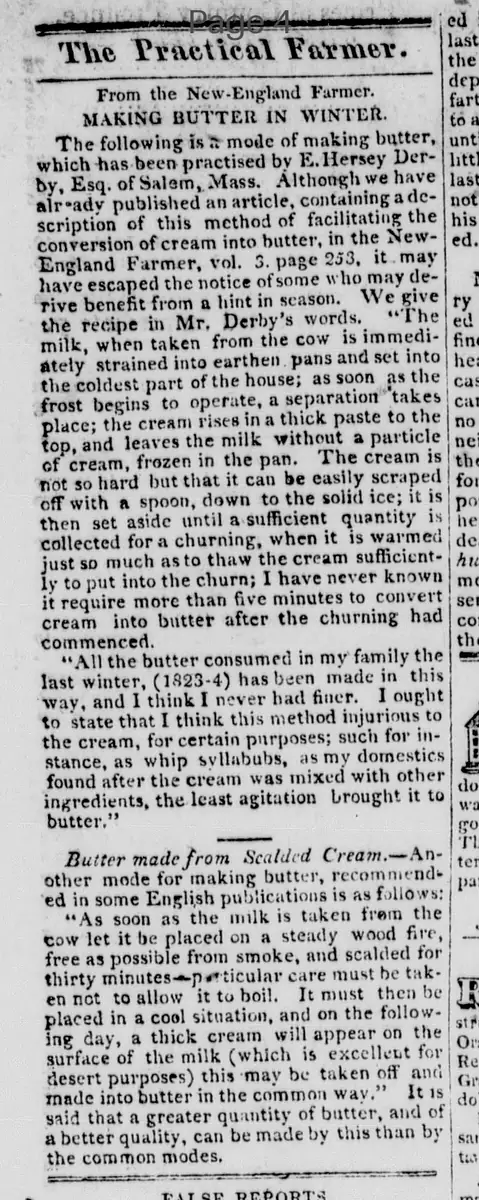
The Practical Farmer.
From the New-England Farmer.
MAKING BUTTER IN WINTER.
The following is a mode of making butter, which has been practised by E. Derby, Esq. of Salem, Mass. Although we have already published an article, containing a description of this method of facilitating the conversion of cream into butter, in the New-England Farmer, vol. 3. page 253, it may give benefit from a hint in season. We give the recipe in Mr. Derby's words. "The milk, when taken from the cow is immediately strained into earthen pans and set into the coldest part of the house; as soon as the frost begins to operate, a separation takes place; the cream rises in a thick paste to the top, and leaves the milk without a particle of cream, frozen in the pan. The cream is not so hard but that it can be easily scraped off with a spoon, down to the solid ice; it is then set aside until a sufficient quantity is collected for a churning, when it is warmed just so much as to thaw the cream sufficiently to put into the churn; I have never known it require more than five minutes to convert cream into butter after the churning had commenced.
"All the butter consumed in my family the last winter, (1823-4) has been made in this way, and I think I never had finer. I ought to state that I think this method injurious to the cream, for certain purposes; such for instance, as whips syllabubs, as my domestics found after the cream was mixed with other ingredients, the least agitation brought it to butter."
Butter made from Scalded Cream.--Another mode for making butter, recommended in some English publications is as follows: "As soon as the milk is taken from the cow let it be placed on a steady wood fire, free as possible from smoke, and scalded for thirty minutes--particular care must be taken not to allow it to boil. It must then be placed in a cool situation, and on the following day, a thick cream will appear on the surface of the milk (which is excellent for desert purposes) this may be taken off and made into butter in the common way." It is said that a greater quantity of butter, and of a better quality, can be made by this than by the common modes.
From the New-England Farmer.
MAKING BUTTER IN WINTER.
The following is a mode of making butter, which has been practised by E. Derby, Esq. of Salem, Mass. Although we have already published an article, containing a description of this method of facilitating the conversion of cream into butter, in the New-England Farmer, vol. 3. page 253, it may give benefit from a hint in season. We give the recipe in Mr. Derby's words. "The milk, when taken from the cow is immediately strained into earthen pans and set into the coldest part of the house; as soon as the frost begins to operate, a separation takes place; the cream rises in a thick paste to the top, and leaves the milk without a particle of cream, frozen in the pan. The cream is not so hard but that it can be easily scraped off with a spoon, down to the solid ice; it is then set aside until a sufficient quantity is collected for a churning, when it is warmed just so much as to thaw the cream sufficiently to put into the churn; I have never known it require more than five minutes to convert cream into butter after the churning had commenced.
"All the butter consumed in my family the last winter, (1823-4) has been made in this way, and I think I never had finer. I ought to state that I think this method injurious to the cream, for certain purposes; such for instance, as whips syllabubs, as my domestics found after the cream was mixed with other ingredients, the least agitation brought it to butter."
Butter made from Scalded Cream.--Another mode for making butter, recommended in some English publications is as follows: "As soon as the milk is taken from the cow let it be placed on a steady wood fire, free as possible from smoke, and scalded for thirty minutes--particular care must be taken not to allow it to boil. It must then be placed in a cool situation, and on the following day, a thick cream will appear on the surface of the milk (which is excellent for desert purposes) this may be taken off and made into butter in the common way." It is said that a greater quantity of butter, and of a better quality, can be made by this than by the common modes.
What sub-type of article is it?
Essay
What themes does it cover?
Agriculture Rural
What keywords are associated?
Butter Making
Winter Cream
Frozen Milk
Scalded Cream
Dairy Farming
What entities or persons were involved?
E. Derby, Esq. Of Salem, Mass.; From English Publications
Literary Details
Title
Making Butter In Winter
Author
E. Derby, Esq. Of Salem, Mass.; From English Publications
Subject
Methods For Making Butter In Winter
Key Lines
The Milk, When Taken From The Cow Is Immediately Strained Into Earthen Pans And Set Into The Coldest Part Of The House; As Soon As The Frost Begins To Operate, A Separation Takes Place; The Cream Rises In A Thick Paste To The Top, And Leaves The Milk Without A Particle Of Cream, Frozen In The Pan.
I Have Never Known It Require More Than Five Minutes To Convert Cream Into Butter After The Churning Had Commenced.
As Soon As The Milk Is Taken From The Cow Let It Be Placed On A Steady Wood Fire, Free As Possible From Smoke, And Scalded For Thirty Minutes Particular Care Must Be Taken Not To Allow It To Boil.