Thank you for visiting SNEWPapers!
Sign up free
Story
November 29, 1873
The Richmond Palladium
Richmond, Wayne County, Indiana
What is this article about?
Editorial on deforestation's harms: reduced rain, soil loss, river shallowness and floods in US West; restoration challenges as in Spain, successes elsewhere; urges preservation via regulations, coal use, and planting.
Clipping
OCR Quality
98%
Excellent
Full Text
Preservation of Forests.
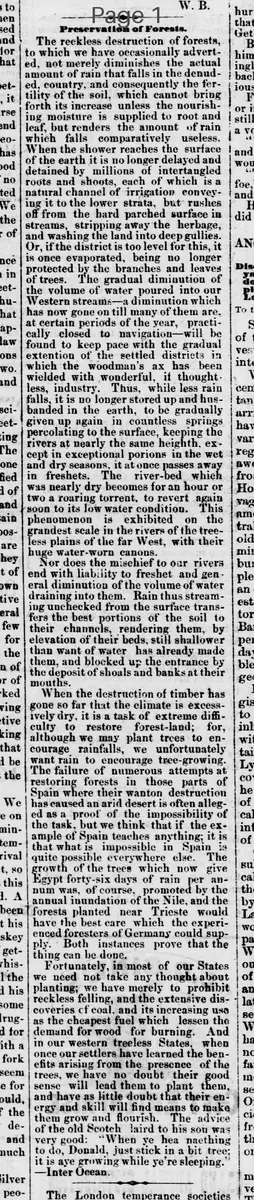
The reckless destruction of forests, to which we have occasionally adverted, not merely diminishes the actual amount of rain that falls in the denuded country, and consequently the fertility of the soil, which cannot bring forth its increase unless the nourishing moisture is supplied to root and leaf, but renders the amount of rain which falls comparatively useless. When the shower reaches the surface of the earth it is no longer delayed and detained by millions of intertangled roots and shoots, each of which is a natural channel of irrigation conveying it to the lower strata, but rushes off from the hard parched surface in streams, stripping away the herbage, and washing the land into deep gullies. Or, if the district is too level for this, it is once evaporated, being no longer protected by the branches and leaves of trees. The gradual diminution of the volume of water poured into our Western streams—a diminution which has now gone on till many of them are, at certain periods of the year, practically closed to navigation—will be found to keep pace with the gradual extension of the settled districts in which the woodman's ax has been wielded with wonderful, if thoughtless, industry. Thus, while less rain falls, it is no longer stored up and husbanded in the earth, to be gradually given up again in countless springs percolating to the surface, keeping the rivers at nearly the same height, except in exceptional portions in the wet and dry seasons, it at once passes away in freshets. The river-bed which was nearly dry becomes for an hour or two a roaring torrent, to revert again soon to its low water condition. This phenomenon is exhibited on the grandest scale in the rivers of the treeless plains of the far West, with their huge water-worn canons.
Nor does the mischief to our rivers end with liability to freshet and general diminution of the volume of water draining into them. Rain thus streaming unchecked from the surface transfers the best portions of the soil to their channels, rendering them, by elevation of their beds, still shallower than want of water has already made them, and blocked up the entrance by the deposit of shoals and banks at their mouths.
When the destruction of timber has gone so far that the climate is excessively dry, it is a task of extreme difficulty to restore forest-land; for, although we may plant trees to encourage rainfalls, we unfortunately want rain to encourage tree-growing. The failure of numerous attempts at restoring forests in those parts of Spain where their wanton destruction has caused an arid desert is often alleged as a proof of the impossibility of the task, but we think that if the example of Spain teaches anything, it is that what is impossible in Spain is quite possible everywhere else. The growth of the trees which now give Egypt forty-six days of rain per annum was, of course, promoted by the annual inundation of the Nile, and the forests planted near Trieste would have the best care which the experienced foresters of Germany could supply. Both instances prove that the thing can be done.
Fortunately, in most of our States we need not take any thought about planting; we have merely to prohibit reckless felling, and the extensive discoveries of coal, and its increasing use as the cheapest fuel which lessen the demand for wood for burning. And in our western treeless States, when once our settlers have learned the benefits arising from the presence of the trees, we have no doubt their good sense will lead them to plant them, and have as little doubt that their energy and skill will find means to make them grow and flourish. The advice of the old Scotch laird to his son was very good: "When ye hae naething to do, Donald, just stick in a bit tree; it is aye growing while ye're sleeping."
The reckless destruction of forests, to which we have occasionally adverted, not merely diminishes the actual amount of rain that falls in the denuded country, and consequently the fertility of the soil, which cannot bring forth its increase unless the nourishing moisture is supplied to root and leaf, but renders the amount of rain which falls comparatively useless. When the shower reaches the surface of the earth it is no longer delayed and detained by millions of intertangled roots and shoots, each of which is a natural channel of irrigation conveying it to the lower strata, but rushes off from the hard parched surface in streams, stripping away the herbage, and washing the land into deep gullies. Or, if the district is too level for this, it is once evaporated, being no longer protected by the branches and leaves of trees. The gradual diminution of the volume of water poured into our Western streams—a diminution which has now gone on till many of them are, at certain periods of the year, practically closed to navigation—will be found to keep pace with the gradual extension of the settled districts in which the woodman's ax has been wielded with wonderful, if thoughtless, industry. Thus, while less rain falls, it is no longer stored up and husbanded in the earth, to be gradually given up again in countless springs percolating to the surface, keeping the rivers at nearly the same height, except in exceptional portions in the wet and dry seasons, it at once passes away in freshets. The river-bed which was nearly dry becomes for an hour or two a roaring torrent, to revert again soon to its low water condition. This phenomenon is exhibited on the grandest scale in the rivers of the treeless plains of the far West, with their huge water-worn canons.
Nor does the mischief to our rivers end with liability to freshet and general diminution of the volume of water draining into them. Rain thus streaming unchecked from the surface transfers the best portions of the soil to their channels, rendering them, by elevation of their beds, still shallower than want of water has already made them, and blocked up the entrance by the deposit of shoals and banks at their mouths.
When the destruction of timber has gone so far that the climate is excessively dry, it is a task of extreme difficulty to restore forest-land; for, although we may plant trees to encourage rainfalls, we unfortunately want rain to encourage tree-growing. The failure of numerous attempts at restoring forests in those parts of Spain where their wanton destruction has caused an arid desert is often alleged as a proof of the impossibility of the task, but we think that if the example of Spain teaches anything, it is that what is impossible in Spain is quite possible everywhere else. The growth of the trees which now give Egypt forty-six days of rain per annum was, of course, promoted by the annual inundation of the Nile, and the forests planted near Trieste would have the best care which the experienced foresters of Germany could supply. Both instances prove that the thing can be done.
Fortunately, in most of our States we need not take any thought about planting; we have merely to prohibit reckless felling, and the extensive discoveries of coal, and its increasing use as the cheapest fuel which lessen the demand for wood for burning. And in our western treeless States, when once our settlers have learned the benefits arising from the presence of the trees, we have no doubt their good sense will lead them to plant them, and have as little doubt that their energy and skill will find means to make them grow and flourish. The advice of the old Scotch laird to his son was very good: "When ye hae naething to do, Donald, just stick in a bit tree; it is aye growing while ye're sleeping."
What sub-type of article is it?
Environmental Advocacy
Scientific Explanation
What themes does it cover?
Nature
Catastrophe
Moral Virtue
What keywords are associated?
Deforestation
Forest Preservation
Rainfall Reduction
Soil Erosion
River Freshets
Climate Dryness
Where did it happen?
Western United States, Spain, Egypt, Trieste
Story Details
Location
Western United States, Spain, Egypt, Trieste
Story Details
The article explains how deforestation reduces rainfall, causes soil erosion, diminishes river volumes leading to navigation issues and freshets, and makes restoration difficult in dry climates. It contrasts failed efforts in Spain with successes in Egypt and near Trieste, advocating prohibition of reckless felling, use of coal, and planting in treeless states.