Thank you for visiting SNEWPapers!
Sign up free
Elko Independent
Elko, Elko County, Nevada
What is this article about?
St. Louis inventor develops secret paint that deadens torpedoes, making ships invulnerable to submarines. Miniature torpedo test on lake failed to explode 40 times. Composition secret; will be presented to Navy Department.
Clipping
OCR Quality
Full Text
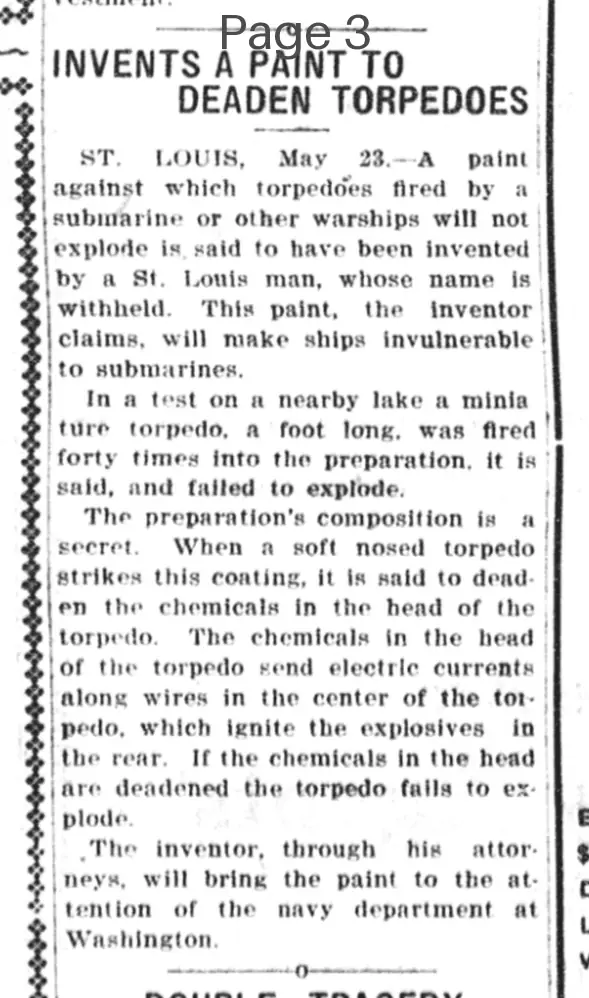
DEADEN TORPEDOES
ST. LOUIS, May 23.—A paint against which torpedoes fired by a submarine or other warships will not explode is said to have been invented by a St. Louis man, whose name is withheld. This paint, the inventor claims, will make ships invulnerable to submarines.
In a test on a nearby lake a miniature torpedo, a foot long, was fired forty times into the preparation, it is said, and failed to explode.
The preparation's composition is a secret. When a soft nosed torpedo strikes this coating, it is said to deaden the chemicals in the head of the torpedo. The chemicals in the head of the torpedo generate electric currents along wires in the center of the torpedo, which ignite the explosives in the rear. If the chemicals in the head are deadened the torpedo fails to explode.
The inventor, through his attorneys, will bring the paint to the attention of the navy department at Washington.
What sub-type of article is it?
What keywords are associated?
Where did it happen?
Domestic News Details
Primary Location
St. Louis
Event Date
May 23
Outcome
miniature torpedo failed to explode after 40 tests; paint to be presented to navy department.
Event Details
A St. Louis man invented a secret paint that deadens torpedoes fired by submarines or warships, making ships invulnerable. In a lake test, a foot-long miniature torpedo was fired 40 times into the preparation without exploding. The paint deadens chemicals in the torpedo's head, preventing ignition of rear explosives.