Thank you for visiting SNEWPapers!
Sign up free
The National Republican And Cincinnati Daily Mercantile Advertiser
Cincinnati, Hamilton County, Ohio
What is this article about?
On February 2, 1833, in the House of Representatives, Mr. Plummer of Mississippi spoke in defense of General Land Office Commissioner Mr. Hayward against a resolution by Mr. Wilde inquiring into the office's appropriations, arrearages, abuses, and personnel conduct, criticizing it as a political attack and highlighting prior failed investigations.
Merged-components note: Parts of the same article: introduction and full text of Mr. Plummer's speech on land office matters, including 'remainder to-morrow' note.
Clipping
OCR Quality
Full Text
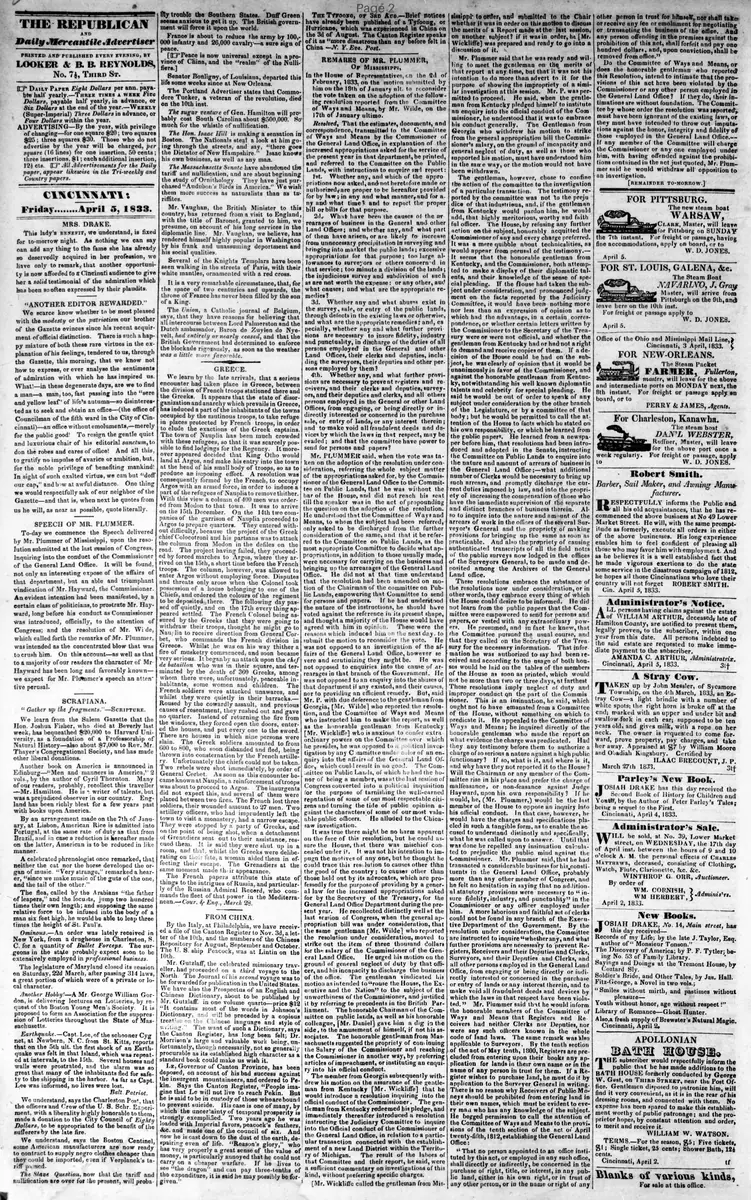
To-day we commence the Speech delivered by Mr. Plummer of Mississippi, upon the resolution submitted at the last session of Congress, inquiring into the conduct of the Commissioner of the General Land Office. It will be found, not only an interesting expose of the affairs of that department, but an able and triumphant vindication of Mr. Hayward, the Commissioner. An evident intention had been manifested, by a certain class of politicians, to prostrate Mr. Hayward, long before his conduct as Commissioner was introduced, officially, to the attention of Congress; and the resolution of Mr. Wilde, which called forth the remarks of Mr. Plummer, was intended as the concentrated blow that was to crush him. On this account-as well as that to a majority of our readers the character of Mr. Hayward has been long and favorably known- we expect for Mr. Plummer's speech an attentive perusal.
REMARKS OF MR. PLUMMER, OF MISSISSIPPI,
In the House of Representatives, on the 2d of February, 1833. on the motion submitted by him on the 18th of January ult. to reconsider the vote taken on the adoption of the following resolution reported from the Committee of Ways and Means, by Mr. Wilde, on the 17th of January ultimo.
Resolved, That the estimates, documents, and correspondence, transmitted to the Committee of Ways and Means by the Commissioner of the General Land Office, in explanation of the increased appropriations asked for the service of the present year in that department, be printed, and referred to the Committee on the Public Lands, with instructions to inquire and report:
1st. Whether any, and which of the appropriations now asked, and not heretofore made or authorized, are proper to be hereafter provided for by law; in any and what manner, and for any and what time? and to report the proper bill or bills for that purpose.
2d. What have been the causes of the arrearages of business in the General and other Land Offices; and whether any, and what part of them have arisen, or are likely to increase from unnecessary precipitation in surveying and bringing into market the public lands; excessive appropriations for that purpose; too large allowances to surveyors or others concerned in that service; too minute a division of the lands; the injudicious survey and subdivision of such as are not worth the expense: or any other, and what causes; and what are the appropriate remedies?
3d. Whether any and what abuses exist in the survey, sale, or entry of the public lands, through defects in the existing laws or otherwise, and what are the appropriate remedies; and, especially, whether any and what further provisions are necessary to insure fidelity, industry and punctuality, in discharge of the duties of all persons employed in the General and other Land Offices, their clerks and deputies, including the surveyors, their deputies and other persons employed by them?
4th. Whether any, and what further provisions are necessary to prevent registers and receivers, and their clerks and deputies, surveyors, and their deputies and clerks, and all other persons employed in the General or other Land Offices, from engaging, or being directly or indirectly interested or concerned in the purchase, sale, or entry of lands, or any interest therein; and to make void all fraudulent deeds and devices by which the laws in that respect, may be evaded; and that the committee have power to send for persons and papers?
Mr. PLUMMER said, when the vote was taken on the adoption of the resolution under consideration, referring the whole subject matter of the appropriations asked for, by the Commissioner of the General Land Office to the Committee on Public Lands, that he was without the bar of the House, and did not reach his seat till the Speaker was in the act of propounding the question on the adoption of the resolution. He understood that the Committee of Ways and Means, to whom the subject had been referred, only asked to be discharged from the further consideration of the same, and that it be referred to the Committee on Public Lands, as the most appropriate Committee to decide what appropriations, in addition to those usually made, were necessary for carrying on the business and bringing up the arrearages of the General Land Office.
He did not at that time understand that the resolution had been amended on motion of the Chairman of the committee on Public Lands, empowering that Committee to send for persons and papers. If he had understood the nature of the instructions, he should have voted against the reference in its present shape, and thought a majority of the House would have agreed with him in opinion. These were the reasons which induced him on the next day, to submit the motion to reconsider the vote. He was not opposed to an investigation of the affairs of the General Land Office, however severe and scrutinizing they might be. He was not opposed to enquiries into the cause of arrearages in that branch of the Government. He was not opposed to an enquiry into the abuses of that department if any existed, and their causes, nor to providing an efficient remedy. But, said Mr. P. with due deference to the gentleman from Georgia, (Mr. Wilde) who reported the resolution, and the Committee of Ways and Means who instructed him to make the report, as well as the honorable gentleman from Kentucky [Mr. Wickliffe] who is anxious to confer extraordinary powers on the Committee over which he presides, he was opposed to a political investigation by any Committee under color of an enquiry into the affairs of the General Land Office, which could result in no good. The Committee on Public Lands, of which he had the honor of being a member, was at the last session of Congress converted into a political inquisition for the purpose of tarnishing the well-earned reputation of some of our most respectable citizens and turning the tide of public opinion against the characters of some of our most valuable public officers.
He alluded to the Chicago investigation.
It was true there might be no harm apparent on the face of this resolution, but he could assure the House, that there was mischief concealed under it. It was not his intention to impugn the motives of anyone, but he thought he could trace this resolution to causes other than the good of the country; to causes other than those held out by its advocates, which are professedly for the purpose of providing by a general law for the increased appropriations asked for by the Secretary of the Treasury, for the General Land Office Department during the present year. He recollected distinctly well at the last session of Congress, when the general appropriation bill was under consideration, that the same gentleman [Mr. Wilde] who reported the resolution under consideration, moved to strike out the item of three thousand dollars for the salary of the Commissioner of the General Land Office.
He urged his motion on the ground of general neglect of duty by that officer, and his incapacity to discharge the business of the office. The gentleman vindicated his motion as intended to "rouse the House, the Executive and the Nation" to the subject of the unworthiness of the Commissioner, and justified it by referring to precedents in the British Parliament. The honorable Chairman of the Committee on public lands, as well as his honorable colleague, [Mr. Daniel] gave him a dig in the side, to the amusement of himself, if not his associates. The honorable gentleman from Massachusetts suggested the propriety of continuing the Salary of the Commissioner and reaching the Commissioner in another way, by preferring articles of impeachment, or instituting an enquiry into his official conduct.
The member from Georgia subsequently withdrew his motion on the assurance of the gentleman from Kentucky [Mr. Wickliffe] that he would introduce a resolution inquiring into the official conduct of the Commissioner. The gentleman from Kentucky redeemed his pledge, and immediately thereafter introduced a resolution instructing the Judiciary Committee to inquire into the Official conduct of the Commissioner of the General Land Office, in relation to a particular transaction connected with the establishment of a new Land District within the Territory of Michigan. The result of the labors of that Committee and their report, he said, were a sufficient commentary on investigations of this kind, without preferring specific charges.
[Mr. Wickliffe called the gentleman from Mississippi to order, and submitted to the Chair whether it was in order on this motion to discuss the merits of a Report made at the last session, on another subject? if it was in order, he [Mr. Wickliffe] was prepared and ready to go into a discussion of it.]
Mr. Plummer said that he was ready and willing to meet the gentleman on the merits of that report at any time, but that it was not his intention to do more than advert to it for the purpose of showing the impropriety of a similar investigation at this session. Mr. P. was permitted to proceed. He said, when the gentleman from Kentucky pledged himself to institute an enquiry into the official conduct of the Commissioner, he understood that it was to embrace his conduct generally. The Gentleman from Georgia who withdrew his motion to strike from the general appropriation bill the Commissioner's salary, on the ground of incapacity and general neglect of duty, as well as those who supported his motion, must have understood him in the same way, or the motion would not have been withdrawn.
The gentleman, however, chose to confine the action of the committee to the investigation of a particular transaction. The testimony reported by the committee was not to the prejudice of that industrious, and, if the gentleman from Kentucky would pardon him, he would add, that highly meritorious, worthy and faithful officer. The House, by refusing any further action on the subject, honorably acquitted the Commissioner of any and every charge preferred.
It was a mere quibble about technicalities, as would appear from perusal of the testimony.—It seems that the honorable gentleman from Kentucky, and the Commissioner, both attempted to make a display of their diplomatic talents, and their knowledge of the sense of special pleading. If the House had taken the subject under consideration, and pronounced judgment on the facts reported by the Judiciary Committee, it would have been nothing more nor less than an expression of opinion as to which had the advantage, in a certain correspondence, or whether certain letters written by the Commissioner to the Secretary of the Treasury were or were not official, and whether the gentleman from Kentucky had or had not a right to demand and receive copies of them. If a decision of the House could be had on the subject, he was clearly of opinion that it would be unanimously in favor of the Commissioner, and against the honorable gentleman from Kentucky, notwithstanding his well known diplomatic talents and celebrity for special pleading. He said he would be out of order to speak of any subject under consideration by the other branch of the Legislature, or by a committee of that body; but he would be permitted to call the attention of the House to facts which he stated on his own responsibility, or which he learned from the public papers. He learned from a newspaper before him, that resolutions had been introduced and adopted in the Senate, instructing the Committee on Public Lands to enquire into the nature and amount of arrears of business in the General Land Office:- what additional number of Clerks would be necessary to bring up such arrears, and promptly discharge the current duties imposed by law, and into the propriety of increasing the compensation of those who have the immediate supervision of the separate and distinct branches of business therein. Also to inquire into the nature and amount of the arrears of work in the offices of the several Surveyor's General and the propriety of making provisions for bringing up the same as soon as practicable. And also the propriety of causing authenticated transcripts of all the field notes of the public surveys now lodged in the offices of the Surveyors General, to be made and deposited among the Archives of the General Land office.
These resolutions embrace the substance of the resolutions now under consideration, or in other words, they embrace every thing of which the House could desire to be informed. He did not learn from the public papers that the Committee were empowered to send for persons and papers, or vested with any extraordinary powers.
He presumed, and in fact he knew, that the Committee pursued the usual course, and that they called on the Secretary of the Treasury for the necessary information. That information he was authorized to say had been received and according to the usage of both houses would be laid on the tables of the members of the House as soon as printed, which would not be more than two or three days, at farthest.
These resolutions imply neglect of duty and improper conduct on the part of the Commissioner. This is an insinuation, he said, which ought not to have emanated from a Committee of the House, without something on which to predicate it. He appealed to the Committee of Ways and Means; he inquired directly of the honorable gentleman who made the report on what evidence the charge was predicated. Had they any testimony before them to authorize a charge of so serious a nature against a high public functionary? If so, what is it, and where is it and why have they not reported it to the House? Will the Chairman or any member of the Committee rise in his place and prefer the charge of malfeasance, or non-feasance against Judge Hayward, upon his own responsibility? If he would, he, (Mr. Plummer,) would be the last member of the House to oppose an inquiry into his official conduct. In that case, however, he would have the charges and specifications placed in such a tangible form, as to enable the accused to understand distinctly and specifically, what he was called upon to answer. Until that was done he repelled any insinuation calculated to prejudice the public mind against the Commissioner. Mr. Plummer said, that he had transacted a considerable business for his constituents in the General Land Office, probably more than any other member of Congress, and he felt no hesitation in saying that no additional statutory provisions were necessary to "insure fidelity, industry, and punctuality" in the Commissioner or any officer employed under him. A more laborious and faithful set of clerks could not be found in any branch of the Executive Department of the Government. By the resolution under consideration, the Committee are instructed to inquire "whether any, and what further provisions are necessary to prevent Registers, Receivers and their Deputies and Clerks, Surveyors, and their Deputies and Clerks, and all other persons employed in the General Land Office, from engaging or being directly or indirectly interested or concerned in the purchase or entry of lands or any interest therein, and to make void all fraudulent deeds and devices by which the laws in that respect have been violated." Mr. Plummer said that he would inform the honorable members of the Committee of Ways and Means that Registers and Receivers had neither Clerks nor Deputies, nor were any such officers known in the whole code of land laws. The same remark was also applicable to Surveyors. By the tenth section of the act of May tenth, 1800, Registers are precluded from entering upon their books any application for lands in their own name or in the name of any person in trust for them. If a Register wishes to purchase land, he must do it by application to the Surveyor General in writing. There is no reason why Receivers of Public Moneys should be prohibited from entering land in their own names, which must be evident to every man who has any knowledge of the subject. He begged permission to call the attention of the Committee of Ways and Means to the provisions of the tenth section of the act of April twenty-fifth, 1812, establishing the General Land Office:
"That no person appointed to an office instituted by this act, or employed in any such office, shall directly or indirectly, be concerned in the purchase of right, title, or interest, in any public land, either in his own right, or in trust of any other person, or in the name or right of any other person in trust for himself, nor shall take or receive any fee or emolument for negotiating or transacting the business of the office. And any person offending in the premises against the prohibition of this act, shall forfeit and pay one hundred dollars, and, upon conviction, shall be removed from office."
Do the Committee of Ways and Means, or does the honorable gentleman who reported this Resolution, intend to intimate that the provisions of this act have been violated by the Commissioner or any other person employed in the General Land Office? If they do, their insinuations are without foundation. The Committee by whose order the resolution was reported; must have been ignorant of the existing laws, or they must have intended to throw out imputations against the honor, integrity and fidelity of those employed in the General Land Office.--If any member of the Committee will charge the Commissioner or any one employed under him, with having offended against the prohibitions contained in the act just quoted, Mr. Plummer said he would withdraw all opposition to an investigation.
[REMAINDER TO-MORROW.]
What sub-type of article is it?
What keywords are associated?
What entities or persons were involved?
Where did it happen?
Domestic News Details
Primary Location
House Of Representatives
Event Date
February 2, 1833
Key Persons
Event Details
Mr. Plummer delivered a speech moving to reconsider a vote on a resolution reported by Mr. Wilde from the Committee of Ways and Means, referring documents from the Commissioner of the General Land Office to the Committee on Public Lands for inquiry into appropriations, arrearages, abuses, and provisions against conflicts of interest, arguing it was a political attack rather than a legitimate investigation and defending Mr. Hayward's conduct based on prior acquittals and existing laws.