Thank you for visiting SNEWPapers!
Sign up free
The National Intelligencer And Washington Advertiser
Washington, District Of Columbia
What is this article about?
In the U.S. House of Representatives on March 5, Mr. Gregg delivers a speech supporting a resolution for non-importation of British goods until grievances over impressment of American seamen and seizures of vessels are resolved, emphasizing national honor and commerce protection.
Merged-components note: These two components form a continuous narrative report of the congressional debate on British affairs, spanning pages 2 and 3 with sequential reading orders and seamless text continuation, ending in '(TO BE CONTINUED.)'.
Clippings
1 of 2
OCR Quality
Full Text
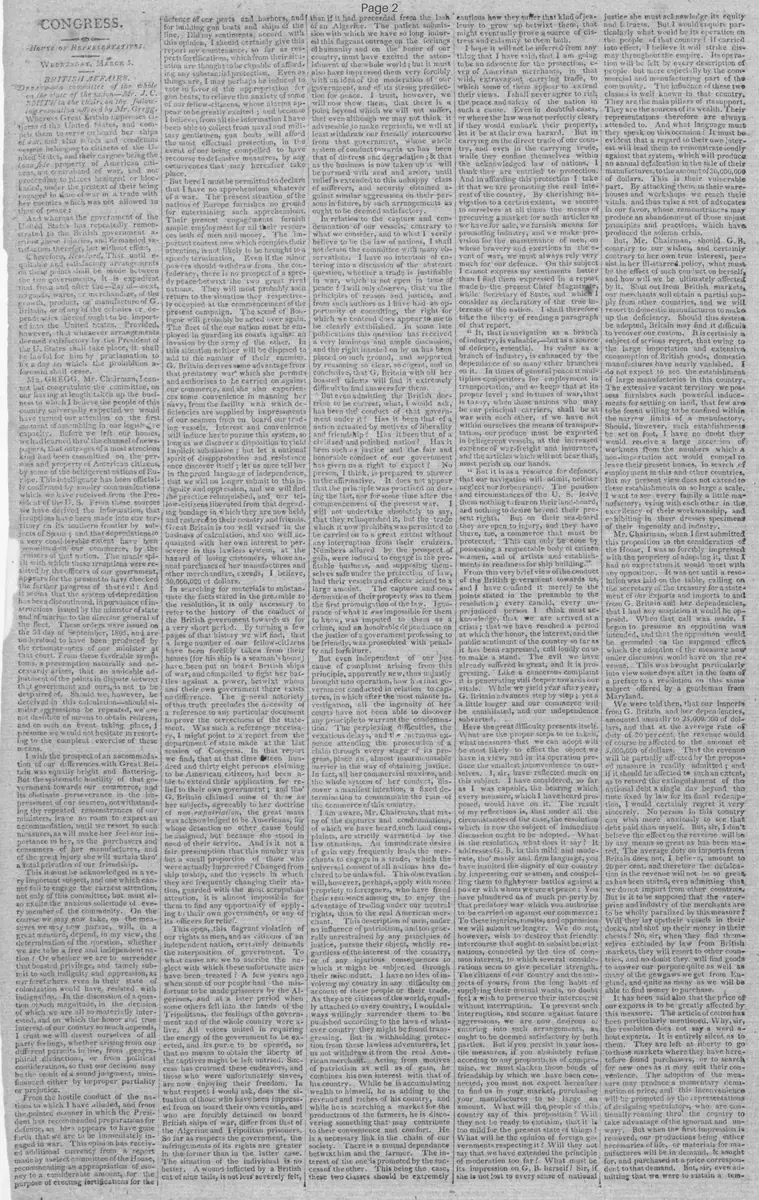
HOUSE OF REPRESENTATIVES.
WEDNESDAY, MARCH 5.
BRITISH AFFAIRS.
During committee of the whole on the state of the union—Mr. J.C. Smith in the chair, on the following resolution offered by Mr. Gregg.
Whereas Great Britain impresses citizens of the United States, and compels them to serve on board her ships of war, and also seizes and condemns vessels belonging to citizens of the United States, and their cargoes being the bona fide property of American citizens, not contraband of war, and not proceeding to places besieged or blockaded, under the pretext of their being engaged in time of war in a trade with her enemies which was not allowed in time of peace:
And whereas the government of the United States has repeatedly remonstrated to the British government against these injuries, and demanded satisfaction therefor, but without effect,
Therefore, Resolved, That until equitable and satisfactory arrangements on these points shall be made between the two governments, it is expedient that from and after the — day of — next, no goods, wares, or merchandize, of the growth, product, or manufacture of Great Britain, or of any of the colonies or dependencies thereof ought to be imported into the United States. Provided, however, that whenever arrangements deemed satisfactory by the President of the U. States shall take place, it shall be lawful for him by proclamation to fix a day on which the prohibition aforesaid shall cease.
Mr. GREGg. Mr. Chairman, I cannot but congratulate the committee, on our having at length taken up the business to which I believe the people of this country universally expected we would have turned our attention on the first moment of assembling in our legislative capacity. Before we left our homes, we had learned thro’ the channel of newspapers, that outrages of a most atrocious kind had been committed on the persons and property of American citizens, by some of the belligerent nations of Europe. This intelligence has been officially confirmed by sundry communications which we have received from the President of the U. S. From these sources we have derived the information, that irruptions have been made into our territory on its southern frontier by subjects of Spain: and that depredations to a very considerable extent have been committed on our commerce, by the cruisers of that nation. The manly spirit with which these irruptions were resisted by the officers of our government, appears for the present to have checked the farther progress of that evil: And it seems that the system of depredation has been discontinued, in pursuance of instructions issued by the minister of state and of marine to the director general of the fleet. These orders were issued on the 31 day of September, 1805, and are understood to have been produced by the remonstrances of our minister at that court. From these favorable symptoms, a presumption naturally and necessarily arises, that an amicable adjustment of the points in dispute betwixt that government and ours, is not to be despaired of. Should we, however, be deceived in this calculation should similar aggressions be repeated, we are not destitute of means to obtain redress, and on such an event taking place, I presume we would not hesitate in resorting to the compleat exercise of these means.
I wish the prospect of an accommodation of our differences with Great Britain was equally bright and flattering. But the systematic hostility of that government towards our commerce, and its obstinate perseverance in the impressment of our seamen, notwithstanding the repeated remonstrances of our ministers, leave no room to expect an accommodation, until we resort to such measures, as will make her feel our importance to her, as the purchasers and consumers of her manufactures, and of the great injury she will sustain thro’ a total privation of our friendship.
This it must be acknowledged is a very important subject, and one which cannot fail to engage the earnest attention, not only of this committee, but must also excite the anxious solicitude of every member of the community. On the course we may now take, on the measures we may now pursue, will, in a great measure, depend, in my view, the determination of the question, whether we are to be a free and independent nation! Or whether we are to surrender that boasted privilege, and tamely submit to such indignity and oppression, as our forefathers even in their state of colonization would have, resisted with indignation, In the discussion of a question of such magnitude, in the decision of which we are all so materially interested, and on which the honor and true interest of our country so much depends, I trust we will divest ourselves of all party feelings, whether arising from our different pursuits in life, from geographical distinctions, or from political considerations, so that our decision may be the result of a sound judgment, uninfluenced either by improper partiality or prejudice.
From the hostile conduct of the nations to which I have alluded, and from the pointed manner in which the President has recommended preparations for defence, an idea appears to have gone forth that we are to be immediately engaged in war. This opinion has received additional currency from a report made by a select committee of the House, recommending an appropriation of money to a considerable amount, for the purpose of erecting fortifications or the defence of our ports and harbors, and for building gun boats and ships of the line. Did my sentiments, accord with this opinion, I should certainly give this report my countenance, so far as respects fortifications. which from their situation are thought to be capable of affording any substantial protection. Even as things are, I may perhaps be induced to vote in favor of the appropriation for gun boats, to relieve the anxiety of some of our fellow-citizens, whose alarms appear to be greatly excited ; and because I believe, from all the information I have been able to collect from naval and military gentlemen, gun boats will afford the most effectual protection, in the event of our being compelled to have recourse to defensive measures, by any occurrences that may hereafter take place.
But here I must be permitted to declare that I have no apprehensions whatever of a war. The present situation of the nations of Europe furnishes no ground for entertaining such apprehensions. Their present engagements furnish ample employment for all their resources both of men and money. The important contest now which occupies their attention, is not likely to be brought to a speedy termination. Even if the minor powers should withdraw from the confederacy, there is no prospect of a speedy peace betwixt the two great rival nations. They will most probably soon return to the situation they respectively occupied at the commencement of the present campaign. The scene of Boulogne will probably be acted over again. The fleet of the one nation must be employed in guarding its coasts against an invasion by the army of the other. In this situation neither will be disposed to add to the number of their enemies.
G. Britain derives some advantage from that predatory war which she permits and authorises to be carried on against our commerce, and she also experiences some convenience in manning her navy, from the facility with which deficiencies are supplied by impressments of our seamen from on board our trading vessels. Interest and convenience will induce her to pursue this system, so long as we discover a disposition to yield implicit submission ; but let a national spirit of disapprobation and resistance once discover itself; let us once tell her in the proud language of independence, that we will no longer submit to this indignity and oppression, and we will find the practice relinquished, and our fellow-citizens liberated from that degrading bondage in which they are now held, and restored to their country and friends. Great Britain is too well versed in the business of calculation, and too well acquainted with her own interest to persevere in this lawless system, at the hazard of losing customers, whose annual purchases of her manufactures and other merchandize, exceeds, I believe, 30,000,000 of dollars.
In searching for materials to substantiate the facts stated in the preamble to the resolution, it is only necessary to refer to the history of the conduct of the British government towards us for a very short period. By turning a few pages of that history we will find, that a large number of our fellow-citizens have been forcibly taken from their homes (for his ship is a seaman's home) have been put on board British ships of war, and compelled to fight her battles against a power, betwixt whom and their own government there exists no difference. The general notoriety of this truth precludes the necessity of a reference to any particular document to prove the correctness of the statement. Was such a reference necessary, I might point to a report from the department of state made at the last session of Congress. In that report we find, that at that time fifteen hundred and thirty eight persons claiming to be American citizens, had been able to extend their application for relief to their own government: and tho’ G. Britain claimed some of these as her subjects, agreeably to her doctrine of non-expatriation, the great mass was acknowledged to be Americans, for whose detention no other cause could be assigned, but because she stood in need of their service. And is it not a fair presumption that this number was but a small proportion of those who were actually impressed? Changed from ship to ship, and the vessels in which they are frequently changing their station, guarded with the most scrupulous attention, it is almost impossible for them to find any opportunity of applying to their own government, or any of its officers for relief.
This open, this flagrant violation of our rights as men, and as citizens of an independent nation, certainly demands the interposition of government. To what cause are we to ascribe the neglect with which these unfortunate men have been treated ? A few years ago when some of our people had the misfortune to be made prisoners by the Algerines, and at a later period when some others fell into the hands of the Tripolitans, the feelings of the government and of the whole country were alive. All voices united in requiring the energy of the government to be exerted, and its purse to be opened, so that no means to obtain the liberty of the captives might be left untried. Success has crowned these endeavors, and those who were unfortunately slaves, are now enjoying their freedom. In what respect I would ask, does the situation of those who have been impressed from on board their own vessels, and who are forcibly detained on board British ships of war, differ from that of the Algerine and Tripolitan prisoners, So far as respects the government, the infringements of its rights are greater in the former than in the latter case. The situation of the individual is no better. A wound inflicted by a British cat of nine tails, is not less severely felt, than if it had proceeded from the lash of an Algerine. The patient submission with which we have so long endured this flagrant outrage on the feelings of humanity and on the honor of our country, must have excited the astonishment of the whole world ; but it must also have impressed them very forcibly with an idea of the moderation of our government, and of its strong predilection for peace. I trust, however, we will now shew them, that there is a point beyond which we will not suffer. that even although we may not think it advisable to make reprisals, we will at least withdraw our friendly intercourse from that government, whose whole system of conduct towards us has been that of distress and degradation ; & that as the business is now taken up it will be pursued with zeal and ardor, until relief is extended to this unhappy class of sufferers, and security obtained against similar aggressions on their persons in future, by such arrangements as ought to be deemed satisfactory.
In relation to the capture and condemnation of our vessels, contrary to what we consider. and to what I verily believe to be the law of nations, I shall not detain the committee with many observations. I have no intention of entering into a discussion of the abstract question, whether a trade is justifiable in war, which is not open in time of peace ? I will only observe, that on the principles of reason and justice, and from such authors as I have had an opportunity of consulting, the right for which we contend does appear to me to be clearly established. In some late publications this question has received a very luminous and ample discussion, and the right insisted on by us has been placed on such ground, and supported by reasoning so clear. so cogent, and so conclusive, that G. Britain with all her boasted talents will find it extremely difficult to find answers for them.
But even admitting the British doctrine to be correct, what, I would ask, has been the conduct of that government under it? Has it been that of a nation actuated by motives of liberality and friendship? Has it been that of a civilized and polished nation? Has it been such as justice and the fair and honorable conduct of our government has given us a right to expect ? No person, I think, is prepared to answer in the affirmative. It does not appear that the principle was practised on during the last, nor for some time after the commencement of the present war. I will not undertake absolutely to say, that they relinquished it, but the trade which it now prohibits was permitted to be carried on to a great extent without any interruption from their cruisers. Numbers allured by the prospect of gain, were induced to engage in the profitable business, and supposing themselves safe under the protection of law, had their vessels and effects seized to a large amount. The capture and condemnation of their property was to them the first promulgation of the law. Ignorance of what it was impossible for them to know, was imputed to them as a crime, and an honorable dependance on the justice of a government professing to be friendly, was prosecuted with penalty and forfeiture.
But even independent of our just cause of complaint arising from this principle, apparently new, thus unjustly brought into operation, how has that government conducted in relation to captures, in which after the most minute investigation, all the ingenuity of her courts have not been able to discover any principle to warrant the condemnation. The perplexing difficulties, the vexatious delays, and the enormous expense attending the prosecution of a claim through every stage of its progress, place an almost insurmountable barrier in the way of obtaining justice. In fact, all her commercial maxims, and the whole system of her conduct, discover a manifest intention, a fixed determination to consummate the ruin of the commerce of this country.
I am aware, Mr. Chairman, that many of the captures and condemnations, of which we have heard such loud complaints, are strictly warranted by the law of nations. An immoderate desire of gain very frequently leads the merchants to engage in a trade, which the universal consent of all nations has declared to be unlawful. This observation will, however, perhaps, apply with more propriety to foreigners, who have fixed their residence among us, to enjoy the advantage of trading under our neutral rights, than to the real American merchant. This description of men, under no influence of patriotism, and too generally unrestrained by any principles of justice, pursue their object, wholly regardless of the interest of the country, or of any injurious consequences to which it might be subjected through their misconduct. I have no idea of involving my country in any difficulty on account of these people or their trade. As they are citizens of the world, equally attached to every country, I would always willingly surrender them to be punished according to the laws of whatever country they might be found transgressing. But in withholding protection from these lawless adventurers, let us not withdraw it from the real American merchant. Acting from motives of patriotism as well as of gain, he combines his own interest with that of his country. While he is accumulating wealth to himself, he is adding to the revenue and riches of his country, and while he is searching a market for the productions of the farmers, he is discovering something that may contribute to their convenience and comfort. He is a necessary link in the chain of our society. There is a mutual dependance betwixt him and the farmer. The interest of the one is promoted by the success of the other. This being the case, these two classes should be extremely cautious how they suffer that kind of jealousy to grow up betwixt them, that might eventually prove a source of distress and calamity to them both.
I hope it will not be inferred from any thing that I have said, that I am going to be an advocate for the protection, even of American merchants, in that wild, extravagant carrying trade, to which some of them appear to extend their views. I shall never agree to risk the peace and safety of the nation in such a cause. Even in doubtful cases, or where the law was not perfectly clear if they would embark their property let it be at their own hazard. But in carrying on the direct trade of our country, and even in the carrying trade, while they confine themselves within the acknowledged law of nations, I think they are entitled to protection. And in affording this protection I take it that we are promoting the real interest of the country. By cherishing navigation to a certain extent, we secure to ourselves at all times the means of procuring a market for such articles as we have for sale, we furnish means for promoting industry, and we make provision for the maintenance of men, on whose bravery and exertions in the event of war, we must always rely very much for our defence. On this subject I cannot express my sentiments better than I find them expressed in a report made by the present Chief Magistrate, while Secretary of State. and which I consider as declaratory of the true interests of the nation, I shall therefore take the liberty of reading a paragraph of that report.
"It, that is navigation as a branch of industry, is valuable, but as a source of defence, essential. Its value as a branch of industry, is enhanced by the dependance of so many other branches on it. In times of general peace it multiplies competitors for employment in transportation, and so keeps that at its proper level ; and in times of war, that is to say, when those nations who may be our principal carriers, shall be at war with each other, if we have not within ourselves the means of transportation, our produce must be exported in belligerent vessels, at the increased expence of war-freight and insurance, and the articles which will not bear that, must perish on our hands,
" But it is as a resource for defence that our navigation will admit, neither neglect nor forbearance. The position and circumstances of the U. S. leave them nothing to fear on their land-board. and nothing to desire beyond their present rights. But on their sea-board they are open to injury, and they have there, too, a commerce that must be protected. This can only be done by possessing a respectable body of citizen seamen, and of artists and establishments in readiness for ship building."
From this very brief view of the conduct of the British government towards us, and I have confined it merely to the points stated in the preamble to the resolution; every candid, every unprejudiced person I think must acknowledge, that we are arrived at a crisis; that we have reached a period at which the honor, the interest, and the public sentiment of the country so far as it has been expressed, call loudly on us to make a stand. The evil we have already suffered is great, and it is progressing. Like a cancerous complaint it is penetrating still deeper towards our vitals. While we yield year after year. G. Britain advances step by step; yet a little longer and our commerce will be annihilated, and our independence subverted.
Here the great difficulty presents itself. What are the proper steps to be taken, what measures that we can adopt will be most likely to effect the object we have in view. and in its operation produce the smallest inconvenience to ourselves. I, sir, have reflected much on this subject. I have considered, so far as I was capable, the bearing which every measure, which I have heard proposed, would have on it. The result of my reflections is, that under all the circumstances of the case, the resolution which is now the subject of immediate discussion ought to be adopted. What is the resolution, what does it say? It addresses G. B. in this mild and moderate, tho’ manly and firm language, you have insulted the dignity of our country by impressing our seamen, and compelling them to fight your battles against a power with whom we are at peace: You have plundered us of much property by that predatory war which you authorise to be carried on against our commerce: To these injuries, insults, and oppression we will submit no longer. We do not, however, wish to destroy that friendly intercourse that ought to subsist betwixt nations, connected by the ties of common interest, to which several considerations seem to give peculiar strength. The citizens of our country and the subjects of yours, from the long habit of supplying their mutual wants, no doubt feel a wish to preserve their intercourse without interruption. To prevent such interruption, and secure against future aggressions, we are now desirous of entering into such arrangements, as ought to be deemed satisfactory by both parties. But if you persist in your hostile measures, if you absolutely refuse acceding to any propositions of compromise, we must slacken those bonds of friendship by which we have been connected, you must not expect hereafter to find us in your market, purchasing your manufactures to so large an amount. What will the people of this country say of this proposition? Will they not be ready to exclaim, that it is too mild for the present state of things? What will be the opinion of foreign governments respecting it? Will they not say that we have extended the principle of moderation too far? What must be its impression on G. B. herself? Sir, if she is not lost to every sense of national justice she must acknowledge its equity and fairness. But I would enquire particularly what would be its operation on the people of that country ? If carried into effect. I believe it will strike dismay throughout the empire. Its operation will be felt by every description of people. but more especially by the commercial and manufacturing part of the community. The influence of these two classes is well known in that country. They are the main pillars of its support. They are the sources of its wealth. Their representations therefore are always attended to. And what language must they speak on this occasion ? It must be evident that a regard to their own interest will lead them to remonstrate loudly against that system, which will produce an annual defalcation in the sale of their manufactures, to the amount of 30,000,000 of dollars. This is their vulnerable part. By attacking them in their warehouses and workshops we reach their vitals. and thus raise a set of advocates in our favor, whose remonstrances may produce an abandonment of those unjust principles and practices, which have produced the solemn crisis,
But, Mr. Chairman, should G. B. contrary to our wishes, and certainly contrary to her own true interest, persist in her ill-starred policy, what must be the effect of such conduct on herself, and how will we be ultimately affected by it. Shut out from British markets, our merchants will obtain a partial supply from other countries, and we will resort to domestic manufactures to make up the deficiency. Should this system be adopted, Britain may find it difficult to recover our custom. It is certainly a subject of serious regret, that owing to the large importation and extensive consumption of British goods, domestic manufactures have nearly vanished. I do not expect to see the establishment of large manufactories in this country. The extensive vacant territory we possess furnishes such powerful inducements for settling on land, that few are to be found willing to be confined within the narrow limits of a manufactory. Should, however, such establishments be set on foot, I have no doubt they would receive a large accession of workmen from the numbers which a non-importation act would compel to leave their present homes, in search of employment in this and other countries. But my present view does not extend to these establishments on so large a scale. I want to see every family a little manufactory, vying with each other in the excellency of their workmanship, and exhibiting in their dresses specimens of their ingenuity and industry.
Mr. Chairman, when I first submitted this proposition to the consideration of the House, I was so forcibly impressed with the propriety of adopting it, that I had no expectation it would meet with any opposition. It was not until a resolution was laid on the table, calling on the secretary of the treasury for a statement of our exports and imports to and from G. Britain and her dependencies, that I had any suspicion it would be opposed. When that call was made, I began to presume an opposition was intended, and that the opposition would be grounded on the supposed effects which the adoption of the measure now under discussion would have on the revenue. This was brought particularly into view some days after in the form of a preface to a resolution on this same subject offered by a gentleman from Maryland.
We were told then, that our imports from G. Britain and her dependencies, amounted annually to 25,000,000 of dollars, and that at the average rate of duty of 20 percent. the revenue would of course be affected to the amount of 5,000,000 of dollars. That the revenue will be partially affected by the proposed measure is readily admitted ; and if it should be affected to such an extent, as to retard the extinguishment of the national debt a single day beyond the time fixed by law for its final redemption, I would certainly regret it very sincerely. No person in this country can wish more anxiously to see that debt paid than myself. But, sir, I don't believe the effect on the revenue will be by any means so great as has been stated. The average duty on imports from Britain does not, I believe, amount to 20 per cent. and therefore the defalcation in the revenue will not be so great as has been stated, even admitting that we do not import from other countries. But is it to be supposed that the enterprize and industry of the merchants are to be wholly paralyzed by this measure? Will they lay up their vessels in their docks, and shut up their money in their chests? No, sir, when they find themselves excluded by law from British markets, they will resort to other countries, and no doubt they, will find goods to answer our purpose quite as well as many of the gewgaws we get from England, and quite as many as we will be able to find money to purchase.
It has been said also that the price of our exports is to be greatly affected by this measure. The article of cotton has been particularly mentioned. Why, sir, the resolution does not say a word about exports. It is entirely silent as to them. They are left at liberty to go to those markets where they have heretofore found purchasers, or to search for new ones as it may suit their convenience. The adoption of the measure may produce a momentary diminution of price, and this inconvenience will be promoted by the representations of designing speculators, who are continually roaming thro' the country to take advantage of the ignorant and unwary. But when the first impression is removed, our productions being either necessaries of life, or materials for manufactures will be in demand, & sought for. and purchased at a price correspondent to that demand. But, sir, even admitting that we were to sustain a temporary loss in this respect, it would be amply compensated by the permanent advantages which would result from the measure.temporary inconvenience from a small reduction in the price of the produce of our farms, are we to put a few cents difference in the price of a pound of cotton, or tobacco, or a barrel of flour, or a quintal of fish in competition with the honor and general interest of our country? Is there a member of this House, is there a man in the community that would submit to see his neighbor dragged into ignoble bondage, merely because it would produce a slight shock in the market for his produce? Such an idea would, I believe, be universally spurned at.
But, Mr. Chairman, the strongest objection I have heard mentioned is, that if we do pass a non-importation act, it cannot be executed, and either we shall be laughed at by Great Britain, or it will afford a pretext to her minister, whose decision is well known, to let loose his cruisers, and sweep the ocean. This is the language used in Britain. Their writers acknowledge that a non-importation act would be to them a serious calamity, but comfort themselves with the reflection that it could not be executed. Now I ask, what reason can be assigned why it could not be as well executed now as it was in former times? Are we so abject, so degenerate as to submit to such national indignity, rather than forego the pleasure resulting from an indulgence in British luxuries? But it may give offence to the British minister who will sweep the ocean with his cruisers. This, to be sure, is a sweeping objection, but how will it apply? What right has the British minister to take offence at any regulations we may see proper to adopt? We have a moral, & we have a constitutional right to manage our commercial concerns in our own way, provided we dont infringe, or violate the rights of other nations. This sacred trust has been committed to us by the people of this country, and I trust we will never feel disposed to resign it to any foreign minister.
But admitting that great man with all his decision, should let loose his cruisers, what will he gain? Is he not more at our mercy than we are at his? If he attempts to make a general sweep, self defence will justify reprisals. The debts owing to British subjects, the immense property owned by them in this country, will of course be laid hold of. I will perhaps be told here, that by the treaty of 1794 sequestration of debts is prohibited. True--But if one of the contracting parties violates the contract, the other is released from his obligation. If Britain violates nine articles of the treaty, she cannot consider us bound by the tenth. Besides, her provinces are quite contiguous and open to us, and by securing them, we would make ourselves masters of the fur trade from which she derives such important advantages. Even on the ocean I doubt whether she would be a gainer in the contest. And this is not mere theory. During the last war, our privateers captured more of their vessels than they took of ours with all their navy. Our shipping then was not more than a fourth of what we now possess, and the number of seamen about in the same proportion. And it is worthy of remark, that owing to the difference in the value of their cargoes and ours, the one consisting entirely of bulky articles, necessaries of life and raw materials for manufactures, and the other made up of these materials after they have received the last touch of art and industry ; if we succeeded in taking one for their three, the balance perhaps would be about equal.
The resolution has also been called a war measure. Now, I would ask, what is there warlike about it? Sir, I before have said and I repeat it, that I deprecate, war. With me it will always be a last resort. Recourse should be had to every peaceable means to obtain justice, before an appeal is made to arms. The resolution I consider purely as a measure of that kind, & so it must appear to the British minister, unless he is determined on war, and then he will find some pretext. It is common for nations going to war, to publish a declaration, stating their reasons in justification of their conduct to other nations. Let the British minister take the resolution & publish it at length, and will any other nation consider it as a sufficient ground for war. It merely states that we consider ourselves injured, and that in justice to ourselves, we must suspend our intercourse until we obtain redress. The British minister will never put his reputation and character at hazard on such a foundation.
Mr. Chairman, in every point of view in which I have been able to consider this subject, the propriety of adopting the resolution which has been read, appears to me equally impressive ; and therefore altho' it may be opposed, I cannot but hope it will receive the sanction of a large majority of the House. In this hope I am confirmed when I refer to the journals, and see what was done by the House of Representatives under circumstances somewhat similar to the present in the year 1794. The same nation of whose conduct we now complain, was then committing depredations on our commerce. She had on the 6th of November issued her celebrated orders, and it is worthy of remark that these orders were first published by the cruisers which were acting under them. The late captures unauthorized by any public orders, but proceeding on a decree of their admiralty court, which it appears was to be considered as the signal for making the sweep, evince a fixed system of hostility towards our commerce, and an ungenerous mode of making its attacks. The unwary and unsuspecting fall a prey to their hidden designs. She was at that time also stimulating the Indians to commit hostilities on our frontiers, and the western posts were not surrendered agreeably to what we considered the intent and meaning of the treaty of 1783. To counteract these hostile measures, a proposition was made in the House of Representatives, for suspending all commercial intercourse with that nation. That proposition was at that time adopted by a very large majority. All parties united in giving it their support. The great political distinction, which has unfortunately prevailed too long in this country, did not on that occasion discover itself a great deal. The representation from the state in which I live, was at that time about equally divided betwixt the two great contending parties, and yet on that question their votes were completely blended. The representation from the southern states, I observe, was generally in favor of that measure. The respectable state of Virginia in particular, which was represented by a constellation of talents, not only ranged itself on the affirmative side of the question by its vote, but also bore a very distinguished part in the argument in support of the measure. From a similarity of circumstances, are we not now to expect a similar result. Altho' the evil complained of is in the first instance more severely felt in a particular section of the country, its effects will ultimately extend to every part of it. And so far as the honor of the government is implicated, a sensibility arising from that source must necessarily be experienced by all its citizens at the same time.
Before I sit down. Mr. Chairman permit me to say, that although my opinion on this subject is formed on the most mature reflection, yet if a majority of the committee think differently, if they prefer something more energetic, or if they have any other system which they consider more efficient to obtain the object, I may for the sake of unanimity be disposed to yield my opinion. Unanimity I consider as all important. We are told by a document on our table, that the nation against whose conduct we complain, calculates on our divisions. Her hopes of being enabled to pursue her system, are built on an idea that division among ourselves will prevent our adopting any efficient measures. In this hope I trust they will now be disappointed, and that we will shew to them and to the world that however we may differ as to the administration of our internal affairs, on all great national questions, in which the honor and true interest of our country in relation to foreign governments is involved, that we are but one people.
(TO BE CONTINUED.)
What sub-type of article is it?
What themes does it cover?
What keywords are associated?
What entities or persons were involved?
Where did it happen?
Story Details
Key Persons
Location
House Of Representatives
Event Date
Wednesday, March 5
Story Details
Mr. Gregg advocates for a congressional resolution prohibiting imports from Great Britain until the British cease impressing American seamen and seizing neutral vessels, arguing it protects national honor, commerce, and independence without resorting to war.