Thank you for visiting SNEWPapers!
Sign up free
Story
September 26, 1884
The Daily Cairo Bulletin
Cairo, Alexander County County, Illinois
What is this article about?
Mrs. Captain Johnson, seduced by Major Edwin Henry in Greenville, Tenn., in 1883, confessed her affair in letters to her husband, expressing deep remorse before her suicide in December. Her husband later killed Henry in Hayville, Tenn.
Clipping
OCR Quality
95%
Excellent
Full Text
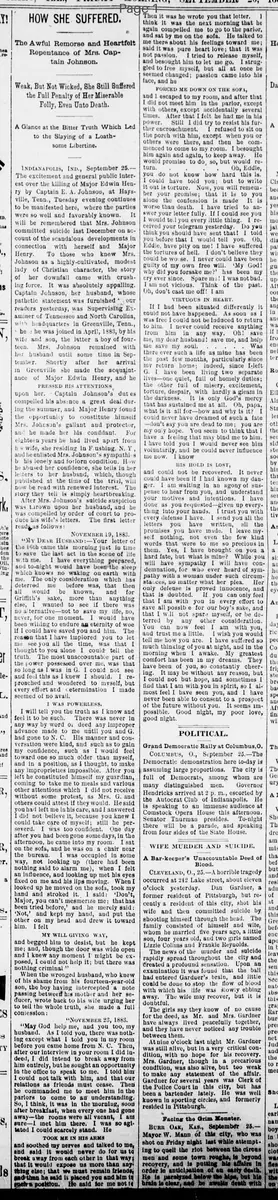
HOW SHE SUFFERED.
The Awful Remorse and Heartfelt Repentance of Mrs. Captain Johnson.
Weak, But Not Wicked, She Still Suffered the Full Penalty of Her Miserable Folly, Even Unto Death.
A Glance at the Bitter Truth Which Led to the Slaying of a Loathsome Libertine.
INDIANAPOLIS, IND., September 25.—The excitement and general public interest over the killing of Major Edwin Henry by Captain E. A. Johnson, at Hayville, Tenn., Tuesday evening continues to be manifested here, where the parties were so well and favorably known. It will be remembered that Mrs. Johnson committed suicide last December on account of the scandalous developments in connection with herself and Major Henry.
To those who knew Mrs. Johnson as a highly-cultivated, modest lady of Christian character, the story of her downfall came with crushing force. It was absolutely appalling.
Captain Johnson, her husband, whose pathetic statement was furnished our readers yesterday, was Supervising Examiner of Tennessee and North Carolina, with headquarters in Greenville, Tenn., he was joined in April, 1883, by his wife and son, the latter a boy of fourteen. Mrs. Johnson remained with her husband until some time in September. Shortly after her arrival in Greenville she made the acquaintance of Major Edwin Henry, and he PRESSED HIS ATTENTIONS upon her. Captain Johnson's duties compelled his absence a great deal during the summer, and Major Henry found the opportunity to constitute himself Mrs. Johnson's gallant and protector, and he made her his confidant. For eighteen years he had lived apart from his wife, she residing in Flushing, N. Y. and he enlisted Mrs. Johnson's sympathies by his lonely and forlorn condition. How he abused her confidence, she tells in her letters to her husband, which, though published at the time of the trial, will now be read with renewed interest. The story they tell is simply heartbreaking.
After Mrs. Johnson's suicide suspicion was thrown upon her husband, and he was compelled by order of court to produce his wife's letters. The first letter reads as follows:
NOVEMBER 19, 1883.
"My Dear Husband:—Your letter of the 16th came this morning just in time to save the last act in the scene of life with me. I have everything prepared, and to-night would have been the sleep which knows no waking on earth with me. The only consideration which has deterred me before was, that then all would be known, and for Griffith's sake, more than anything else, I wanted to see if there was no alternative—not to save my life, no, never, for one moment. I would have been willing to endure an eternity of woe if I could have saved you and him. The reason that I have implored you to let me see you all the time, was that I thought to you alone I could tell the truth. The most unaccountable part of the power possessed over me, was that so long as I was in G. I could not see and feel this as I knew I should. I reproached and wondered to myself, but every effort and determination I made seemed of no avail.
I WAS POWERLESS.
I will tell you the truth as I know and feel it to be such. There was never in any way by word or deed any improper advance made to me until you and G. had gone to N. C. His manner and conversation were kind, and such as to gain my confidence, such as I would feel toward one so much older than myself, and in a position, as I thought, to make any improprieties impossible. After you left he constituted himself my guardian, coming to take me to meals and various other attentions which I did not receive without some protest, as Mrs. G. and others could attest if they would. He said you had left me in his care, and I answered I did not believe it, because you knew I could take care of myself; still he persevered. I was too confident. One day after you had been gone some days, in the afternoon, he came into my room. I sat on the sofa, and he was on a chair near the bureau. I was occupied in some way, not looking up (there had been nothing said to alarm me), when I felt an influence, and looking up met his eyes fixed on me and his lips moving. When I looked up he moved on the sofa, took my hand and stroked it. I said: 'Don't. Major, you can't mesmerize me; that has been tried before,' and he merely said: 'No,' and kept my hand, and put the other on my head and drew it toward him. I felt MY WILL GIVING WAY, and begged him to desist, but he kept me; and, though the door was wide open and I knew any moment I might be exposed, I could not help it; but there was nothing criminal"
When the wronged husband, who knew of his shame from his fourteen-year-old son, the boy having intercepted a note passing between his mother and her seducer, wrote back to his wife urging her to tell the whole truth, she made a full confession:
"NOVEMBER 23, 1883.
"May God help me, and you too, my husband. As I told you, there was nothing except what I told you in my room before you came home from N. C. Then, after our interview in your room I did indeed, I did intend to break away from him entirely, but he sought an opportunity in the office to speak to me. I told him I could not talk with him, and that our relations as friends must cease. There he commanded me to meet him in the parlors to come to an understanding. So, I think, it was in the morning, soon after breakfast, when every one had gone away—the rooms were all vacant, I am sure—I met him there. I was so agitated I could scarcely stand. He TOOK ME IN HIS ARMS and soothed my nerves and talked to me and said it would never do for us to break away from each other in that way that it would expose us more than anything else; that we must remain friends and then he said it placed you and him in such a position. He said for me not to
Then it was he wrote you that letter. I think it was the next morning that he again compelled me to go to the parlor, and sat by me on the sofa. He talked to me there about his feelings toward me; said it was pure heart love; that it was not passion. I tried to release myself, and besought him to let me go. I struggled to free myself, but all at once he seemed changed; passion came into his face, and he FORCED ME DOWN ON THE SOFA and I escaped to my room, and after that I did not meet him in the parlor, except with others, except accidentally several times. After that I felt he had me in his power. Still I did try to resist his further encroachment. I refused to sit on the porch with him, except when you or others were there, and then he commenced to come to my room. I besought him again and again, to keep away. He would promise to do so, but would return. Oh, Eddie, you do not know how hard this is. I could have told you; but to write it out is torture. Now, you will remember your promise; that it is to you alone the confession is made It is worse than death. I have tried to answer your letter fully. If I could see you I would tell you every little thing. I received your telegram yesterday. 'Do you think you should have sent that! I told you before that I would tell you. Oh, Eddie, have pity on me! I have suffered the tortures of hell. I don't believe they could be worse. I never could have been guilty of my own free will. My God! why did you forsake me?' has been my cry ever since. Spare me! I was not bad. I am not vicious. Think of the past. Oh, don't cast me off! I am VIRTUOUS IN HEART. If I had been situated differently it could not have happened. As soon as I was free I could not be induced to return to him. I never could receive anything from him in any way. Oh! save me, my dear husband! save me, and help me save my soul. Was there ever such a life as mine has been the past few months, particularly since my return home; indeed, since I left G. I have been living two separate lives—one quiet, full of homely duties; the other full of misery, excitement, torture, despair, with hardly a gleam in the darkness. It is only God's mercy that has sustained me at all. Oh, papa, what is it all for—how and why is it? I could never have dreamed of such a fate —don't say you are dead to me; you are my only hope. You seem to think that I have a feeling that may bind me to him. I have told you I would never see him voluntarily, and he could never influence me now. I know HIS HOLD IS LOST, and could not be recovered. It never could have been if I had known my danger. I am waiting in an agony of suspense to hear from you, and understand your motives and intentions. I have done as you requested—given up everything into your hands. I trust you with every defense I have. I send you all the letters you have written, all the promises you have made. I leave myself nothing, not even the few kind words that were to me so precious in them. Yes, I have brought on you a hard fate, but what is mine? While you will have sympathy I will have condemnation, for who ever heard of sympathy with a woman under such circumstances, no matter what her plea. Her only defense is proved innocence, and that is doubted. If you can only feel that I am with you in every effort to save all possible for our boy's sake, and that I will not spare myself, or be deterred by any other consideration. You can now feel I am with you, and trust me a little. I wish you would tell me how you are. I have suffered so much thinking of you at night, and in the morning when I awake. My greatest comfort has been in my dreams. They have been of you, so constantly cheering. It may be without any reason, but I could not but hope, and sometimes I find that I am with you in spirit, so I almost feel I have seen you, and I have never been able to consent to a prospect of the future without you. It seems impossible. Good night, my poor love, good night."
The Awful Remorse and Heartfelt Repentance of Mrs. Captain Johnson.
Weak, But Not Wicked, She Still Suffered the Full Penalty of Her Miserable Folly, Even Unto Death.
A Glance at the Bitter Truth Which Led to the Slaying of a Loathsome Libertine.
INDIANAPOLIS, IND., September 25.—The excitement and general public interest over the killing of Major Edwin Henry by Captain E. A. Johnson, at Hayville, Tenn., Tuesday evening continues to be manifested here, where the parties were so well and favorably known. It will be remembered that Mrs. Johnson committed suicide last December on account of the scandalous developments in connection with herself and Major Henry.
To those who knew Mrs. Johnson as a highly-cultivated, modest lady of Christian character, the story of her downfall came with crushing force. It was absolutely appalling.
Captain Johnson, her husband, whose pathetic statement was furnished our readers yesterday, was Supervising Examiner of Tennessee and North Carolina, with headquarters in Greenville, Tenn., he was joined in April, 1883, by his wife and son, the latter a boy of fourteen. Mrs. Johnson remained with her husband until some time in September. Shortly after her arrival in Greenville she made the acquaintance of Major Edwin Henry, and he PRESSED HIS ATTENTIONS upon her. Captain Johnson's duties compelled his absence a great deal during the summer, and Major Henry found the opportunity to constitute himself Mrs. Johnson's gallant and protector, and he made her his confidant. For eighteen years he had lived apart from his wife, she residing in Flushing, N. Y. and he enlisted Mrs. Johnson's sympathies by his lonely and forlorn condition. How he abused her confidence, she tells in her letters to her husband, which, though published at the time of the trial, will now be read with renewed interest. The story they tell is simply heartbreaking.
After Mrs. Johnson's suicide suspicion was thrown upon her husband, and he was compelled by order of court to produce his wife's letters. The first letter reads as follows:
NOVEMBER 19, 1883.
"My Dear Husband:—Your letter of the 16th came this morning just in time to save the last act in the scene of life with me. I have everything prepared, and to-night would have been the sleep which knows no waking on earth with me. The only consideration which has deterred me before was, that then all would be known, and for Griffith's sake, more than anything else, I wanted to see if there was no alternative—not to save my life, no, never, for one moment. I would have been willing to endure an eternity of woe if I could have saved you and him. The reason that I have implored you to let me see you all the time, was that I thought to you alone I could tell the truth. The most unaccountable part of the power possessed over me, was that so long as I was in G. I could not see and feel this as I knew I should. I reproached and wondered to myself, but every effort and determination I made seemed of no avail.
I WAS POWERLESS.
I will tell you the truth as I know and feel it to be such. There was never in any way by word or deed any improper advance made to me until you and G. had gone to N. C. His manner and conversation were kind, and such as to gain my confidence, such as I would feel toward one so much older than myself, and in a position, as I thought, to make any improprieties impossible. After you left he constituted himself my guardian, coming to take me to meals and various other attentions which I did not receive without some protest, as Mrs. G. and others could attest if they would. He said you had left me in his care, and I answered I did not believe it, because you knew I could take care of myself; still he persevered. I was too confident. One day after you had been gone some days, in the afternoon, he came into my room. I sat on the sofa, and he was on a chair near the bureau. I was occupied in some way, not looking up (there had been nothing said to alarm me), when I felt an influence, and looking up met his eyes fixed on me and his lips moving. When I looked up he moved on the sofa, took my hand and stroked it. I said: 'Don't. Major, you can't mesmerize me; that has been tried before,' and he merely said: 'No,' and kept my hand, and put the other on my head and drew it toward him. I felt MY WILL GIVING WAY, and begged him to desist, but he kept me; and, though the door was wide open and I knew any moment I might be exposed, I could not help it; but there was nothing criminal"
When the wronged husband, who knew of his shame from his fourteen-year-old son, the boy having intercepted a note passing between his mother and her seducer, wrote back to his wife urging her to tell the whole truth, she made a full confession:
"NOVEMBER 23, 1883.
"May God help me, and you too, my husband. As I told you, there was nothing except what I told you in my room before you came home from N. C. Then, after our interview in your room I did indeed, I did intend to break away from him entirely, but he sought an opportunity in the office to speak to me. I told him I could not talk with him, and that our relations as friends must cease. There he commanded me to meet him in the parlors to come to an understanding. So, I think, it was in the morning, soon after breakfast, when every one had gone away—the rooms were all vacant, I am sure—I met him there. I was so agitated I could scarcely stand. He TOOK ME IN HIS ARMS and soothed my nerves and talked to me and said it would never do for us to break away from each other in that way that it would expose us more than anything else; that we must remain friends and then he said it placed you and him in such a position. He said for me not to
Then it was he wrote you that letter. I think it was the next morning that he again compelled me to go to the parlor, and sat by me on the sofa. He talked to me there about his feelings toward me; said it was pure heart love; that it was not passion. I tried to release myself, and besought him to let me go. I struggled to free myself, but all at once he seemed changed; passion came into his face, and he FORCED ME DOWN ON THE SOFA and I escaped to my room, and after that I did not meet him in the parlor, except with others, except accidentally several times. After that I felt he had me in his power. Still I did try to resist his further encroachment. I refused to sit on the porch with him, except when you or others were there, and then he commenced to come to my room. I besought him again and again, to keep away. He would promise to do so, but would return. Oh, Eddie, you do not know how hard this is. I could have told you; but to write it out is torture. Now, you will remember your promise; that it is to you alone the confession is made It is worse than death. I have tried to answer your letter fully. If I could see you I would tell you every little thing. I received your telegram yesterday. 'Do you think you should have sent that! I told you before that I would tell you. Oh, Eddie, have pity on me! I have suffered the tortures of hell. I don't believe they could be worse. I never could have been guilty of my own free will. My God! why did you forsake me?' has been my cry ever since. Spare me! I was not bad. I am not vicious. Think of the past. Oh, don't cast me off! I am VIRTUOUS IN HEART. If I had been situated differently it could not have happened. As soon as I was free I could not be induced to return to him. I never could receive anything from him in any way. Oh! save me, my dear husband! save me, and help me save my soul. Was there ever such a life as mine has been the past few months, particularly since my return home; indeed, since I left G. I have been living two separate lives—one quiet, full of homely duties; the other full of misery, excitement, torture, despair, with hardly a gleam in the darkness. It is only God's mercy that has sustained me at all. Oh, papa, what is it all for—how and why is it? I could never have dreamed of such a fate —don't say you are dead to me; you are my only hope. You seem to think that I have a feeling that may bind me to him. I have told you I would never see him voluntarily, and he could never influence me now. I know HIS HOLD IS LOST, and could not be recovered. It never could have been if I had known my danger. I am waiting in an agony of suspense to hear from you, and understand your motives and intentions. I have done as you requested—given up everything into your hands. I trust you with every defense I have. I send you all the letters you have written, all the promises you have made. I leave myself nothing, not even the few kind words that were to me so precious in them. Yes, I have brought on you a hard fate, but what is mine? While you will have sympathy I will have condemnation, for who ever heard of sympathy with a woman under such circumstances, no matter what her plea. Her only defense is proved innocence, and that is doubted. If you can only feel that I am with you in every effort to save all possible for our boy's sake, and that I will not spare myself, or be deterred by any other consideration. You can now feel I am with you, and trust me a little. I wish you would tell me how you are. I have suffered so much thinking of you at night, and in the morning when I awake. My greatest comfort has been in my dreams. They have been of you, so constantly cheering. It may be without any reason, but I could not but hope, and sometimes I find that I am with you in spirit, so I almost feel I have seen you, and I have never been able to consent to a prospect of the future without you. It seems impossible. Good night, my poor love, good night."
What sub-type of article is it?
Family Drama
Deception Fraud
Tragedy
What themes does it cover?
Deception
Misfortune
Tragedy
What keywords are associated?
Seduction
Affair
Remorse
Suicide
Confession
Mesmerism
What entities or persons were involved?
Mrs. Captain Johnson
Captain E. A. Johnson
Major Edwin Henry
Griffith
Where did it happen?
Greenville, Tenn.
Story Details
Key Persons
Mrs. Captain Johnson
Captain E. A. Johnson
Major Edwin Henry
Griffith
Location
Greenville, Tenn.
Event Date
November 1883
Story Details
Mrs. Johnson confesses in letters to her husband her seduction by Major Henry, who used mesmerism and force to overcome her will, leading to an affair; she expresses remorse and plans suicide, which she later carries out, prompting her husband to kill Henry.