Thank you for visiting SNEWPapers!
Sign up free
Literary
November 21, 1801
Alexandria Advertiser And Commercial Intelligencer
Alexandria, Virginia
What is this article about?
A letter from a Hindu philosopher in Philadelphia to his friend in Delhi, describing the Gitagovinda poem's narrative of Radha and Krishna's love, separation, longing, and reconciliation, with extensive poetic excerpts depicting natural beauty, jealousy, and remorse.
Clipping
OCR Quality
95%
Excellent
Full Text
THE COMMERCIAL
No. XI.
LETTER
From a Hindu Philosopher, residing in Philadelphia, to his friend in Delhi.
RESOLUTIONS MOGALS.
Beloved friend, since of my heart,
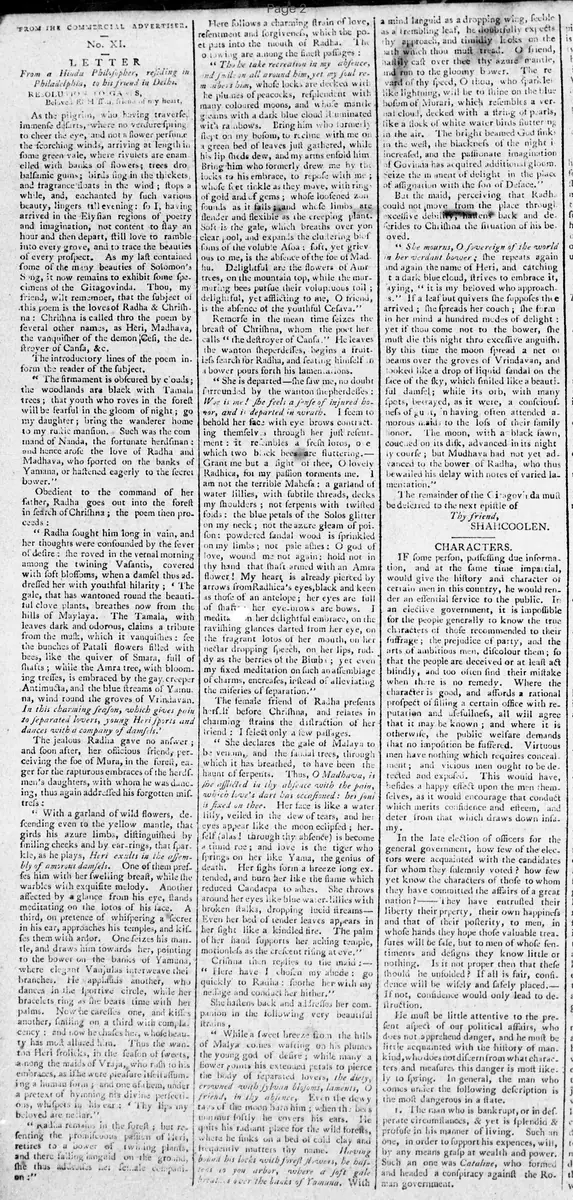
As the pilgrim, who having traversed immense deserts, where no verdure springs to cheer the eye, and not a flower perfumes the scorching winds, arriving at length in some green vale, where rivulets are enamelled with banks of flowers; trees drop balsamic gums: birds sing in the thickets and fragrance floats in the wind; stops a while, and, enchanted by such various beauty, lingers till evening: O! having arrived in the Elysian regions of poetry and imagination, not content to stay an hour and then depart, still love to ramble into every grove, and to trace the beauties of every prospect. As my last contained some of the many beauties of Solomon's Song, it now remains to exhibit some specimens of the Gitagovinda. Thou, my friend, wilt remember, that the subject of this poem is the loves of Radha & Krishna: Krishna is called through the poem by several other names, as Hari, Madhava, the vanquisher of the demon Kesi, the destroyer of Kansa, &c.
The introductory lines of the poem inform the reader of the subject.
"The firmament is obscured by clouds: the woodlands are black with Tamala trees; that youth who roves in the forest will be fearful in the gloom of night; go my daughter; bring the wanderer home to my rustic mansion." Such was the command of Nanda, the fortunate herdsman: and hence arose the love of Radha and Madhava, who parted on the banks of Yamuna, or hastened eagerly to the secret bower."
Obedient to the command of her father, Radha goes out into the forest in search of Krishna; the poem then proceeds:
"Radha sought him long in vain, and her thoughts were confounded by the fever of desire: she roved in the vernal morning among the twining Vasantis, covered with soft blossoms, when a damsel thus addressed her with youthful hilarity: 'The gale, that has wantoned round the beautiful clove plants, breathes now from the hills of Malaya. The Tamala, with leaves dark and odorous, claims a tribute from the musk, which it vanquishes: see the bunches of Patali flowers filled with bees, like the quiver of Smara, full of shafts: while the Amra tree, with blooming tresses, is embraced by the gay creeper Antimukta, and the blue streams of Yamuna, wind round the groves of Vrindavan. In this charming season, which gives pain to separated lovers, young Hari sports and dances with a company of damsels.'
The jealous Radha gave no answer: and soon after, her officious friend, perceiving the foe of Mura, in the forest, eager for the rapturous embraces of the herdsmen's daughters, with whom he was dancing, thus again addressed his forgotten mistress:
"With a garland of wild flowers, descending even to the yellow mantle, that girds his azure limbs, distinguished by smiling cheeks and by ear-rings, that sparkle, as he plays, Hari exults in the assembly of amorous damsels. One of them presses him with her swelling breast, while the lute warbles with exquisite melody. Another affected by a glance from his eye, stands meditating on the lotus of his face. A third, on pretence of whispering a secret in his ear, approaches his temples, and kisses them with ardor. One seizes his mantle, and draws him towards her, pointing to the bower on the banks of Yamuna, where elegant Vanjulas interweave their branches. He applauds another, who dances in the sportive circle, while her bracelets ring as she beats time with her palms. Now he caresses one, and kisses another, falling on a third with complacency: and now he chases her, whose beauty has most allured him. Thus the wanton Hari frolicks, in the season of sweets, among the maids of Vraja, who rush to his embraces, as if he were pleasure itself assuming a human form; and one of them, under a pretext of hymning his divine perfections, whispers in his ear: 'Thy lips my beloved are nectar.'"
"Radha remains in the forest: but resenting the promiscuous passion of Hari, retires to a bower of twining plants, and there falling languid on the ground, thus addresses her female companion: "
Here follows a charming strain of love, resentment and forgiveness, which the poet puts into the mouth of Radha. The following are among the finest passages:
"Though he take recreation in my absence, and smile on all around him, yet my soul remembers him, whose locks are decked with the plumes of peacocks, resplendent with many coloured moons, and whose mantle gleams with a dark blue cloud illuminated with rainbows. Bring him who formerly slept on my bosom, to recline with me on a green bed of leaves just gathered, while his lip sheds dew, and my arms enfold him. Bring him who formerly drew me by the locks to his embrace, to repose with me; whose feet tinkle as they move, with rings of gold and of gems; whose loosened zone sounds as it falls: and whose limbs are slender and flexible as the creeping plant. Soft is the gale, which breathes over yon clear pool, and expands the clustering blossoms of the voluble Asoka: soft, yet grievous to me, is the absence of the foe of Madhu. Delightful are the flowers of Amra trees, on the mountain top, while the murmuring bees pursue their voluptuous toil; delightful, yet afflicting to me. O friend, is the absence of the youthful Kesava."
Remorse in the mean time seizes the breast of Krishna, whom the poet here calls "the destroyer of Kansa." He leaves the wanton shepherdesses, begins a fruitless search for Radha, and seating himself in a bower pours forth his lamentations.
"She is departed--the saw me, no doubt surrounded by the wanton shepherdesses: Woe is me! she feels a sense of injured honor, and is departed in wrath. I seem to behold her face with eye brows contracting themselves through her just resentment: it resembles a fresh lotus, on which two black bees are fluttering.-- Grant me but a sight of thee, O lovely Radhika, for my passion torments me. I am not the terrible Mahesa: a garland of water lilies, with subtle threads, decks my shoulders; not serpents with twisted folds: the blue petals of the Solasa glitter on my neck; not the azure gleam of poison: powdered sandal wood is sprinkled on my limbs; not pale ashes: O god of love, wound me not again: hold not in thy hand that shaft armed with an Amra flower! My heart is already pierced by arrows from Radhika's eyes, black and keen as those of an antelope; her eyes are full of shafts-- her eye-brows are bows. I meditate on her delightful embrace, on the ravishing glances darted from her eye, on the fragrant lotus of her mouth, on her nectar dropping speech, on her lips, ruddy as the berries of the Bimba; yet even my fixed meditation on such an assemblage of charms, increases, instead of alleviating the miseries of separation."
The female friend of Radha presents herself before Krishna, and relates in charming strains the distraction of her friend: I select only a few passages.
"She declares the gale of Malaya to be venomous, and the sandal trees, through which it has breathed, to have been the haunt of serpents. Thus, O Madhava, is the afflicted in thy absence with the pain, which love's dart has occasioned: her soul is fixed on thee. Her face is like a water lilly, veiled in the dew of tears, and her eyes appear like the moon eclipsed; herself (alas! through thy absence) is become a timid roe; and love is the tiger who springs on her like Yama, the genius of death. Her sighs form a breeze long extended, and burn her like the flame which reduced Camdeva to ashes. She throws around her eyes like blue water-lillies with broken stalks, dropping lucid streams-- Even her bed of tender leaves appears in her sight like a kindled fire. The palm of her hand supports her aching temple, motionless as the crescent rising at eve."
Krishna then replies to the maid--
"Here have I chosen my abode: go quickly to Radha: soothe her with my message and conduct her hither."
She hastens back and addresses her companion in the following very beautiful strains,
"While a sweet breeze from the hills of Malaya comes wafting on his plumes the young god of desire; while many a flower points his extended petals to pierce the body of separated lovers, the deity, crowned with sylvan blossoms, laments, (O friend, in thy absence, Even the dewy rays of the moon harm him: when the bees murmur softly he covers his ears. He quits his radiant place for the wild forests, where he sinks on a bed of cold clay and frequently mutters thy name. Having bound his locks with forest flowers, he hastens to yon arbor, where a soft gale breathes over the banks of Yamuna. With a mind languid as a dropping wing, feeble as a trembling leaf, he doubtfully expects thy approach, and timidly looks on the path which thou must tread. O friend, hastily cast over thee thy azure mantle, and run to the gloomy bower. The reward of thy speed, O thou, who sparkle like lightning, will be to thine on the blue bosom of Morari, which resembles a vernal cloud, decked with a string of pearls, like a flock of white water birds fluttering in the air. The bright beamed God sinks in the west. the blackness of the night is increased, and the passionate imagination of Govinda has acquired additional gloom. Seize the moment of delight in the place of assignation with the son of Dasaratha."
But the maid, perceiving that Radha could not move from the place through excessive debility, hastens back and describes to Krishna the situation of his beloved.
"She mourns, O sovereign of the world in her verdant bower: she repeats again and again the name of Hari, and catching at a dark blue cloud, strives to embrace it, saying, "it is my beloved who approaches." If a leaf but quivers She supposes the arrived: she spreads her couch: she forms in her mind a hundred modes of delight: yet if thou come not to the bower, she must die this night thro excessive anguish. By this time the moon spread a net of beams over the groves of Vrindavan, and looked like a drop of liquid sandal on the face of the sky, which smiled like a beautiful damsel; while its orb, with many spots, betrayed, as it were, a consciousness of guilt, in having often attended amorous maids to the loss of their family honor. The moon, with a black fawn, couched on its disk, advanced in its nightly course: but Madhava had not yet advanced to the bower of Radha, who thus bewailed his delay with notes of varied lamentation."
The remainder of the Gitagovinda must be deferred to the next epistle of
Thy friend,
SHAHCOOLEN.
No. XI.
LETTER
From a Hindu Philosopher, residing in Philadelphia, to his friend in Delhi.
RESOLUTIONS MOGALS.
Beloved friend, since of my heart,
As the pilgrim, who having traversed immense deserts, where no verdure springs to cheer the eye, and not a flower perfumes the scorching winds, arriving at length in some green vale, where rivulets are enamelled with banks of flowers; trees drop balsamic gums: birds sing in the thickets and fragrance floats in the wind; stops a while, and, enchanted by such various beauty, lingers till evening: O! having arrived in the Elysian regions of poetry and imagination, not content to stay an hour and then depart, still love to ramble into every grove, and to trace the beauties of every prospect. As my last contained some of the many beauties of Solomon's Song, it now remains to exhibit some specimens of the Gitagovinda. Thou, my friend, wilt remember, that the subject of this poem is the loves of Radha & Krishna: Krishna is called through the poem by several other names, as Hari, Madhava, the vanquisher of the demon Kesi, the destroyer of Kansa, &c.
The introductory lines of the poem inform the reader of the subject.
"The firmament is obscured by clouds: the woodlands are black with Tamala trees; that youth who roves in the forest will be fearful in the gloom of night; go my daughter; bring the wanderer home to my rustic mansion." Such was the command of Nanda, the fortunate herdsman: and hence arose the love of Radha and Madhava, who parted on the banks of Yamuna, or hastened eagerly to the secret bower."
Obedient to the command of her father, Radha goes out into the forest in search of Krishna; the poem then proceeds:
"Radha sought him long in vain, and her thoughts were confounded by the fever of desire: she roved in the vernal morning among the twining Vasantis, covered with soft blossoms, when a damsel thus addressed her with youthful hilarity: 'The gale, that has wantoned round the beautiful clove plants, breathes now from the hills of Malaya. The Tamala, with leaves dark and odorous, claims a tribute from the musk, which it vanquishes: see the bunches of Patali flowers filled with bees, like the quiver of Smara, full of shafts: while the Amra tree, with blooming tresses, is embraced by the gay creeper Antimukta, and the blue streams of Yamuna, wind round the groves of Vrindavan. In this charming season, which gives pain to separated lovers, young Hari sports and dances with a company of damsels.'
The jealous Radha gave no answer: and soon after, her officious friend, perceiving the foe of Mura, in the forest, eager for the rapturous embraces of the herdsmen's daughters, with whom he was dancing, thus again addressed his forgotten mistress:
"With a garland of wild flowers, descending even to the yellow mantle, that girds his azure limbs, distinguished by smiling cheeks and by ear-rings, that sparkle, as he plays, Hari exults in the assembly of amorous damsels. One of them presses him with her swelling breast, while the lute warbles with exquisite melody. Another affected by a glance from his eye, stands meditating on the lotus of his face. A third, on pretence of whispering a secret in his ear, approaches his temples, and kisses them with ardor. One seizes his mantle, and draws him towards her, pointing to the bower on the banks of Yamuna, where elegant Vanjulas interweave their branches. He applauds another, who dances in the sportive circle, while her bracelets ring as she beats time with her palms. Now he caresses one, and kisses another, falling on a third with complacency: and now he chases her, whose beauty has most allured him. Thus the wanton Hari frolicks, in the season of sweets, among the maids of Vraja, who rush to his embraces, as if he were pleasure itself assuming a human form; and one of them, under a pretext of hymning his divine perfections, whispers in his ear: 'Thy lips my beloved are nectar.'"
"Radha remains in the forest: but resenting the promiscuous passion of Hari, retires to a bower of twining plants, and there falling languid on the ground, thus addresses her female companion: "
Here follows a charming strain of love, resentment and forgiveness, which the poet puts into the mouth of Radha. The following are among the finest passages:
"Though he take recreation in my absence, and smile on all around him, yet my soul remembers him, whose locks are decked with the plumes of peacocks, resplendent with many coloured moons, and whose mantle gleams with a dark blue cloud illuminated with rainbows. Bring him who formerly slept on my bosom, to recline with me on a green bed of leaves just gathered, while his lip sheds dew, and my arms enfold him. Bring him who formerly drew me by the locks to his embrace, to repose with me; whose feet tinkle as they move, with rings of gold and of gems; whose loosened zone sounds as it falls: and whose limbs are slender and flexible as the creeping plant. Soft is the gale, which breathes over yon clear pool, and expands the clustering blossoms of the voluble Asoka: soft, yet grievous to me, is the absence of the foe of Madhu. Delightful are the flowers of Amra trees, on the mountain top, while the murmuring bees pursue their voluptuous toil; delightful, yet afflicting to me. O friend, is the absence of the youthful Kesava."
Remorse in the mean time seizes the breast of Krishna, whom the poet here calls "the destroyer of Kansa." He leaves the wanton shepherdesses, begins a fruitless search for Radha, and seating himself in a bower pours forth his lamentations.
"She is departed--the saw me, no doubt surrounded by the wanton shepherdesses: Woe is me! she feels a sense of injured honor, and is departed in wrath. I seem to behold her face with eye brows contracting themselves through her just resentment: it resembles a fresh lotus, on which two black bees are fluttering.-- Grant me but a sight of thee, O lovely Radhika, for my passion torments me. I am not the terrible Mahesa: a garland of water lilies, with subtle threads, decks my shoulders; not serpents with twisted folds: the blue petals of the Solasa glitter on my neck; not the azure gleam of poison: powdered sandal wood is sprinkled on my limbs; not pale ashes: O god of love, wound me not again: hold not in thy hand that shaft armed with an Amra flower! My heart is already pierced by arrows from Radhika's eyes, black and keen as those of an antelope; her eyes are full of shafts-- her eye-brows are bows. I meditate on her delightful embrace, on the ravishing glances darted from her eye, on the fragrant lotus of her mouth, on her nectar dropping speech, on her lips, ruddy as the berries of the Bimba; yet even my fixed meditation on such an assemblage of charms, increases, instead of alleviating the miseries of separation."
The female friend of Radha presents herself before Krishna, and relates in charming strains the distraction of her friend: I select only a few passages.
"She declares the gale of Malaya to be venomous, and the sandal trees, through which it has breathed, to have been the haunt of serpents. Thus, O Madhava, is the afflicted in thy absence with the pain, which love's dart has occasioned: her soul is fixed on thee. Her face is like a water lilly, veiled in the dew of tears, and her eyes appear like the moon eclipsed; herself (alas! through thy absence) is become a timid roe; and love is the tiger who springs on her like Yama, the genius of death. Her sighs form a breeze long extended, and burn her like the flame which reduced Camdeva to ashes. She throws around her eyes like blue water-lillies with broken stalks, dropping lucid streams-- Even her bed of tender leaves appears in her sight like a kindled fire. The palm of her hand supports her aching temple, motionless as the crescent rising at eve."
Krishna then replies to the maid--
"Here have I chosen my abode: go quickly to Radha: soothe her with my message and conduct her hither."
She hastens back and addresses her companion in the following very beautiful strains,
"While a sweet breeze from the hills of Malaya comes wafting on his plumes the young god of desire; while many a flower points his extended petals to pierce the body of separated lovers, the deity, crowned with sylvan blossoms, laments, (O friend, in thy absence, Even the dewy rays of the moon harm him: when the bees murmur softly he covers his ears. He quits his radiant place for the wild forests, where he sinks on a bed of cold clay and frequently mutters thy name. Having bound his locks with forest flowers, he hastens to yon arbor, where a soft gale breathes over the banks of Yamuna. With a mind languid as a dropping wing, feeble as a trembling leaf, he doubtfully expects thy approach, and timidly looks on the path which thou must tread. O friend, hastily cast over thee thy azure mantle, and run to the gloomy bower. The reward of thy speed, O thou, who sparkle like lightning, will be to thine on the blue bosom of Morari, which resembles a vernal cloud, decked with a string of pearls, like a flock of white water birds fluttering in the air. The bright beamed God sinks in the west. the blackness of the night is increased, and the passionate imagination of Govinda has acquired additional gloom. Seize the moment of delight in the place of assignation with the son of Dasaratha."
But the maid, perceiving that Radha could not move from the place through excessive debility, hastens back and describes to Krishna the situation of his beloved.
"She mourns, O sovereign of the world in her verdant bower: she repeats again and again the name of Hari, and catching at a dark blue cloud, strives to embrace it, saying, "it is my beloved who approaches." If a leaf but quivers She supposes the arrived: she spreads her couch: she forms in her mind a hundred modes of delight: yet if thou come not to the bower, she must die this night thro excessive anguish. By this time the moon spread a net of beams over the groves of Vrindavan, and looked like a drop of liquid sandal on the face of the sky, which smiled like a beautiful damsel; while its orb, with many spots, betrayed, as it were, a consciousness of guilt, in having often attended amorous maids to the loss of their family honor. The moon, with a black fawn, couched on its disk, advanced in its nightly course: but Madhava had not yet advanced to the bower of Radha, who thus bewailed his delay with notes of varied lamentation."
The remainder of the Gitagovinda must be deferred to the next epistle of
Thy friend,
SHAHCOOLEN.
What sub-type of article is it?
Epistolary
Essay
Poem
What themes does it cover?
Love Romance
Religious
Nature
What keywords are associated?
Gitagovinda
Radha
Krishna
Hindu Poetry
Love Separation
Nature Descriptions
Jealousy
Remorse
Reconciliation
What entities or persons were involved?
Shahcoolen
Literary Details
Title
Letter From A Hindu Philosopher, Residing In Philadelphia, To His Friend In Delhi.
Author
Shahcoolen
Subject
Specimens Of The Gitagovinda, The Loves Of Radha & Krishna
Form / Style
Epistolary Essay With Poetic Excerpts
Key Lines
The Firmament Is Obscured By Clouds: The Woodlands Are Black With Tamala Trees; That Youth Who Roves In The Forest Will Be Fearful In The Gloom Of Night; Go My Daughter; Bring The Wanderer Home To My Rustic Mansion.
Radha Sought Him Long In Vain, And Her Thoughts Were Confounded By The Fever Of Desire: She Roved In The Vernal Morning Among The Twining Vasantis, Covered With Soft Blossoms...
Though He Take Recreation In My Absence, And Smile On All Around Him, Yet My Soul Remembers Him, Whose Locks Are Decked With The Plumes Of Peacocks...
She Is Departed The Saw Me, No Doubt Surrounded By The Wanton Shepherdesses: Woe Is Me! She Feels A Sense Of Injured Honor, And Is Departed In Wrath.
While A Sweet Breeze From The Hills Of Malaya Comes Wafting On His Plumes The Young God Of Desire; While Many A Flower Points His Extended Petals To Pierce The Body Of Separated Lovers...