Thank you for visiting SNEWPapers!
Sign up free
Editorial
July 30, 1811
Alexandria Daily Gazette, Commercial & Political
Alexandria, Virginia
What is this article about?
This editorial sarcastically mocks Thomas Jefferson's 1806 prediction that England would collapse within a year amid the Napoleonic Wars, emphasizing Britain's enduring naval and military strength, increased revenue, and victories over French allies, while criticizing Democratic supporters' hopes for Bonaparte's dominance and 'liberty of the seas.'
Clipping
OCR Quality
95%
Excellent
Full Text
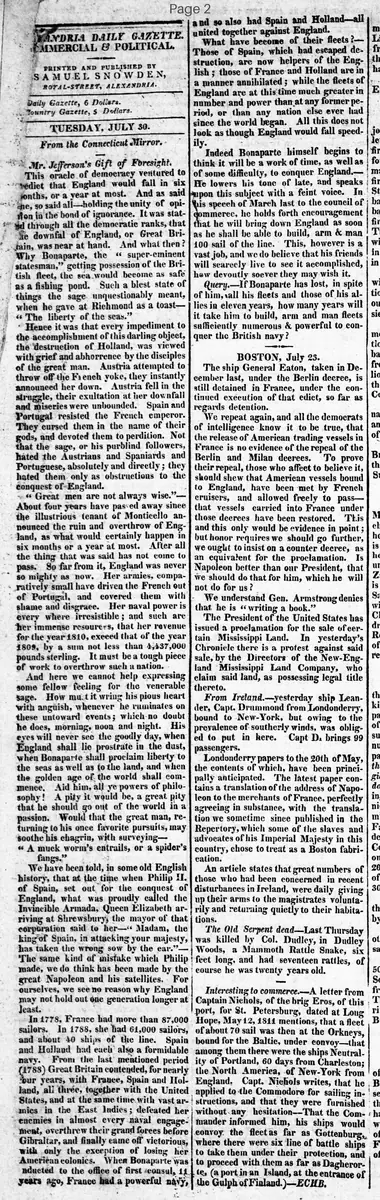
From the Connecticut Mirror.
Mr. Jefferson's Gift of Foresight.
This oracle of democracy ventured to predict that England would fall in six months, or a year at most. And as said one, so said all--holding the unity of opinion in the bond of ignorance. It was stated through all the democratic ranks, that the downfall of England, or Great Britain, was near at hand. And what then? Why Bonaparte, the "super-eminent statesman," getting possession of the British fleet, the sea would become as safe as a fishing pond. Such a blest state of things the sage unquestionably meant, when he gave at Richmond as a toast-- "The liberty of the seas."
Hence it was that every impediment to the accomplishment of this darling object, the destruction of Holland, was viewed with grief and abhorrence by the disciples of the great man. Austria attempted to throw off the French yoke, they instantly announced her doom. Austria fell in the struggle, their exultation at her downfall and miseries were unbounded. Spain and Portugal resisted the French emperor. They cursed them in the name of their gods, and devoted them to perdition. Not that the sage, or his purblind followers, hated the Austrians and Spaniards and Portuguese, absolutely and directly; they hated them only as obstructions to the conquest of England.
"Great men are not always wise."
About four years have passed away since the illustrious tenant of Monticello announced the ruin and overthrow of England, as what would certainly happen in six months or a year at most. After all the thing that was said has not come to pass. So far from it, England was never so mighty as now. Her armies, comparatively small have driven the French out of Portugal, and covered them with shame and disgrace. Her naval power is every where irresistible; and such are her immense resources, that her revenue for the year 1810, exceed that of the year 1809, by a sum not less than 4,137,000 pounds sterling. It must be a tough piece of work to overthrow such a nation.
And here we cannot help expressing some fellow feeling for the venerable sage. How much it wring his pious heart with anguish, whenever he ruminates on these untoward events; which--no doubt he does, morning, noon and night. His eyes will never see the goodly day, when England shall lie prostrate in the dust, when Bonaparte shall proclaim liberty to the seas as well as to the land, and when the golden age of the world shall commence. Aid him, all ye powers of philosophy! A pity it would be, a great pity that he should go out of the world in a passion. Would that the great man, returning to his once favorite pursuits, may soothe his chagrin, with surveying-- "A muck worm's entrails, or a spider's fangs."
We have been told, in some old English history, that at the time when Philip II. of Spain, set out for the conquest of England, what was proudly called the Invincible Armada, Queen Elizabeth arriving at Shrewsbury, the mayor of that corporation said to her--"Madam, the king of Spain, in attacking your majesty, has taken the wrong sow by the ear."
The same kind of mistake which Philip made, we do think has been made by the great Napoleon and his satellites. For ourselves, we see no reason why England may not hold out one generation longer at least.
In 1778, France had more than 87,000 sailors. In 1788, she had 61,000 sailors, and about 40 ships of the line. Spain and Holland had each also a formidable navy. From the last mentioned period (1788) Great Britain contended, for nearly our years, with France, Spain and Holland, all three, together with the United States, and at the same time with vast armies in the East Indies; defeated her enemies in almost every naval engagement, overthrew their grand forces before Gibraltar, and finally came off victorious, with only the exception of losing her American colonies. When Bonaparte was conducted to the office of first consul, 11 years ago, France had a powerful navy.
and so also had Spain and Holland--all united together against England.
What have become of their fleets?-- Those of Spain, which had escaped destruction, are now helpers of the English; those of France--and Holland are in a manner annihilated; while the fleets of England are at this time much greater in number and power than at any former period, or than any nation else ever had since the world began. All this does not look as though England would fall speedily.
Indeed Bonaparte himself begins to think it will be a work of time, as well as of some difficulty, to conquer England.-- He lowers his tone of late, and speaks upon this subject with a faint voice. In his speech of March last to the council of commerce, he holds forth encouragement that he will bring down England as soon as he shall be able to build, arm & man 100 sail of the line. This, however is a vast job, and we do believe that his friends will scarcely live to see it accomplished, how devoutly soever they may wish it.
Query.--If Bonaparte has lost, in spite of him, all his fleets and those of his allies in eleven years, how many years will it take him to build, arm and man fleets sufficiently numerous & powerful to conquer the British navy?
Mr. Jefferson's Gift of Foresight.
This oracle of democracy ventured to predict that England would fall in six months, or a year at most. And as said one, so said all--holding the unity of opinion in the bond of ignorance. It was stated through all the democratic ranks, that the downfall of England, or Great Britain, was near at hand. And what then? Why Bonaparte, the "super-eminent statesman," getting possession of the British fleet, the sea would become as safe as a fishing pond. Such a blest state of things the sage unquestionably meant, when he gave at Richmond as a toast-- "The liberty of the seas."
Hence it was that every impediment to the accomplishment of this darling object, the destruction of Holland, was viewed with grief and abhorrence by the disciples of the great man. Austria attempted to throw off the French yoke, they instantly announced her doom. Austria fell in the struggle, their exultation at her downfall and miseries were unbounded. Spain and Portugal resisted the French emperor. They cursed them in the name of their gods, and devoted them to perdition. Not that the sage, or his purblind followers, hated the Austrians and Spaniards and Portuguese, absolutely and directly; they hated them only as obstructions to the conquest of England.
"Great men are not always wise."
About four years have passed away since the illustrious tenant of Monticello announced the ruin and overthrow of England, as what would certainly happen in six months or a year at most. After all the thing that was said has not come to pass. So far from it, England was never so mighty as now. Her armies, comparatively small have driven the French out of Portugal, and covered them with shame and disgrace. Her naval power is every where irresistible; and such are her immense resources, that her revenue for the year 1810, exceed that of the year 1809, by a sum not less than 4,137,000 pounds sterling. It must be a tough piece of work to overthrow such a nation.
And here we cannot help expressing some fellow feeling for the venerable sage. How much it wring his pious heart with anguish, whenever he ruminates on these untoward events; which--no doubt he does, morning, noon and night. His eyes will never see the goodly day, when England shall lie prostrate in the dust, when Bonaparte shall proclaim liberty to the seas as well as to the land, and when the golden age of the world shall commence. Aid him, all ye powers of philosophy! A pity it would be, a great pity that he should go out of the world in a passion. Would that the great man, returning to his once favorite pursuits, may soothe his chagrin, with surveying-- "A muck worm's entrails, or a spider's fangs."
We have been told, in some old English history, that at the time when Philip II. of Spain, set out for the conquest of England, what was proudly called the Invincible Armada, Queen Elizabeth arriving at Shrewsbury, the mayor of that corporation said to her--"Madam, the king of Spain, in attacking your majesty, has taken the wrong sow by the ear."
The same kind of mistake which Philip made, we do think has been made by the great Napoleon and his satellites. For ourselves, we see no reason why England may not hold out one generation longer at least.
In 1778, France had more than 87,000 sailors. In 1788, she had 61,000 sailors, and about 40 ships of the line. Spain and Holland had each also a formidable navy. From the last mentioned period (1788) Great Britain contended, for nearly our years, with France, Spain and Holland, all three, together with the United States, and at the same time with vast armies in the East Indies; defeated her enemies in almost every naval engagement, overthrew their grand forces before Gibraltar, and finally came off victorious, with only the exception of losing her American colonies. When Bonaparte was conducted to the office of first consul, 11 years ago, France had a powerful navy.
and so also had Spain and Holland--all united together against England.
What have become of their fleets?-- Those of Spain, which had escaped destruction, are now helpers of the English; those of France--and Holland are in a manner annihilated; while the fleets of England are at this time much greater in number and power than at any former period, or than any nation else ever had since the world began. All this does not look as though England would fall speedily.
Indeed Bonaparte himself begins to think it will be a work of time, as well as of some difficulty, to conquer England.-- He lowers his tone of late, and speaks upon this subject with a faint voice. In his speech of March last to the council of commerce, he holds forth encouragement that he will bring down England as soon as he shall be able to build, arm & man 100 sail of the line. This, however is a vast job, and we do believe that his friends will scarcely live to see it accomplished, how devoutly soever they may wish it.
Query.--If Bonaparte has lost, in spite of him, all his fleets and those of his allies in eleven years, how many years will it take him to build, arm and man fleets sufficiently numerous & powerful to conquer the British navy?
What sub-type of article is it?
Foreign Affairs
Partisan Politics
War Or Peace
What keywords are associated?
Jefferson Prediction
England Strength
Napoleonic Wars
British Navy
Democratic Ignorance
Liberty Of The Seas
Bonaparte Fleets
What entities or persons were involved?
Thomas Jefferson
Napoleon Bonaparte
England
Austria
Spain
Portugal
France
Holland
Queen Elizabeth
Philip Ii Of Spain
Editorial Details
Primary Topic
Mockery Of Jefferson's Prediction Of England's Imminent Fall
Stance / Tone
Satirical Pro British Criticism Of Jefferson And Democrats
Key Figures
Thomas Jefferson
Napoleon Bonaparte
England
Austria
Spain
Portugal
France
Holland
Queen Elizabeth
Philip Ii Of Spain
Key Arguments
Jefferson Predicted England's Fall In Six Months To A Year, But It Has Not Happened After Four Years.
England's Military And Naval Power Is Stronger Than Ever, With Increased Revenue And Victories Over French Forces.
Democrats Exulted In Allies' Falls As Steps Toward Conquering England, But Hated Resistors Only As Obstacles.
Historical Parallels Like The Spanish Armada Show Similar Failed Attempts Against England.
France, Spain, And Holland's Navies Have Been Destroyed Or Allied With England, While Britain's Fleet Is Unmatched.
Bonaparte Now Admits Conquering England Requires Building 100 Ships Of The Line, A Daunting Task.