Thank you for visiting SNEWPapers!
Sign up free
Constitutional Whig
Richmond, Virginia
What is this article about?
In Letter III to the public, Stephen Simpson details his 1829 meetings with President-elect Andrew Jackson, exposing political intrigues by advisors like Major Eaton and Lewis, criticizing cabinet appointments such as Ingham's, and arguing against Jackson's re-election to save his reputation from corruption and ruin.
Merged-components note: Merged continuation of Stephen Simpson's letter into a single component, as the text flows directly from one to the next with sequential reading order.
Clipping
OCR Quality
Full Text
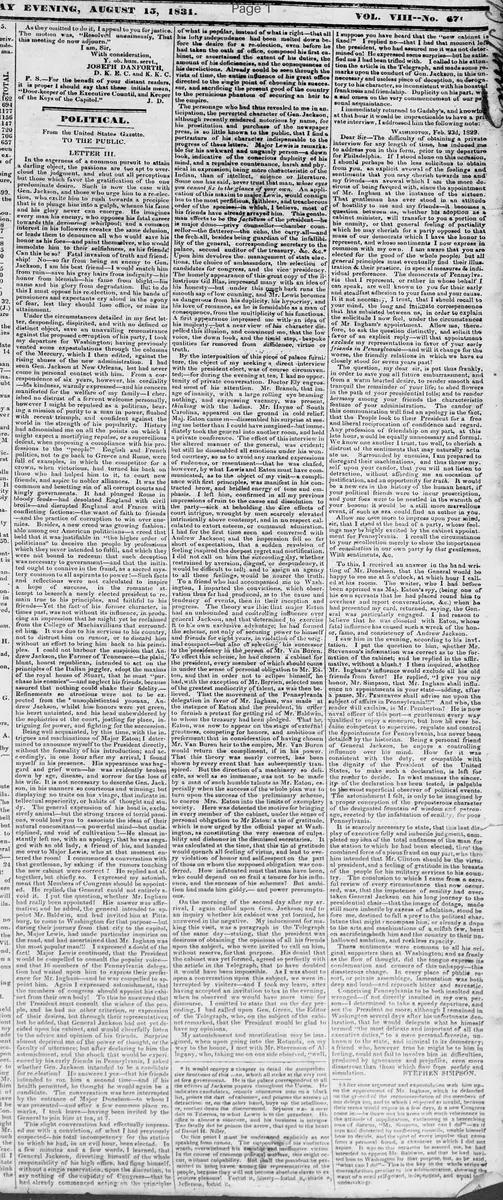
From the United States Gazette.
TO THE PUBLIC.
LETTER III.
In the eagerness of a common pursuit to attain a darling object, the passions are too apt to overcloud the judgment, and shut out all perceptions but those which favor the gratification of the one predominate desire. Such is now the case with Gen. Jackson, and those who urge him to a re-election, who excite him to rush towards a precipice that is to plunge him into a gulph, whence his fame and his glory never can emerge. He imagines every man his enemy, who opposes his fatal career towards this devouring whirlpool; and a common interest in his followers creates the same delusion, or leads them to denounce all who would save his honor as his foes—and paint themselves, who would immolate him to their selfishness, as his friends! Can this be so? Fatal invasion of truth and friendship! No—so far from being an enemy to Gen. Jackson, I am his best friend—I would snatch him from ruin—save his gray hairs from indignity—his honor from blemish—his fame from blight—his name and his glory from degradation. But to do this I must oppose his re-election, and his bands of pensioners and expectants cry aloud in the agony of fear, lest they should lose office, or miss its attainment.
Under the circumstances detailed in my first letter, desponding, dispirited, and with no defined or distinct object, save an unavailing remonstrance against the proposed corruption of his party, I took my departure for Washington; having previously vented some expostulations through the columns of the Mercury, which I then edited, against the rising abuses of the new administration. I had seen Gen. Jackson at New Orleans, but had never come in personal contact with him. From a correspondence of six years, however, his cordiality—his kindness, warmly expressed and his concern manifested for the welfare of my family—I cherished no distrust of a fervent welcome personally, however I might be repulsed as a politician, bearing a mission of purity to a man in power, flushed with recent triumph, and confident against the world in the strength of his popularity. History had admonished me on all the points on which I might expect a mortifying repulse, or a supercilious defeat, when proposing a compliance with his professions to the "people!" English and French politics, not to go back to Greece and Rome, were full of examples, in which the competitor for a crown, when victorious, had turned his back on those who had helped him to it, to court new friends, and aspire to nobler alliances. It was the common and besetting sin of all corrupt courts and kingly governments. It had plunged Rome in bloody feuds—had desolated England with civil broils—and disrupted England and France with conflicting factions:—the want of faith to friends—and the practice of corruption to win over enemies. Besides, a new creed was growing fashionable among our American politicians—a creed that held that it was justifiable in "the higher order of politicians" to deceive the people by professions which they never intended to fulfil, and which they were not bound to redeem: that such deception was necessary to government—and that the initiated ought to connive in the fraud, as a sacred mystery common to all aspirants to power!—Such facts and reflections were not calculated to inspire a hope of success, in the romantic attempt to beseech a newly elected president to remain true to his principles, and faithful to his friends—Yet the fact—of his former character, in times past, was not without its influence, in producing an impression that he might yet be reclaimed from the College of Machiavillians that surrounded him. It was due to his services to his country, not to distrust him on rumor, or to discard him without an effort to bring him back to his principles. I could not harbour the suspicion that Andrew Jackson, the Farmer of Tennessee—the plain, blunt, honest republican, intended to act on the principles of the Italian juggler, adopt the maxims of the royal house of Stuart, that he must "purchase his enemies"—and neglect his friends, because assured that nothing could shake their fidelity.—Refinements so atrocious were not to be expected from the unsophisticated yeoman, Andrew Jackson, whilst his honors were yet green, his heart untainted, and his head unbewildered by the sophistries of the court, jostling for place, intriguing for power, and fighting for the succession.
Being well acquainted, by this time, with the intrigues and machinations of Major Eaton; I determined to announce myself to the President directly, without the formality of his introduction; and accordingly, in one hour after my arrival, I found myself in his presence. His appearance was haggard and grief worn—he was evidently broken down by age, disease, and sorrow for the loss of his wife. It is not necessary to describe Gen. Jackson, in his manners so courteous and winning; but displaying no traits on his visage, that indicate intellectual superiority, or habits of thought and study. The general expression of his head is, exclusively animal—but the strong traces of torrid passions, would lead you to associate the ideas of their natural concomitant—a powerful mind—but undisciplined, and void of cultivation! He almost instantly left me, with an apology, that he was engaged with an old lady, a friend of his, and handed me over to Major Lewis, who at that moment entered the room! I commenced a conversation with that gentleman, by asking if the rumors touching the new cabinet were correct? He replied not altogether, but chiefly so. I expressed my astonishment that Members of Congress should be appointed. He replied, the General could not entirely avoid it. I put the question, whether Mr. Ingham had really been appointed? His answer was affirmative; and he added, the general intended to appoint Mr. Baldwin, and had invited him at Pittsburgh, to come to Washington for that purpose—but during their journey from that city to the capitol, he, Major Lewis, had made particular inquiries on the road, and had ascertained that Mr. Ingham was the most popular man!!! I expressed a doubt of the fact! Major Lewis continued, that the President would be compelled to consult the popular voice—and that 16 members of the Pennsylvania delegation had waited upon him to express their preference for Mr. Ingham—and he was compelled to appoint him. Again I expressed astonishment, that the members of congress should appoint his cabinet from their own body! To this he answered that the President must consult the wishes of the people, and he had no other criterion, or expression of their desires, but through their representatives; but he added, that General Jackson had not yet decided upon his cabinet, and would cheerfully listen to the advice and opinion of his friends. Surprise almost deprived me of the power of thought, or the faculty of utterance; but after declaring to him the astonishment, and the shock that would be experienced by his early friends in Pennsylvania, I asked whether Gen. Jackson intended to be a candidate for re-election? He answered yes—that his friends intended to run him a second time—and if his health permitted, he thought he would again be a candidate. The conversation was here interrupted by the entrance of Major Donelson—to whom I was presented—and after a few common place remarks. I took leave—having been invited by the General to join him at tea, at 7.
This slight conversation had effectually impressed me with a conviction, of what I had previously suspected—his total incompetency for the station to which he had, in an evil hour, been elected. In a few minutes and a few words, I learned, that General Jackson, divesting himself of the whole responsibility of his high office, had flung himself, without a single reservation, upon the discretion, to say nothing of the cupidity of Congress—that he had already commenced acting on the principle of what is popular, instead of what is right—that all his lofty independence had been swallowed down before the desire for a re-election, even before he had taken the oath of office, composed his first cabinet, or ascertained the extent of his duties, the amount of his deficiencies, and the consequences of his derelictions. Already could be seen through the vista of time, the entire influence of his great office directed to the single point of choosing his successor, and sacrificing the present good of the country to the pernicious phantom of securing an heir to the empire.
The personage who had thus revealed to me in anticipation, the perverted character of Gen. Jackson, although recently rendered notorious by name, for his prostitution and purchase of the newspaper press, is so little known to the public, that I find a portraiture of his character indispensable to the progress of these letters. Major Lewis is remarkable for his awkward and ungainly person—a down look, indicative of the conscious duplicity of his mind, and a repulsive countenance, harsh and physical in expression being more characteristic of the Indian, than of intellect, science or literature. Some one has said, never trust that man, whose eyes you cannot fix to the glance of your own. An application of this maxim to major Lewis, would consign him to the most perfidious, faithless, and treacherous order of the species—in which, I believe, most of his friends have already arrayed him. This gentleman affects to be the factotum of the president—he is major domo—privy counsellor—chamber counsellor—the flatterer—the echo, the carry-all—and the fetch-all, besides being guardian of the infallibility of the general, corresponding secretary to the palace, second auditor of the treasury. &c. &c.*
Upon him devolves the management of state elections, the choice of ambassadors, the selection of candidates for congress, and the vice presidency. The homely appearance of this great copy of the illustrious Gil Blas, impressed many with an idea of his honesty—but—under this rough bark runs the smooth sap of low cunning, and Mr. Lewis becomes as dangerous from his duplicity, his hypocrisy, and his love of romance, as he is formidable as a man of consequence, from the multiplicity of his functions.
A first appearance impressed me with an idea of his modesty—but a near view of his character dispelled this illusion, and convinced me, that the low voice, the down look, and the timid step, bespoke qualities far removed from diffidence, virtue or truth.
By the interposition of this piece of palace furniture, the object of my seeking a direct interview with the president elect, was of course circumvented; for during the evening at tea, I had no opportunity of private conversation. Doctor Ely engrossed most of his attention. Mr. Branch, that image of inanity, with a large rolling eye beaming nothing, and expressing vacancy, was present, thinking with the ladies. Mr. Hayne of South Carolina, appeared on the ground in cold relief. Maj. Eaton came in—dissembled his surprise at seeing me better than I could have imagined—but immediately took the general into another room, and held a private conference. The effect of this interview in the altered manner of the general, was evident; but still he dissembled all emotions under his wonted courtesy, so as to avoid any marked expressions of rudeness, or resentment—that he was chafed, however, by what Lewis and Eaton must have communicated, as to the object of my visit—a compliance with first principles, was manifest in his contracted brow, and bridled energy of tone and emphasis. I left him, confirmed in all my previous impressions of ruin to the cause and dissolution to the party—sick at beholding the dire effects of court intrigue, wrought by men scarcely elevated intrinsically above contempt, and in no respect calculated to extort esteem, or command admiration.
I had for the first time seen and conversed with Andrew Jackson; and the impression fell so far short of expectation, that a sudden revulsion of feeling inspired the deepest regret and mortification. I did not call on him the succeeding day, whether restrained by aversion, disgust, or despondency, it would be difficult to tell; and to assign an agency to all these feelings, would be nearer the truth.
To a friend who had accompanied me to Washington, I imparted the convictions, which observation thus far had produced, as to the cause and tendency of events, then in their inception and progress.
The theory was this: that major Eaton had an unbounded and controlling influence over general Jackson, and that determined to exercise it to his own exclusive advantage; he had formed the scheme, not only of securing power to himself and friends for eight years, in violation of the original compact—but also of selecting his successor to the presidency in the person of Mr. Van Buren. To effect this scheme, he had chosen a cabinet for the president, every member of which should come in under the sense of personal obligation to Mr. Eaton, and that in order not to eclipse himself, he had, with the exception of Mr. Berrien, selected men of the greatest mediocrity of talent, as was then believed. That the movement of the Pennsylvania delegation in favor of Mr. Ingham, was made at the instance of Eaton and the president, in order to furnish a pretext for getting rid of Mr. Baldwin, to whom the treasury had been pledged. That he, Eaton, was now to appear on the stage of external greatness, competing for honors, and ambitious of preferment; that in consideration of having chosen Mr. Van Buren heir to the empire, Mr. Van Buren would return the compliment, if in his power.
That this theory was nearly correct, has been shown by every event that has subsequently transpired. But the direction of a machinery so delicate, as well as so immense, was not to be made by a man of such humble talents as Mr. Eaton, especially when the success of the whole plan was to turn upon the success of the preliminary scheme, to coerce Mrs. Eaton into the limits of exemplary society. Here was detected the motive for bringing in every member of the cabinet, under the sense of personal obligation to Mr Eaton: a tie of gratitude, which is now urged by the official paper at Washington, as constituting the very essence of culpability and dishonor in the dismissed secretaries. It was calculated at the time, that this tie of gratitude would quench all feeling of virtue, and lead to every violation of honor and self-respect on the part of those on whom the supposed obligation was conferred. How infatuated must that man have been, who could depend on so frail a tenure for his influence, and the success of his schemes? But ambition had made him giddy,—and power presumptuous,
On the morning of the second day after my arrival, I again called upon Gen. Jackson; and to an inquiry whether his cabinet was yet formed, he answered in the negative. My inducement for making this visit, was a paragraph in the Telegraph of the same day—stating, that the president was desirous of obtaining the opinions of all his friends upon the subject, who were invited to call on him, without reserve, for that purpose. His denial that the cabinet was yet formed, agreed so perfectly with the article in the Telegraph, that to have doubted it would have been impossible. As I was about to open a conversation upon this subject, we were interrupted by visitors—and I took my leave, after having accepted an invitation to tea in the evening, when he observed we would have more time for discourse. I omitted to state that on the day preceding, I had called upon Gen. Green, the Editor of the Telegraph, who, on the subject of the cabinet remarked, that the President would be glad to have my opinions,
My astonishment and mortification may be imagined, when upon going into the Rotunda, on my way to the house, I met with Mr. Stevenson of Alleghany, who, taking me on one side observed, "well,
* It would occupy a chapter to detail the comprehensive functions of this man, which all strike at the very root of free government. He is the palace correspondent to all the editors of Jackson papers throughout the Union. He indicates candidates, records obnoxious men on a black list, points the dart of calumny, and poisons the arrows of detraction: or, on the other hand, buys up the rebellious, or, soothes down the discontented. Sejanus was a mere dolt to Tiberius, to what Lewis is to the president. His office is almost a sinecure, and his business intrigue.
Too fatally did he poison the arrow, that sped to the heart of Daniel H. Miller.
On this point I must be understood explicitly as not speaking from rumor. The outpourings of his vindictive wrath, overwhelmed his amiable and inoffensive victim. In the course of common political warfare, this might occur, without culpability. But shall the president be permitted to bring havoc among the representatives of the people, because they will not become absolute slaves to executive pleasure! Forbid it, liberty—forbid it, shade of Jefferson, forbid it,
+ After some argument and expostulation with him upon the appointment of Mr. Ingham, which he defended on the ground of the recommendation of the members of our delegation, and to which I objected as invalid, because their terms would expire in a few days, & a new Congress come in:—he threw out his arms with much vehemence in the attitude of supplication, exclaiming in a beseeching tone of distress, "Mr. Simpson, what can I do" —as if torn and distracted by conflicting councils, unable himself how to decide, and the sport of every impulse that came from a personal friend. a character to which I did not aspire. It was on this occasion he assured me, he had intended to appoint Mr. Baldwin, and that he had invited him to Washington for that purpose; but, as he said, "what can I do?" This is the key to the whole series contradictions peculiar to his administration, showing the want of a mind self-poised, independent, and equal undertakings.
I suppose you have heard that the "new cabinet is fixed?" I replied no—that I had that moment left the president, who had assured me it was not determined on! He expressed some surprise—but he satisfied me I had been trifled with. I called to his attention the article in the Telegraph, and made some remarks upon the conduct of Gen. Jackson, in this unnecessary and useless piece of deception, so derogatory to his character, so inconsistent with his boasted frankness and friendship. Duplicity on his part, was a sad omen on the very commencement of our personal acquaintance.
I immediately returned to Gadsby's, and knowing at that hour it would be impracticable to have a private interview, I addressed him the following note:
WASHINGTON, Feb. 23d, 1829.
Dear Sir—The difficulty of obtaining a private interview for any length of time, has induced me to address you in this form, prior to my departure for Philadelphia. If I stood alone on this occasion, I should perhaps be the less solicitous to obtain from you, an explicit avowal of the feelings and sentiments that you may cherish towards me and my friends—an avowal which I am the more desirous of being favored with, since the appointment of Mr. Ingham at the instance of the sixteen. That gentleman has ever stood in an attitude of hostility to me and my friends—it becomes a question between us, whether his adoption as a cabinet minister, will transfer to you a portion of his enmity, or that general feeling of partiality which he may cherish for a party opposed to that mass of our democrats which I have the honor to represent, and whose sentiments I now express in common with my own. I am aware that you are elected for the good of the whole people; but all general principles must eventually find their illustration & their practice, in special measures & individual preferences. The democrats of Pennsylvania that I represent, or rather in whose behalf I can speak, are well known to you for their early and steadfast adhesion to your fame and your cause. It is not necessary, I trust, that I should recall to your mind, the long and intimate correspondence that has subsisted between us, in order to explain the solicitude I now feel, under the circumstances of Mr Ingham's appointment. Allow me, therefore, to ask the question distinctly, and solicit the favor of an explicit reply—will that appointment exclude my representations in favor of your early friends in Pennsylvania—and will it change for the worse, the friendly relations in which we have so closely stood for seven years past?
The question, my dear sir, is put thus frankly, in order to save you all future embarrassment, and from a warm hearted desire, to render smooth and tranquil the remainder of your life; to shed flowers in the path of your presidential toils; and to render harmony among your friends the characteristic feature of your administration. The candor of this communication will find an apology in the fact, that the People look to their President for a free and liberal reciprocation of confidence and regard. Any profession of friendship on my part, at this late hour, would be equally unnecessary and formal. We know one another I trust, too well, to cherish a distrust of the sentiments that may naturally actuate us.
Surrounded by enemies, I am prepared to disregard their machinations, and thus throw myself upon your candor, that you will not listen to detraction, without affording me an occasion of justification, and an opportunity for truth. It would be a new era in the history of the human heart, if your political friends were to incur proscription, and your foes were to be nestled in the warmth of your bosom: it would be a still more marvellous event, if such an era could find an author in you.
Allow me once more to impress upon your mind, sir, that I stand at the head of a party, whose feelings may be highly excited by the cabinet appointment for Pennsylvania. I recall the circumstance to your recollection merely to show the importance of conciliation in our own party by that gentleman.
With sentiments, &c.
To this, I received an answer in the hand writing of Mr. Donelson, that the General would be happy to see me at 5 o'clock, at which hour I called at his rooms. The waiter, who I had before been apprised was Maj. Eaton's spy, (being one of his own servants that he had placed round him to overhear and report conversations, &c.) when he had presented my card, returned, saying, the General was particularly engaged. I had reason to believe that he was closeted with Eaton, whose fatal influence has caused such a wreck of the honor, fame, and consistency of Andrew Jackson.
I saw him in the evening, according to his invitation. I put the question to him, whether Mr. Stevenson's information was correct as to the formation of the cabinet; and he replied in the affirmative, without a blush. I then inquired, whether Mr. Ingham's influence would exclude all his old friends from favor? He replied, "I give you my honor, Mr. Simpson, that Mr. Ingham shall influence no appointments in your state—adding, after a pause, Mr. Pemberton shall advise me upon the subject of affairs in Pennsylvania!!!" And who, the reader will exclaim, is Mr. Pemberton? He is now naval officer of this port—a gentleman every way qualified to enjoy a sinecure, but how he ever became competent to supervise, regulate and control the appointments for Pennsylvania, has never been detailed by the historian. Being a personal friend of General Jackson, he enjoys a controlling influence over his mind. How far it was consistent with the duty, or compatible with the dignity of the President of the United States, to make such a declaration, is left for the reader to decide. In what manner the sincerity of the declaration has been tested, is palpable to the most superficial observer of political events.
The astonishment I felt, is only to be imagined by a proper conception of the preposterous character of the designated fountain of wisdom and patronage, erected by the infatuation of senility, for poor Pennsylvania.
It is scarcely necessary to state, that this last display of executive folly and imbecile judgment, completed my idea of the total unfitness of the man for the station to which he had been elected, thro' the combined force of a pious fraud on our part, who thro him intended that Mr. Clinton should be the virtual president, and a feeling of gratitude in the breasts of the people for his military services to his country. The conclusion to which I came from a careful review of every circumstance that now occurred, was, that the impotence of senility had overtaken General Jackson on his long journey to the presidential chair—that the image of dotage, made still more imbecile by excess of adulation, stood before me, destined to fall a prey to the political charlatans that might encompass him, or already a dupe to the arts and machinations of a selfish few, bent on sacrificing both him and the country to their unhallowed ambition, and reckless rapacity.
These sentiments were common to all his original supporters then at Washington; and as freely as the flow of thought, did the tongue express its condemnation and censure of this unhappy—this disastrous change. In every place of public resort, or private assemblage, lamentation as both deep and loud—and reproach bitter and sarcastic.
Conceiving Pennsylvania to be both insulted and wronged—if not directly insulted in my own person—I determined to take a speedy departure, and see the President no more; although I remained in Washington several days after his unfortunate declaration, that he would delegate what he himself termed "the most delicate and important of all the executive duties," to a mere personal favorite, unknown to the state, and inimical to its democracy; a friend who, however true he might be to him in feeling, could not fail to involve him in difficulties, produced by ignorance and prejudice, even more disastrous than those which flow from perfidy and simulation.
STEPHEN SIMPSON.
What sub-type of article is it?
What themes does it cover?
What keywords are associated?
What entities or persons were involved?
Letter to Editor Details
Author
Stephen Simpson
Recipient
To The Public
Main Argument
stephen simpson opposes andrew jackson's re-election, arguing that corrupt advisors like eaton and lewis are leading him to ruin his honor and legacy through political intrigue, cabinet manipulations, and prioritizing popularity over principle.
Notable Details