Thank you for visiting SNEWPapers!
Sign up free
Gazette Of The United States, & Philadelphia Daily Advertiser
Philadelphia, Philadelphia County, Pennsylvania
What is this article about?
On Tuesday, the U.S. House of Representatives passed a bill to protect commerce (46-0). Mr. Harper proposed resolutions to expand the army to 50,000 men and add warships amid tensions with France. Debate ensued on Mr. Livingston's resolution to instruct the Paris envoy for peace; it failed after a vote with listed yeas and nays.
Merged-components note: Merging the congressional proceedings text with the accompanying tables containing the yeas and nays vote lists, as they form a single logical unit of domestic news reporting.
Clipping
OCR Quality
Full Text
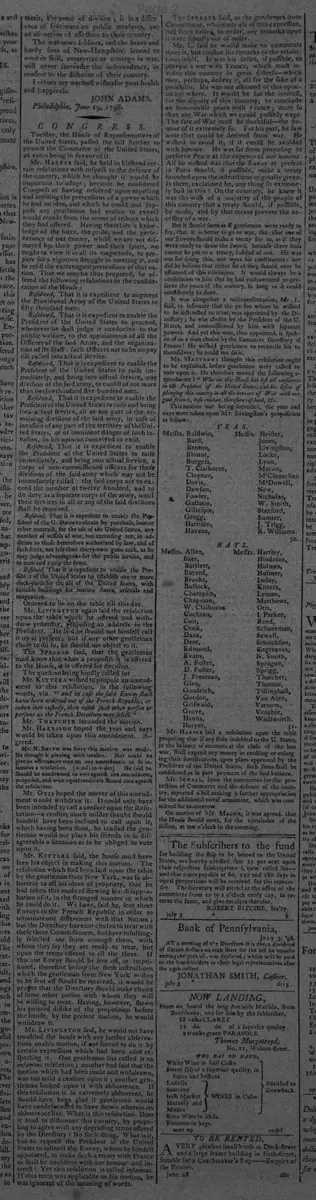
Tuesday, the House of Representatives of the United States, passed the bill further to protect the Commerce of the United States, 46 votes being in favour of it.
Mr. Harper said, he held in his hand certain resolutions with respect to the defence of the country, which he thought it would be important to adopt; because he considered Congress as having resolved upon repelling and resisting the pretensions of a power which he had no idea, and which he could not suppose any gentleman had reason to expect would recede from the terms of tribute which they had offered. Having therefore a knowledge of the force, the pride, and the perseverance of our enemy, whilst we are not dismayed by their power and their spirit, we ought to view it in all its magnitude, to prepare for a vigorous struggle in meeting it, and to resist the extravagant pretensions of that nation. That we may be thus prepared, he offered the following resolutions to the consideration of the House:
Resolved, That it is expedient to augment the Provisional Army of the United States to fifty thousand men.
Resolved, That it is expedient to enable the President of the United States to proceed, whenever he shall judge it conducive to the public welfare, to the appointment of all the Officers of the said Army, and the organization of its Staff: such Officers not to be on pay till called into actual service.
Resolved, That it is expedient to enable the President of the United States to raise immediately, and bring into actual service, one division of the said army, to consist of not more than twelve thousand five hundred men.
Resolved, That it is expedient to enable the President of the United States to raise and bring into actual service, all or any part of the remaining divisions of the said army, in case of invasion of any part of the territory of the United States, or of imminent danger of such invasion, in his opinion conceived to exist.
Resolved, That it is expedient to enable the President of the United States to raise immediately, and bring into actual service, a corps of non-commissioned officers for those divisions of the said army which may not be immediately raised: the said corps not to exceed the number of twelve hundred, and to do duty as a separate corps of the army, until their services in all or any of the said divisions shall be required.
Resolved, That it is expedient to enable the President of the U. States to obtain by purchase, loan or other contract, for the use of the United States, any number of vessels of war, not exceeding ten, in addition to those heretofore authorized by law, and of such force, not less than thirty-two guns each, as he may judge advantageous for the public service, and to man and equip the same.
Resolved, That it is expedient to enable the President of the United States to establish one or more dock-yards for the use of the United States, with suitable buildings for marine stores, arsenals and magazines.
Ordered to lie on the table till this day.
Mr. Livingston again laid the resolution upon the table which he offered and withdrew yesterday, proposing an address to the President. He said he should not himself call it up at present; but if any other gentleman chose to do so, he should not object to it.
The SPEAKER said, that the gentleman must know that when a proposition is offered to the House, it is offered for decision.
The question being loudly called for Mr. Kittera wished to propose an amendment to this resolution, in the following words, viz. "and in case the said Envoy shall have been ordered out of the French Republic, or taken into custody, then with such other person or persons as the French Directory may elect."
Mr. Thacher seconded the motion.
Mr. Harrison hoped the yeas and nays would be taken upon this amendment. Agreed.
Mr. N. Smith was sorry this motion was made. He thought it playing with treason, Nor could he give an affirmative vote on any amendment to so infamous a resolution. (call to order) He said he should be constrained to vote against the amendment, proposed, and with equal readiness should vote against the resolution.
Mr. Otis hoped the mover of this amendment would withdraw it. It could only have been intended to cast a censure upon the Resolution—a censure much milder than he should himself have been inclined to cast upon it, which having been done, he trusted the gentleman would not place his friends in so disagreeable a situation as to be obliged to vote upon it.
Mr. Kittera said, the house must have seen his object in making this motion. The resolution which had been laid upon the table by the gentleman from New York, was so abhorrent to all his ideas of propriety, that he had taken this mode of showing his disapprobation of it, in the strongest manner in which he could do it. We have, said he, sent three Envoys to the French Republic in order to terminate our differences with that Nation; but the Directory have not chosen to treat with these three Commissioners, but have insultingly selected one from amongst them, with whom they say they are ready to treat, but upon the terms offered to all the three. If this one Envoy should be sent off, or imprisoned, therefore before the fresh instructions which the gentleman from New York wishes to be sent off should be received, it would be proper that the Directory should make choice of some other person with whom they will be willing to treat. Having, however, shewn his pointed dislike of the proposition before the house, by the present motion, he would withdraw it.
Mr. Livingston said, he would not have troubled the house with any farther observations on this motion, if not forced to do it by certain expressions which had been used respecting it. One gentleman has called it an infamous resolution; another had said that the motion which had been made and withdrawn, was too mild a censure upon it; another gentleman looked upon it with abhorrence. If this resolution is so extremely abhorrent, he should have been glad if gentlemen would have condescended to have shown wherein its abhorrence lies. What is this resolution. Does it tend to dishonour this country, by proposing to agree with any degrading terms offered by the Directory? No such thing, What is it, but—to request the President of the United States to instruct the Envoy, whom he himself appointed, to make such a treaty with France as shall be consistent with our honour and interest? Yet this resolution is called infamous. If this term was applicable to his motion, he was ignorant of the meaning of words.
The Speaker said, as the gentleman from Connecticut, who made use of this expression, had been called to order, any remarks upon it were equally out of order.
Mr. L. said he would make no comments upon it, but confine his remarks to the resolution itself, It was his desire, if possible, to prevent a war with France, which must involve this country in great distress—which may, perhaps, destroy it, all for the sake of a punctilio. He was not ashamed of this opinion any where. It would be for the interest, for the dignity of this country, to conclude an honourable peace with France; more so than any War which we could possibly wage.
The fate of War must be doubtful—the honour of it extremely so. For his part, he saw none that could be derived from war. He wished to avoid it, if it could be avoided with honour. He was far from proposing to preserve Peace at the expense of our honour.
All he wished was that the Envoy at present in Paris should, if possible, make a treaty founded upon the instructions originally given.
Is there, exclaimed he, any thing so extremely bad in this? On the contrary, he knew it was the wish of a majority of the people of this country that a treaty should, if possible, be made, and by that means prevent the necessity of a war.
But it should seem as if gentlemen were ready to say, that it is better to go to war, than that one of our Envoys should make a treaty for us, as if they were ready to draw the sword, because three seals cannot be put to a treaty, instead of one. He was not for doing this, nor were his constituents: nor did he believe that either he or they should ever be ashamed of this resolution. It would always be a consolation to him that he had endeavoured to preserve the peace of the country, as long as it could consistently be done.
It was altogether a misrepresentation, Mr. L. said, to insinuate that the person whom he wished to be instructed to treat, was appointed by the Directory; he was chosen by the President of the U. States, and commissioned by him with separate powers. And yet this man, thus appointed, is spoken of as a man chosen by the Executive Directory of France! He wished gentlemen to reconcile this to themselves; he could not do it.
Mr. Matthews thought this resolution ought to be explained, before gentlemen were called to vote upon it. He therefore moved the following amendment? "Whereas this House has lost all confidence in the President of the United States, and his desire of plunging this country in all the horrors of War with our good friends, is so evident, therefore resolved, &c."
This motion not being seconded, the yeas and nays were taken upon Mr. Livingston's proposition as follows:
| Messrs. Baldwin, Bard, Benton, Blount, Burgess, T. Claiborne, Clopton, Davis, Dawson, Fowler, Gallatin, Gillespie, Gregg, Harrison, Havens, | Messrs. Heister, Jones, Livingston, Locke, Lyon, Macon, M'Clenachan, M'Dowell, New, Nicholas, W. Smith, Stanford, Sumter, J. Trigg, R. Williams. |
| Messrs. Allen, | Messrs. Hartley, |
| Baer, | Hindman, |
| Bartlett, | Holmes, |
| Bayard, | Hostmer, |
| Brooks, | Imlay, |
| Bullock, | Kittera, |
| Champlin, | Lyman, |
| Chapman, | Matthews, |
| W. Claiborne | Otis, |
| Cochran, | I. Parker, |
| Coit, | Reed, |
| Craik, | Schureman, |
| Dana, | Sewall, |
| Dent, | Sinnickson, |
| Edmond, | Sitgreaves, |
| Evans, | N. Smith, |
| A. Foster, | Sprague, |
| D. Foster, | Sprigg, |
| J. Freeman, | Thacher, |
| Glen, | Thomas, |
| Goodrich, | Tillinghast, |
| Gordon, | Van Alen, |
| Griswold, | Varnum, |
| Grove, | Venable, |
| Hanna, | Wadsworth, |
| Harper, |
Mr. Harper laid a resolution upon the table proposing that if any state indebted to the U. States, in the balance of accounts at the close of the late war, shall expend any money in erecting or enlarging their fortifications, upon plans approved by the President of the United States, such sums shall be considered as in part payment of the said balance.
Mr. Sewall, from the committee for the protection of Commerce and the defence of the country, reported a bill making a farther appropriation for the additional naval armament, which was committed for to-morrow.
On motion of Mr. Macon, it was agreed, that the House should meet, for the remainder of the session, at ten o'clock in the morning.
What sub-type of article is it?
What keywords are associated?
What entities or persons were involved?
Domestic News Details
Event Date
Tuesday
Key Persons
Outcome
bill to protect commerce passed 46 votes in favor. harper's resolutions ordered to lie on the table. livingston's resolution voted on with yeas (approx. 30) and nays (approx. 50), implying failure. additional bills reported and motions agreed.
Event Details
The House passed a commerce protection bill. Mr. Harper offered resolutions to augment the army to 50,000 men, appoint officers, raise divisions, add warships, and establish dock-yards for defense against France. Debate on Mr. Livingston's resolution to instruct the Paris envoy for an honorable treaty; amendments proposed and withdrawn; vote taken with yeas and nays listed. Other resolutions and bills on fortifications, naval appropriations, and session hours discussed.