Thank you for visiting SNEWPapers!
Sign up free
Editorial
March 4, 1901
El Paso Daily Herald
El Paso, El Paso County, Texas
What is this article about?
Editorial criticizes wide-open gambling in El Paso as the primary cause of credit delinquencies (96% of bad debts), moral decay, and economic harm to merchants, who face higher losses, rents, and prices; urges restriction as morally and legally wrong.
Clipping
OCR Quality
95%
Excellent
Full Text
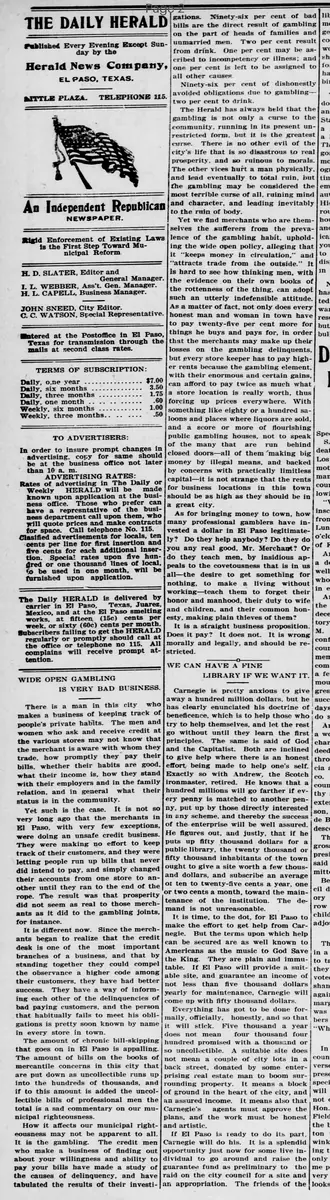
WIDE OPEN GAMBLING IS VERY BAD BUSINESS.
There is a man in this city who makes a business of keeping track of people's private habits. The men and women who ask and receive credit at the various stores may not know that the merchant is aware with whom they trade, how promptly they pay their bills, whether their habits are good, what their income is, how they stand with their employers and in the family relation, and in general what their status is in the community.
Yet such is the case. It is not so very long ago that the merchants in El Paso, with very few exceptions, were doing an unsafe credit business. They were making no effort to keep track of their customers, and they were letting people run up bills that never did intend to pay, and simply changed their accounts from one store to another until they ran to the end of the rope. The result was that prosperity did not seem as real to those merchants as it did to the gambling joints, for instance.
It is different now. Since the merchants began to realize that the credit desk is one of the most important branches of a business, and that by standing together they could compel the observance a higher code among their customers, they have had better success. They have a way of informing each other of the delinquencies of bad paying customers, and the person that habitually fails to meet his obligations is pretty soon known by name in every store in town.
The amount of chronic bill-skipping that goes on in El Paso is appalling. The amount of bills on the books of mercantile concerns in this city that are put down as uncollectible runs up into the hundreds of thousands, and if to this amount is added the uncollectible bills of professional men the total is a sad commentary on our municipal righteousness.
How it affects our municipal righteousness may not be apparent to all. It is the gambling. The credit men who make a business of finding out about your willingness and ability to pay your bills have made a study of the causes of delinquency, and have tabulated the results of their investigations.
Ninety-six per cent of bad bills are the direct result of gambling on the part of heads of families and unmarried men. Two per cent result from drink. One per cent may be ascribed to incompetency or illness; and one per cent is left to be assigned to all other causes. Ninety-six per cent of dishonestly avoided obligations due to gambling two per cent to drink.
The Herald has always held that the gambling is not only a curse to the community, running in its present unrestricted form, but it is the greatest curse. There is no other evil of the city's life that is so disastrous to real prosperity, and so ruinous to morals. The other vices hurt a man physically, and lead eventually to total ruin, but the gambling may be considered the most terrible curse of all, ruining mind and character, and leading inevitably to the ruin of body.
Yet we find merchants who are themselves the sufferers from the prevalence of the gambling habit, upholding the wide open policy, alleging that it "keeps money in circulation," and "attracts trade from the outside."
It is hard to see how thinking men, with the evidence on their own books of the rottenness of the thing, can adopt such an utterly indefensible attitude.
As a matter of fact, not only does every honest man and woman in town have to pay twenty-five per cent more for things he buys and pays for, in order that the merchants may make up their losses on the gambling delinquents, but every store keeper has to pay higher rents because the gambling element, with their enormous and certain gains, can afford to pay twice as much what a store location is really worth, thus forcing up prices everywhere.
With something like eighty or a hundred saloons and places where liquors are sold, and a score or more of flourishing public gambling houses, not to speak of the many that are run behind closed doors-all of them making big money by illegal means, and backed by concerns with practically limitless capital-it is not strange that the rents for business locations in this town should be as high as they should be in a great city.
As for bringing money to town, how many professional gamblers have invested a dollar in El Paso legitimately? Do they help anybody? Do they do you any real good, Mr. Merchant? Or do they teach men, by insidious appeals to the covetousness that is in us all-the desire to get something for nothing, to make a living without working-teach them to forget their honor and manhood, their duty to wife and children, and their common honesty, making plain thieves of them?
It is a straight business proposition. Does it pay? It does not. It is wrong morally and legally, and should be restricted.
There is a man in this city who makes a business of keeping track of people's private habits. The men and women who ask and receive credit at the various stores may not know that the merchant is aware with whom they trade, how promptly they pay their bills, whether their habits are good, what their income is, how they stand with their employers and in the family relation, and in general what their status is in the community.
Yet such is the case. It is not so very long ago that the merchants in El Paso, with very few exceptions, were doing an unsafe credit business. They were making no effort to keep track of their customers, and they were letting people run up bills that never did intend to pay, and simply changed their accounts from one store to another until they ran to the end of the rope. The result was that prosperity did not seem as real to those merchants as it did to the gambling joints, for instance.
It is different now. Since the merchants began to realize that the credit desk is one of the most important branches of a business, and that by standing together they could compel the observance a higher code among their customers, they have had better success. They have a way of informing each other of the delinquencies of bad paying customers, and the person that habitually fails to meet his obligations is pretty soon known by name in every store in town.
The amount of chronic bill-skipping that goes on in El Paso is appalling. The amount of bills on the books of mercantile concerns in this city that are put down as uncollectible runs up into the hundreds of thousands, and if to this amount is added the uncollectible bills of professional men the total is a sad commentary on our municipal righteousness.
How it affects our municipal righteousness may not be apparent to all. It is the gambling. The credit men who make a business of finding out about your willingness and ability to pay your bills have made a study of the causes of delinquency, and have tabulated the results of their investigations.
Ninety-six per cent of bad bills are the direct result of gambling on the part of heads of families and unmarried men. Two per cent result from drink. One per cent may be ascribed to incompetency or illness; and one per cent is left to be assigned to all other causes. Ninety-six per cent of dishonestly avoided obligations due to gambling two per cent to drink.
The Herald has always held that the gambling is not only a curse to the community, running in its present unrestricted form, but it is the greatest curse. There is no other evil of the city's life that is so disastrous to real prosperity, and so ruinous to morals. The other vices hurt a man physically, and lead eventually to total ruin, but the gambling may be considered the most terrible curse of all, ruining mind and character, and leading inevitably to the ruin of body.
Yet we find merchants who are themselves the sufferers from the prevalence of the gambling habit, upholding the wide open policy, alleging that it "keeps money in circulation," and "attracts trade from the outside."
It is hard to see how thinking men, with the evidence on their own books of the rottenness of the thing, can adopt such an utterly indefensible attitude.
As a matter of fact, not only does every honest man and woman in town have to pay twenty-five per cent more for things he buys and pays for, in order that the merchants may make up their losses on the gambling delinquents, but every store keeper has to pay higher rents because the gambling element, with their enormous and certain gains, can afford to pay twice as much what a store location is really worth, thus forcing up prices everywhere.
With something like eighty or a hundred saloons and places where liquors are sold, and a score or more of flourishing public gambling houses, not to speak of the many that are run behind closed doors-all of them making big money by illegal means, and backed by concerns with practically limitless capital-it is not strange that the rents for business locations in this town should be as high as they should be in a great city.
As for bringing money to town, how many professional gamblers have invested a dollar in El Paso legitimately? Do they help anybody? Do they do you any real good, Mr. Merchant? Or do they teach men, by insidious appeals to the covetousness that is in us all-the desire to get something for nothing, to make a living without working-teach them to forget their honor and manhood, their duty to wife and children, and their common honesty, making plain thieves of them?
It is a straight business proposition. Does it pay? It does not. It is wrong morally and legally, and should be restricted.
What sub-type of article is it?
Moral Or Religious
Economic Policy
Social Reform
What keywords are associated?
Gambling Curse
Credit Delinquency
El Paso Merchants
Moral Ruin
Economic Harm
Vice Restriction
What entities or persons were involved?
Merchants
Professional Gamblers
Credit Men
The Herald
Editorial Details
Primary Topic
Critique Of Wide Open Gambling In El Paso
Stance / Tone
Strongly Anti Gambling Advocating Restriction
Key Figures
Merchants
Professional Gamblers
Credit Men
The Herald
Key Arguments
96% Of Bad Bills Result From Gambling
Gambling Is The Greatest Curse To Community Prosperity And Morals
Merchants Suffer Losses From Gambling Related Delinquencies
Wide Open Gambling Inflates Rents And Increases Prices For Honest Customers
Gambling Teaches Dishonesty And Ruins Families
Gambling Does Not Legitimately Invest In Or Benefit The Town