Thank you for visiting SNEWPapers!
Sign up free
Jenks's Portland Gazette
Portland, Cumberland County, Maine
What is this article about?
In Prussian territory, chemist Mr. Richard verified Margrafs' discovery that high-quality sugar can be produced in large quantities from the beet root known as Scarcity Root or Mangold. Successful experiments in upper Saxony and Brunswick suggest it could supply Prussia amid Muscovado sugar scarcity.
Clipping
OCR Quality
Full Text
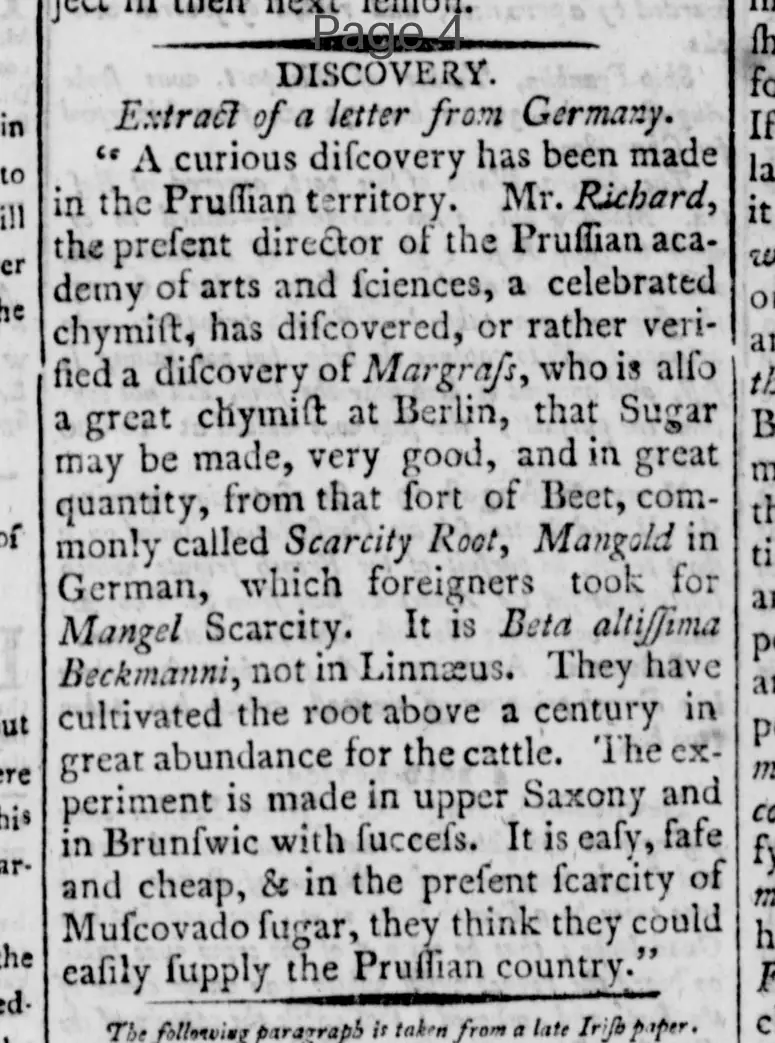
Extract of a letter from Germany.
"A curious discovery has been made in the Prussian territory. Mr. Richard, the present director of the Prussian academy of arts and sciences, a celebrated chymist, has discovered, or rather verified a discovery of Margrafs, who is also a great chymist at Berlin, that Sugar may be made, very good, and in great quantity, from that sort of Beet, commonly called Scarcity Root, Mangold in German, which foreigners took for Mangel Scarcity. It is Beta altissima Beckmanni, not in Linnæus. They have cultivated the root above a century in great abundance for the cattle. The experiment is made in upper Saxony and in Brunswick with success. It is easy, safe and cheap, & in the present scarcity of Muscovado sugar, they think they could easily supply the Prussian country."
What sub-type of article is it?
What keywords are associated?
What entities or persons were involved?
Where did it happen?
Foreign News Details
Primary Location
Prussian Territory
Key Persons
Outcome
experiments successful in upper saxony and brunswick; could easily supply the prussian country amid scarcity of muscovado sugar.
Event Details
Mr. Richard verified Margrafs' discovery that sugar can be made from the beet root called Scarcity Root or Mangold (Beta altissima Beckmanni). The root has been cultivated for over a century for cattle. The process is easy, safe, and cheap.