Thank you for visiting SNEWPapers!
Sign up free
Virginia Argus
Richmond, Virginia
What is this article about?
The editorial defends the U.S. Embargo Act as a wise response to Britain's restrictive Orders in Council, which threaten American commerce by assuming oceanic dominance and ignoring treaties. It argues the embargo prevents ruin and strengthens U.S. negotiating position amid tensions.
Merged-components note: Continuation across pages of opinionated analysis on British Orders in Council; original labels were 'domestic_news' and 'editorial', unified as 'editorial' due to commentary tone.
Clippings
1 of 2
OCR Quality
Full Text
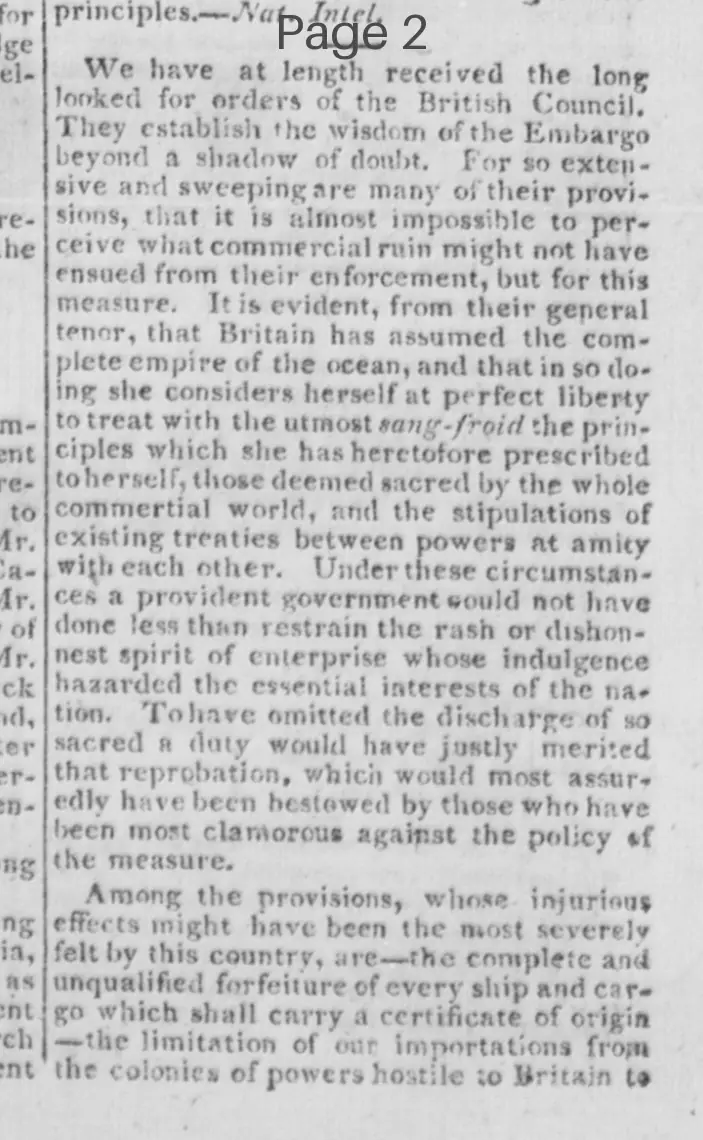
Among the provisions, whose injurious effects might have been the most severely felt by this country, are—the complete and unqualified forfeiture of every ship and cargo which shall carry a certificate of origin —the limitation of our importations from the colonies of powers hostile to Britain to
the quantity consumed by ourselves—and the imposition of duties, such as Britain please to prescribe, on all such goods imported into her territory and exported to a nation at war with her.
By the first provision, we believe, every species of trade, now authorised by France and her allies to their countries, is prohibited, not under any common penalty, but by the entire confiscation of vessel and cargo.
By the second a rule is applied, not only unjust in itself, but unsusceptible of any other measure of application than shall be applied by the cupidity of the free booter, and the tyranny of power that considers itself irresponsible to any motives other than those which are dictated by its own temporary interests.
And, by the third, the trade of the whole world is made tributary to the injustice and cupidity of Britain.
Such are the very cursory reflections which arise from a single perusal of these celebrated orders. We can consider them in no other light than that of an enforcement of the same principles of absolute power, with the recent proclamation relative to seamen. However general they may all nominally be in their application, they are principally, if not exclusively intended for us They are, we fear, the pillars on which the pending negociations are to rest. And they must either be intended to shut the door upon all commercial amity between the two nations; or to be used as so many make-weights in the adjustment of our differences. If dictated by the latter motive, they are predicated on the hope, if not the belief, that the terrors they hold forth will induce us to crouch to terms at which we should otherwise revolt
If either of these be their object, the embargo is the correct and commanding measure by which they will be best met It will, on the first supposition, save our commercial capital from destruction ; and on the latter supposition, it will enable our executive to treat with becoming disregard this signal display of power, by permitting British valor and cupidity to parade the ocean, and there enjoy the proud triumph of fighting wind-mills or waging war with the elements. Secure in ourselves we may laugh this proud spirit to scorn; and may, undismayed tell the mistress of the ocean, while you persist in robbing us we will stay at home. Treat us justly, and we will supply you with that, without which your colonies will become the seats of rebellion, and your manufactures be ruined. Continue to exercise a lawless system of injustice, but beware of the consequences! An invading foe may think that the propitious moment for aiming a death blow at your existence, when the arm of brother shall be raised against brother, and when despair shall have left in the breasts of your subjects no hopes so animating as that of a complete change of their condition.—ib.
What sub-type of article is it?
What keywords are associated?
What entities or persons were involved?
Editorial Details
Primary Topic
Defense Of The Embargo Against British Orders In Council
Stance / Tone
Strongly Supportive Of Embargo, Critical Of British Commercial Aggression
Key Figures
Key Arguments