Thank you for visiting SNEWPapers!
Sign up free
The Kusko Times
Takotna, Tokotna, Mcgrath, Alaska
What is this article about?
Governor George A. Parks' first annual report to the Secretary of the Interior details Alaska's steady industrial progress in 1924, with growth in fisheries ($30M+), mining ($16M+), and forests. It covers seals, foxes, reindeer, trade balance, transportation improvements, health issues, and recommends laws for development, schools, and policing.
Merged-components note: Continuation of the article 'Abstract of Gov. Park's First Annual Report' across pages 1, 2, and 3. Label changed from domestic_news for the page 3 portion to story for consistency with the overall narrative report.
Clippings
1 of 3
OCR Quality
Full Text
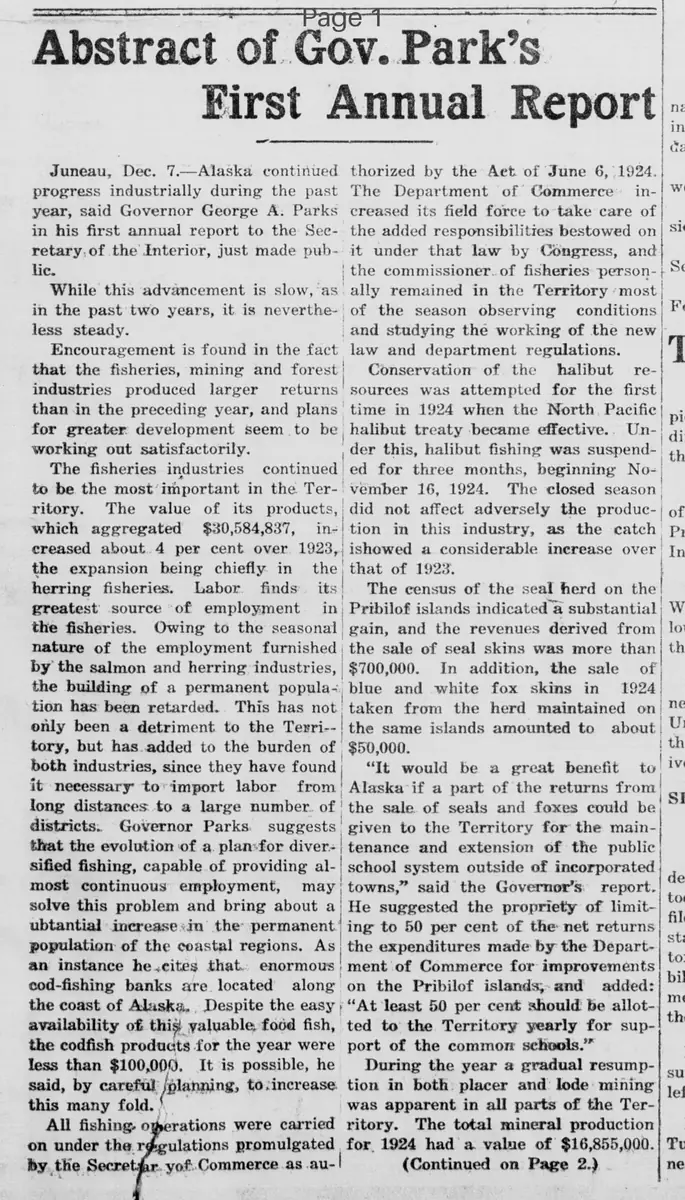
Juneau, Dec. 7.—Alaska continued progress industrially during the past year, said Governor George A. Parks in his first annual report to the Secretary of the Interior, just made public.
While this advancement is slow, as in the past two years, it is nevertheless steady.
Encouragement is found in the fact that the fisheries, mining and forest industries produced larger returns than in the preceding year, and plans for greater development seem to be working out satisfactorily.
The fisheries industries continued to be the most important in the Territory. The value of its products, which aggregated $30,584,837, increased about 4 per cent over 1923, the expansion being chiefly in the herring fisheries. Labor finds its greatest source of employment in the fisheries. Owing to the seasonal nature of the employment furnished by the salmon and herring industries, the building of a permanent population has been retarded. This has not only been a detriment to the Territory, but has added to the burden of both industries, since they have found it necessary to import labor from long distances to a large number of districts. Governor Parks suggests that the evolution of a plan for diversified fishing, capable of providing almost continuous employment, may solve this problem and bring about a substantial increase in the permanent population of the coastal regions. As an instance he cites that enormous cod-fishing banks are located along the coast of Alaska. Despite the easy availability of this valuable food fish, the codfish products for the year were less than $100,000. It is possible, he said, by careful planning, to increase this many fold.
All fishing operations were carried on under the regulations promulgated by the Secretary of Commerce as authorized by the Act of June 6, 1924.
The Department of Commerce increased its field force to take care of the added responsibilities bestowed on it under that law by Congress, and the commissioner of fisheries personally remained in the Territory most of the season observing conditions and studying the working of the new law and department regulations.
Conservation of the halibut resources was attempted for the first time in 1924 when the North Pacific halibut treaty became effective. Under this, halibut fishing was suspended for three months, beginning November 16, 1924. The closed season did not affect adversely the production in this industry, as the catch showed a considerable increase over that of 1923.
The census of the seal herd on the Pribilof islands indicated a substantial gain, and the revenues derived from the sale of seal skins was more than $700,000. In addition, the sale of blue and white fox skins in 1924 taken from the herd maintained on the same islands amounted to about $50,000.
"It would be a great benefit to Alaska if a part of the returns from the sale of seals and foxes could be given to the Territory for the maintenance and extension of the public school system outside of incorporated towns," said the Governor's report.
He suggested the propriety of limiting to 50 per cent of the net returns the expenditures made by the Department of Commerce for improvements on the Pribilof islands, and added: "At least 50 per cent should be allotted to the Territory yearly for support of the common schools."
During the year a gradual resumption in both placer and lode mining was apparent in all parts of the Territory. The total mineral production for 1924 had a value of $16,855,000.
(Continued on Page 2.)
Abstract of Governor
Park's Annual Report
(Continued from Page 1)
The production of gold exceeded that of 1923. Prospectors were encouraged by several new discoveries, and the consolidation and renewed activities of some of the larger dredging companies have stimulated the quest for low grade placer ground. Governor Parks recommends more liberal laws for the development of the low grade placer gravels of the Territory. The existing law, he points out, was designed to prevent the monopolization of bonanza ground, and works a hardship on capital seeking to develop areas of low grade ground which cannot be profitably worked except by large scale operations. The gold lode mining industry of the Territory showed a healthy development, and the increase in gold output for the year was due mainly to the activity in the lode mines, particularly in Southeastern Alaska. While benefits to the gold mining industry following the completion of the Alaska Railroad have been rather slow to appear in the production of gold, significant developments are now in progress which, with an increase in prospecting, will eventually lead to augmented gold returns.
The production of the copper mines was materially smaller than in 1923. This resulted from unsatisfactory market conditions which provided no stimulus for extended or enlarged operations. Coal production likewise experienced a decrease, but extensive explorations are being carried on which point to increased production and wider distribution of Alaskan coal in the near future.
The Katalla oil fields continue to be the only producing fields in the Territory. However, exploration in other districts was carried on by some of the larger companies. Wells are being drilled in the Cold Bay district by the Standard Oil Company of California and the Associated Oil Company. Geologic and topographic surveys lying within Naval Petroleum Reserve No. 4, on the Arctic slope, were made by government agencies during the year. Definite results of these surveys cannot be determined until office and laboratory studies have been made of the data and technical information thus obtained.
While receipts from resources within the national forests of Alaska showed a healthy growth for the year, the Territory's timber industry continues to be but a small factor in the industrial life, and the annual returns from the forests infinitesimal when possibilities for development and utilization of the forest resources are realized. In the calendar year 1924 the timber cut from the national forests aggregated 52,500,000 board feet, and the total cut since 1909, when the national forests in Alaska were created, has been 582,000,000 board feet. In accord with the fixed policy of the government to encourage utilization of forest resources to a point equal to the average yearly growth of timber, the annual cut from Alaska forests should aggregate 1,000,000,000 board feet. In other words, the total value of timber production in the past sixteen years, is about one-half of the growth annually.
Governor Parks points out that the logical extension of the development of forest resources must come through the pulp and paper industry. The predominant species, Sitka spruce and western hemlock, are both excellent pulping woods; the trees largely of sizes more suitable for pulp than lumber, and freight from Alaska to the market not such an important factor for paper as for lumber of a much lower unit value. Cheap water power, an essential to pulp and paper making, is available locally in abundance, and the region has the advantage of cheap year-round water transportation from the woods to mill, and for the finished product from the mills to market. The possible sustained yearly output, 1,000,000,000 board feet, is sufficient to produce not less than 1,300,000 tons of news print paper.
Surveys of undeveloped power sites disclose a potential water power capacity of 475,000 h.p. in Southwestern Alaska alone, while only 433,000 h.p. would be required to produce the maximum amount of news print contained in the possible annual output from the national forests. Contrary to popular opinion, maintenance of national forests in Alaska has not proven expensive to the government. The total receipts from timber sales, leases, etc., on the national forests of the Territory from the time the forests were placed under the administration in 1909, up to and including the fiscal year 1923, were $1,154,977. During the same period the total expenditures on these forests amounted to $1,112,415.
Fox farming is annually increasing in importance in the Territory's industries, the total value of improvements in stock on these farms being estimated at about $6,000,000. There are approximately 391 farms, containing more than 36,000 foxes of various species. Governor Parks urges the enactment by Congress of a suitable law providing for the location of lands in the public domain outside of the national forests for fox farms. The same laws, he suggests, should be made applicable for reindeer growers. "The native reindeer herds," said Governor Parks, "are supervised by the Bureau of Education, and if they are to be protected in their ranges we must have a law that will enable the Secretary of the Interior to locate and lease the grazing lands."
There are approximately 300,000 animals in the Alaskan reindeer herds, two-thirds of which belong to the Eskimo. With the start thus made, and with present improved refrigeration methods employed by the transportation companies, it is possible at no distant date that reindeer meat exported from two hundred thousand square miles of barren portions of Northern and Western Alaska will prove to be a valuable asset to the Territory. It is estimated those sections of Alaska could furnish pasturage for more than 4,000,000 animals.
The balance of trade for the year remained in favor of Alaska. Products of its industries shipped to the States aggregated in value $55,440,645, while the value of all commodities brought into the Territory from the States amounted to $33,321,569, leaving a balance in favor of the Territory of $27,420,833.
During the year the Territory's system of travel and communication was materially improved. Wagon roads and trails were pushed further out in all sections of the Territory, and in some regions these extensions have made available lands which formerly were unattainable by settlers, and, now open to settlement, are being taken up by individuals eager to avail themselves of the opportunities offered.
In Interior Alaska airplanes compete with automobiles and river steamers for both passenger and freight business. Airplane service inaugurated out of Fairbanks, the
(Continued on Page 3.)
Abstract of Governor Parks' Annual Report
(Continued from Page 2.)
The interior terminus of the Alaska Railroad, has served many remote mining settlements, some beyond the Arctic circle, bringing them into closer touch with more settled districts of the Territory as well as to the States, and has been no small factor in stimulating mining developments in the isolated regions. Not unmindful of the part played by this means of transportation, the last Territorial Legislature provided funds for airplane landing fields that are now being constructed in the remote sections of the Territory. When these are completed, districts that formerly were accessible only through weeks of travel, sometimes hazardous and always tedious, can be reached within a few short hours.
The Alaska Railroad, in conjunction with river steamers operated by it on the Yukon and Tanana rivers, renders excellent service to all of the Territory, from Resurrection Bay to St. Michael on the Bering Sea and to mining settlements in the Upper Kuskokwim river regions. Gov. Parks directs attention to the fact that a large amount of work remains to be done before the railroad is completed, and adds: "Adequate appropriations are essential if the operation and maintenance charges are to be reduced to a reasonable amount."
He said: "The annual report of the general manager of the Alaska Railroad showed the policy adopted early in 1924 making for economy and efficiency in operation, has resulted in decreased maintenance costs and a reduction in the annual deficiency."
Supplementing these communications are water routes out of Nome both north and south to Bristol Bay and out of Cook Inlet, unserved by regular transportation lines, for which subsidies are provided by the Territorial Legislature. Three steamship lines operated during the summer of 1924, and four in 1925 maintained an excellent service throughout the summer season. The Canadian national steamship lines resumed operations between Vancouver and Southeastern Alaska points for the first time since 1917.
Tourist travel to Alaska was increased over 1924, virtually all of the steamers operating between Seattle and Southeastern and Western Alaska, and Vancouver and Southeastern Alaska, carrying capacity loads during the season. Hundreds of tourists visited Interior Alaska via the Alaska Railroad and the Richardson Highway, and many of these visited the McKinley National Park, opened for its first full season. The construction of an automobile road from McKinley Park Station into the heart of this park will undoubtedly attract more and more visitors each succeeding year.
Changes in the boundaries of the land districts to make them conform to the boundaries of the judicial divisions are recommended to facilitate the administration of public land laws. The Governor asks for removal of restrictions on the number of trade and manufacturing sites that may be acquired by an individual or corporation. He points out that the requirement of the homestead law that surveys be rectangular and boundaries follow cardinal courses, is impracticable in coastal Alaska, often times making it impossible for pioneer homesteaders to acquire the desirable agricultural lands. He also asks for the inclusion of Alaska in the programs for a national topographic survey authorized by Congress last winter and requests allotments as funds are available.
Governor Parks reports a marked increase in the death rate during the year. Reports on the condition of public health, he points out, are very incomplete and received from sources so varied as to detract from their reliability. Tuberculosis exacts a heavy toll among the aboriginal tribes, and during the year severe epidemics of measles in all four divisions, influenza reaching epidemic proportions in three divisions, small-pox in two, and diphtheria in three, were reported.
The condition of the aboriginal races, the Governor said, is deplorable, and no great improvement is believed possible until some form of Territorial contact is made with the various services and agencies engaged in medical relief among them. No one knows the number of hospitals in the Territory nor their equipment, the number and location of physicians, nor even approximately the number of people, whites and natives, depending on them for relief. Areas containing thousands of natives never have seen a physician, and in matters of sanitation are still in the Stone Age.
Arising from such conditions each year are emergencies which demand, or seem to demand, immediate attention, costing many thousands of dollars annually. Much of this money is wasted because of imperfect knowledge of conditions in isolated districts and for want of co-operation between such relief agencies as are available.
Governor Parks cites the Bristol Bay area, containing an aboriginal population of more than 5,000 people, and the Yukon river valley and tributary regions as specific instances where more efficient public health service is needed. For the latter he recommended a hospital boat for service on the Yukon river and tributary streams for summer relief work and suggested the advisability of extending this work throughout the year by reopening the hospital at the abandoned military post at Fort Gibbon. He also urged that funds be made available for a medical and sanitary survey of villages inhabited by the aboriginal tribes in the Bristol Bay area.
Eight agencies working for law enforcement under as many heads without any method of co-ordination has brought about much duplication of effort, resulting in inefficiency and extravagance, declared the Governor in his report. This was not attributed to the personnel of the various agencies, but was said to be inherent to the method in vogue and impossible of elimination until responsibility for law enforcement should be vested in a single organization, under one chief, having headquarters within the Territory. Hence he recommends that a Territorial constabulary be created as offering the most practical solution of the problem, which would not only effect material economy, but would increase efficiency and eliminate the confusion of conflicting efforts. Governor Parks said: "Properly organized and in charge of efficient officers, a constabulary with headquarters in Alaska can patrol the Territory, enforcing laws, at a minimum expense."
Recommendations.
1. Enactment of law authorizing the Secretary of the Interior to lease public domain for grazing and for the propagation of fur-bearing animals.
2. Amendment of present law which limits the number of trade and manufacturing sites that may be acquired by an individual or corporation.
3. Amendment of homestead laws to permit survey of boundary lines on other than cardinal courses.
4. Boundaries of land districts be changed to conform to judicial divisions.
5. Construction of administration building in Juneau.
6. Allotment of part of the revenues from the seal islands to a fund for the support and maintenance of the public schools.
7. Repeal of the law restricting the number of placer mining claims that may be located by an individual or corporation.
8. Creation of a Territorial police responsible for law enforcement in the Territory to replace the eight organizations now in existence.
9. Legislation that will authorize the issuance of patents for town lots to natives.
10. Allotment of funds for topographic surveys in Alaska under the act of February 27, 1925.
11. Purchase and equipment of a boat as floating clinic for summer work on Yukon river and tributaries to supply medical aid and instruction in sanitation and hygiene to natives and others in the interior of Alaska and rehabilitation of the abandoned military hospital at Tanana for winter service, when boat is out of commission.
12. That the work heretofore carried on by the Bureau of Mines under the appropriation for mining investigation in Alaska be continued and that authority be obtained which will authorize a co-operative agreement between the federal government and the Territory whereby the Territorial funds for mining investigation may be expended by the federal agents.
What sub-type of article is it?
What themes does it cover?
What keywords are associated?
What entities or persons were involved?
Where did it happen?
Story Details
Key Persons
Location
Alaska
Event Date
1924
Story Details
Governor Parks' report summarizes industrial advancements in fisheries, mining, forestry, fox farming, reindeer herding, transportation, tourism, public health challenges among natives, and recommends legislative changes for development, education funding, land laws, and a territorial police force.