Thank you for visiting SNEWPapers!
Sign up free
Story
February 4, 1850
Portage Sentinel
Ravenna, Portage County, Ohio
What is this article about?
Reports on the Parkman murder case in Boston: sightings of Dr. Parkman after alleged murder time, anonymous letters claiming responsibility from Philadelphia and Texas, and identification of remains by family member for Dr. Webster's trial.
Clipping
OCR Quality
95%
Excellent
Full Text
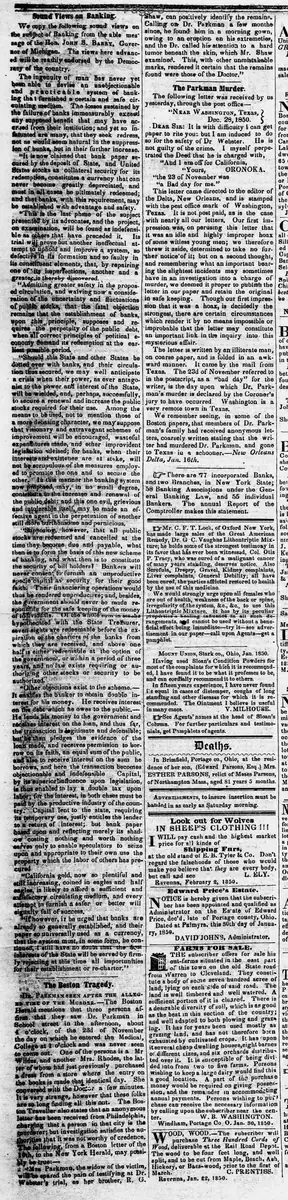
The Boston Tragedy
PARKMAN SEEN AFTER THE ALLEGED TIME OF THE MURDER.—The Boston Herald mentions that three persons affirm that they saw Dr. Parkman in School street in the afternoon, about 4 o'clock, of the 23d of November the day on which he entered the Medical College at 1 o'clock and was never seen to come out. One of the persons is a Mr. Wildes: and another Mrs. Rhodes, the latter of whom had just previously purchased dress from a store where the entry on the books is made that identical day. She conversed with the Doctor a few minutes. It is very strange, however that these folks are so long finding all this out. The Boston Traveller also states that an anonymous letter has been received from Philadelphia, charging that a person in that city is the murderer, but investigation satisfies the authorities that it was not worthy of credence, the following from a Boston letter of the 10th, to the New York Herald, may possibly be true: —
Mrs. Parkman, the widow of the victim, will be spared the pain of testifying at Dr. Webster's trial, as her brother, R. G. Shaw, can positively identify the remains. Calling on Dr. Parkman a few months since, he found him in a morning gown, owing to an eruption on his extremities, and the Dr. called his attention to a hard tumor beneath the skin, which Mr. Shaw examined. This, with other unmistakable marks, rendered it certain that the remains found were those of the Doctor.
The Parkman Murder.
The following letter was received by us yesterday, through the post office—
"Near Washington, Texas,
Dec. 28, 1850.
Dear Sir: It is with difficulty I can get paper to write you: but I am induced to do so for the safety of Dr. Webster. He is not guilty of the crime. I myself perpetrated the Deed that he is charged with,
"And I am off for California,
"Yours,
ORONOKA,
"the 23 of November was
a Bad day for me."
This letter came directed to the editor of the Delta, New Orleans, and is stamped with the post office mark of Washington, Texas. It is not post paid, as is the case with nearly all our letters. Our first impression was, on perusing this letter that it was an idle and highly improper hoax of some witless young men; we therefore threw it aside, determined to take no further notice of it; but on a second thought, and remembering what an important bearing the slightest incidents may sometimes have in an investigation into a charge of murder, we deemed it proper to publish the letter in our paper and retain the original in safe keeping. Though our first impression that it was a hoax, is decidedly the strongest, there are certain circumstances which render it by no means impossible or improbable that the letter may constitute an important link in the inquiry into this mysterious affair.
The letter is written by an illiterate man, on coarse paper, and is folded in an awkward manner. It came by the mail from Texas. The 23d of November referred to in the postscript, as a "bad day" for the writer, is the day upon which Dr. Parkman's murder is declared by the Coroner's jury to have occurred. Washington is a very remote town in Texas.
We remember seeing, in some of the Boston papers, that members of Dr. Parkman's family had received anonymous letters, coarsely written stating that the writer had murdered Dr. Parkman, and gone to Texas in a schooner.—New Orleans Delta, Jan. 16th.
PARKMAN SEEN AFTER THE ALLEGED TIME OF THE MURDER.—The Boston Herald mentions that three persons affirm that they saw Dr. Parkman in School street in the afternoon, about 4 o'clock, of the 23d of November the day on which he entered the Medical College at 1 o'clock and was never seen to come out. One of the persons is a Mr. Wildes: and another Mrs. Rhodes, the latter of whom had just previously purchased dress from a store where the entry on the books is made that identical day. She conversed with the Doctor a few minutes. It is very strange, however that these folks are so long finding all this out. The Boston Traveller also states that an anonymous letter has been received from Philadelphia, charging that a person in that city is the murderer, but investigation satisfies the authorities that it was not worthy of credence, the following from a Boston letter of the 10th, to the New York Herald, may possibly be true: —
Mrs. Parkman, the widow of the victim, will be spared the pain of testifying at Dr. Webster's trial, as her brother, R. G. Shaw, can positively identify the remains. Calling on Dr. Parkman a few months since, he found him in a morning gown, owing to an eruption on his extremities, and the Dr. called his attention to a hard tumor beneath the skin, which Mr. Shaw examined. This, with other unmistakable marks, rendered it certain that the remains found were those of the Doctor.
The Parkman Murder.
The following letter was received by us yesterday, through the post office—
"Near Washington, Texas,
Dec. 28, 1850.
Dear Sir: It is with difficulty I can get paper to write you: but I am induced to do so for the safety of Dr. Webster. He is not guilty of the crime. I myself perpetrated the Deed that he is charged with,
"And I am off for California,
"Yours,
ORONOKA,
"the 23 of November was
a Bad day for me."
This letter came directed to the editor of the Delta, New Orleans, and is stamped with the post office mark of Washington, Texas. It is not post paid, as is the case with nearly all our letters. Our first impression was, on perusing this letter that it was an idle and highly improper hoax of some witless young men; we therefore threw it aside, determined to take no further notice of it; but on a second thought, and remembering what an important bearing the slightest incidents may sometimes have in an investigation into a charge of murder, we deemed it proper to publish the letter in our paper and retain the original in safe keeping. Though our first impression that it was a hoax, is decidedly the strongest, there are certain circumstances which render it by no means impossible or improbable that the letter may constitute an important link in the inquiry into this mysterious affair.
The letter is written by an illiterate man, on coarse paper, and is folded in an awkward manner. It came by the mail from Texas. The 23d of November referred to in the postscript, as a "bad day" for the writer, is the day upon which Dr. Parkman's murder is declared by the Coroner's jury to have occurred. Washington is a very remote town in Texas.
We remember seeing, in some of the Boston papers, that members of Dr. Parkman's family had received anonymous letters, coarsely written stating that the writer had murdered Dr. Parkman, and gone to Texas in a schooner.—New Orleans Delta, Jan. 16th.
What sub-type of article is it?
Crime Story
Mystery
What themes does it cover?
Crime Punishment
Justice
What keywords are associated?
Parkman Murder
Dr Webster Trial
Anonymous Letters
Texas Confession
Sightings
Remains Identification
What entities or persons were involved?
Dr. Parkman
Dr. Webster
Mrs. Parkman
R. G. Shaw
Mr. Wildes
Mrs. Rhodes
Oronoka
Where did it happen?
Boston
Story Details
Key Persons
Dr. Parkman
Dr. Webster
Mrs. Parkman
R. G. Shaw
Mr. Wildes
Mrs. Rhodes
Oronoka
Location
Boston
Event Date
23d Of November
Story Details
Reports of Dr. Parkman sighted after entering Medical College on November 23; anonymous letters from Philadelphia and Texas claiming responsibility for the murder, suspected as hoaxes; remains identified by tumor mark for Webster's trial.