Thank you for visiting SNEWPapers!
Sign up free
Atlanta Daily World
Atlanta, Fulton County, Georgia
What is this article about?
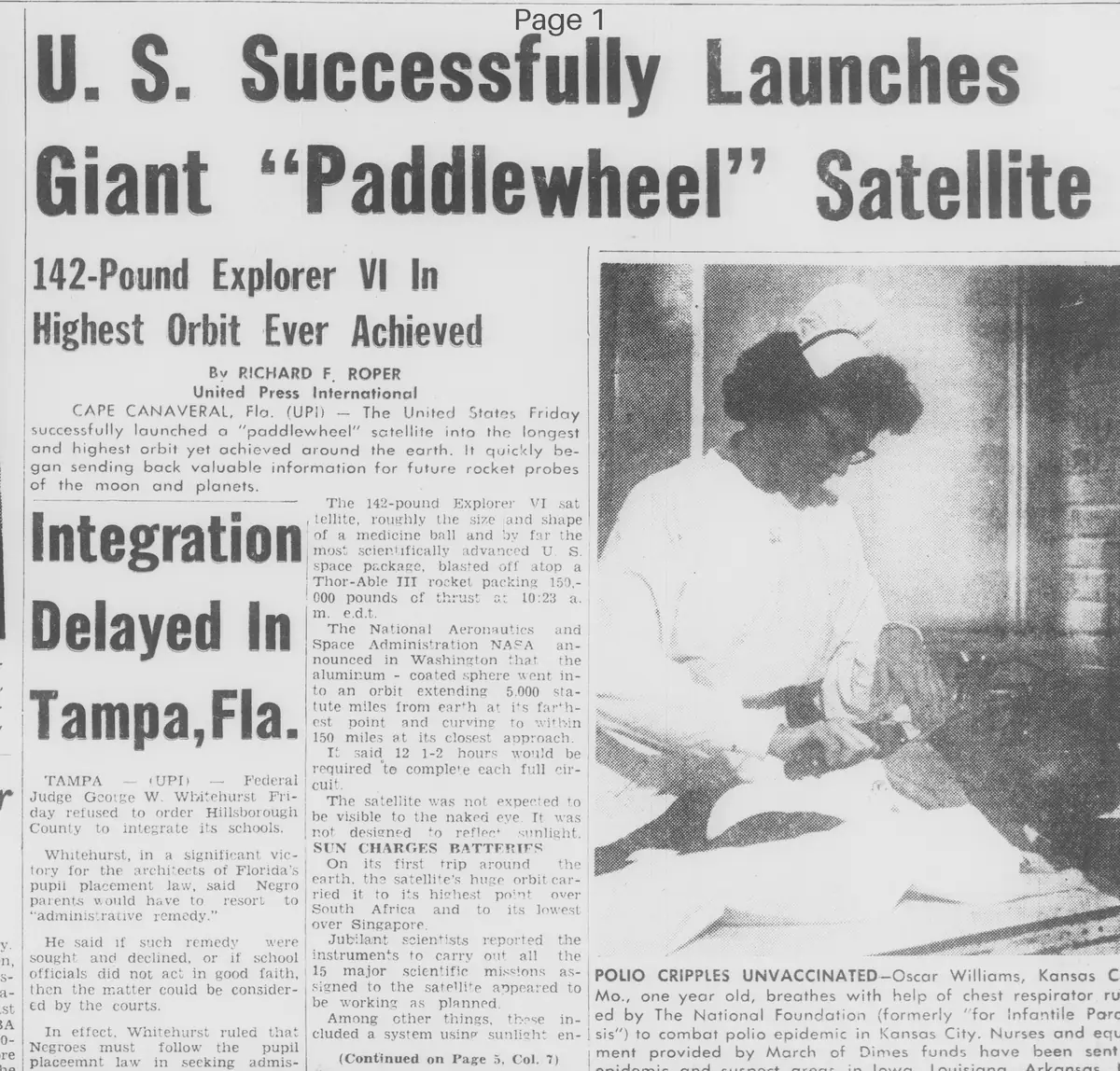
On Friday, the U.S. launched Explorer VI, a scientifically advanced 'paddlewheel' satellite, into a high Earth orbit from Cape Canaveral. The 142-pound sphere, powered by solar cells, began sending data crucial for future lunar and planetary missions, marking a key space achievement.
Merged-components note: Continuation of satellite launch story from page 1 to page 6.
Clippings
1 of 2
OCR Quality
Full Text
CAPE CANAVERAL, Fla. (UPI) - The United States Friday successfully launched a "paddlewheel" satellite into the longest and highest orbit yet achieved around the earth. It quickly began sending back valuable information for future rocket probes of the moon and planets.
The 142-pound Explorer VI satellite, roughly the size and shape of a medicine ball and by far the most scientifically advanced U.S. space package, blasted off atop a Thor-Able III rocket packing 150,000 pounds of thrust at 10:23 a.m. EDT.
The National Aeronautics and Space Administration (NASA) announced in Washington that the aluminum-coated sphere went into an orbit extending 26,000 statute miles from earth at its farthest point and curving to within 150 miles at its closest approach.
It said 12 1/2 hours would be required to complete each full circuit.
The satellite was not expected to be visible to the naked eye. It was not designed to reflect sunlight.
SUN CHARGES BATTERIES
On its first trip around the earth, the satellite's huge orbit carried it to its highest point over South Africa and to its lowest over Singapore.
Jubilant scientists reported the instruments to carry out all the 15 major scientific missions assigned to the satellite appeared to be working as planned.
Among other things, these included a system using sunlight energy to charge batteries that power the instruments.
U.S. Successfully (Continued from Page One)
energy to recharge Explorer's chemical batteries, a scanning device which will take the first crude television pictures ever made of the earth's surface from space and an amazing electronic brain
The brain, called "Telebit," not only collects information but stores it and transmits on command from the ground.
Within 12 minutes after its launching Explorer VI began reporting scientific data on radio command from ground stations.
The scientists estimated the satellite's life expectancy at "in excess of a year"
Explorer VI, the ninth successful U. S. satellite compared with Russia's three, heightened the likelihood of a rocket probe of the moon in October and a probe millions of miles into space tentatively scheduled for November
LAUNCHING GOES SMOOTHLY
It also raised the possibility of a rocket shot towards Mars when that planet swings into a suitable position Oct. 1, 1960 and toward Venus in 1961.
Equipment similar to Explorer VI's will be carried aboard these more ambitious shots.
Dr. Abe Silverstein, NASA director for space flight development, said the satellite's solar cell system for recharging its batteries particularly was "of great interest to moon and planet missions."
It was this system which gave the Explorer its nickname of "Paddlewheel." Four projecting paddle-shaped vanes jutting out from the satellite each carried 2,000 tiny silicon-based cells for converting the sunlight into electricity
Unlike many vast satellite launchings, that of Explorer VI went smoothly and almost precisely according to plan. There were no technical holdups causing delay in the launching
The orbit was close to the 23,000 mile apogee greatest distance and 160-mile perigee closest approach originally planned.
The hoped-for orbital period was about 12 hours, compared with the achieved period of 12 1/2 hours promptly at 4 p.m. Sunday August 9th.
What sub-type of article is it?
What themes does it cover?
What keywords are associated?
What entities or persons were involved?
Where did it happen?
Story Details
Key Persons
Location
Cape Canaveral, Fla.
Event Date
Friday, August 9th, 1959
Story Details
The United States successfully launched the 142-pound Explorer VI satellite, nicknamed 'Paddlewheel' for its solar cell vanes, into a high orbit using a Thor-Able III rocket. It began transmitting data for future moon and planet probes, with instruments including a solar battery charger and 'Telebit' data storage system.