Thank you for visiting SNEWPapers!
Sign up free
Martinsburg Gazette And Public Advertiser
Martinsburg, Berkeley County, West Virginia
What is this article about?
The Richmond Whig rebuts the Enquirer's denial of Andrew Stevenson's statement predicting Union dissolution if John Quincy Adams is re-elected, supported by Samuel J. Blair's certificate. It also verifies Judge Richard E. Parker's remark about removing Adams by force if necessary, amid 1828 election tensions.
Clipping
OCR Quality
Full Text
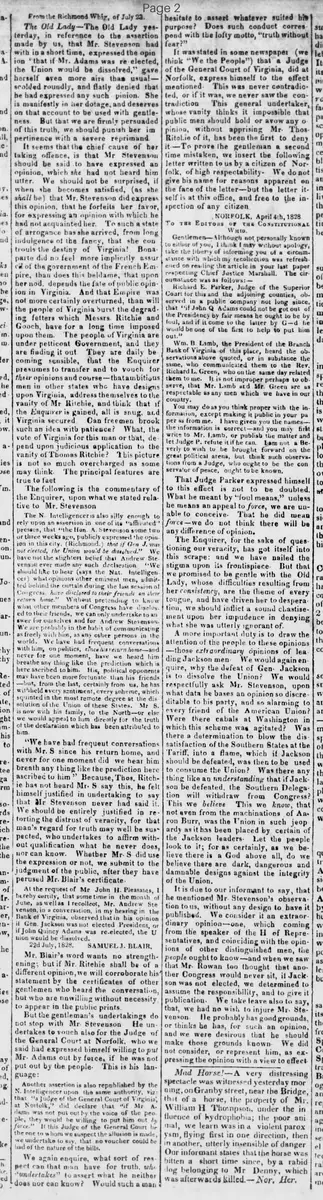
The Old Lady—The Old Lady yesterday, in reference to the assertion made by us, that Mr. Stevenson had within a short time, expressed the opinion that if Mr. Adams was re-elected, the Union would be dissolved," gave herself even more airs than usual—scolded roundly, and flatly, denied that he had expressed any such opinion. She is manifestly in her dotage, and deserves on that account to be used with gentleness. But that we are firmly persuaded of this truth, we should punish her impertinence with a severe reprimand.
It seems that the chief cause of her taking offence, is that Mr. Stevenson should be said to have expressed an opinion, which she had not heard him utter. We should not be surprised, if when she becomes satisfied, (as she shall be) that Mr. Stevenson did express this opinion, that he forfeits her favor, for expressing an opinion with which he had not acquainted her. To such a state of arrogance has she arrived, from long indulgence of the fancy, that she controls the destiny of Virginia! Bonaparte did not feel more implicitly assured of the government of the French Empire, than does this beldame, that upon her nod, depends the fate of public opinion in Virginia. And that Empire was not more certainly overturned, than will the people of Virginia burst the degrading fetters which Messrs. Ritchie and Gooch, have for a long time imposed upon them. The people of Virginia are under petticoat Government, and they are finding it out. They are daily becoming sensible, that the Enquirer presumes to transfer and to vouch for their opinions and course—that ambitious men in other states who have designs upon Virginia, address themselves to the vanity of Mr. Ritchie, and think that if the Enquirer is gained, all is snug, and Virginia secured. Can freemen brook such an idea with patience? What, the vote of Virginia for this man or that, depend upon judicious application to the vanity of Thomas Ritchie? This picture is not so much overcharged as some may think. The principal features are true to fact.
The following is the commentary of the Enquirer, upon what we stated relative to Mr. Stevenson.
The N. Intelligencer is also silly enough to rely upon an assertion in one of its "affiliated" presses, that "the Hon. A. Stevenson some two or three weeks ago, publicly expressed the opinion in this city, (Richmond,) that if Gen. J. was not elected, the Union would be dissolved." We have not the slightest belief that Andrew Stevenson ever made any such declaration. "We should like to hear (says the Nat. Intelligencer) what opinions other eminent men, admitted behind the curtain during the last session of Congress, have disclosed to their friends on their return home." Without pretending to know what other members of Congress have disclosed to their friends, we can only undertake to answer for ourselves and for Andrew Stevenson. We are probably in the habit of communicating as freely with him, as any other persons in the world." We have had frequent conversations with him, on politics, since his return home—and never for one moment, have we heard him breathe any thing like the prediction which is here ascribed to him. His political opponents may have been more fortunate than his friends—but, from the last, certainly from us, he has withheld every sentiment, every scheme, which squinted in the most remote degree at the dissolution of the Union of these States. Mr. S. is now with his family, to the North—or else we would appeal to him directly for the truth of the declaration which has been attributed to him.
"We have had frequent conversations with Mr. S. since his return home, and never for one moment did we hear him breath any thing like the prediction here ascribed to him." Because, Thos. Ritchie has not heard Mr. S. say this, he felt himself justified in undertaking to say that Mr. Stevenson never had said it. We should be entirely justified in retorting the distrust of veracity, for that man's regard for truth may well be suspected, who undertakes to affirm without qualification what he never does, nor can know. Whether Mr. S. did use the expression or not, we submit to the judgment of the public, after they have perused Mr. Blair's certificate.
At the request of Mr. John H. Pleasants, I hereby certify, that some time in the month of June, as well as I recollect, Mr. Andrew Stevenson, in a conversation, in my hearing in the Bank of Virginia, observed that in his opinion if Gen. Jackson was not elected President, or if John Quincy Adams was re-elected, the Union would be dissolved.
22d July, 1828.
SAMUEL J. BLAIR,
Mr. Blair's word wants no strengthening; but if Mr. Ritchie shall be of a different opinion, we will corroborate his statement by the certificates of other gentlemen who heard the conversation, but who are unwilling without necessity to appear in the public prints.
But the gentleman's undertakings do not stop with Mr. Stevenson. He undertakes to vouch also for the Judge of the General Court at Norfolk, who we said had expressed himself willing to put Mr. Adams out by force, if he was not put out by the people. This is his language:
Another assertion is also republished by the N. Intelligencer upon the same authority, viz: that "a Judge of the General Court of Virginia, at Norfolk," did declare that "if Mr. Adams was not put out by the voice of the people, they would be willing to put him out by force." If this Judge of the General Court be the one to whom we suspect the allusion is made, we undertake to say, that no voucher could be had of the nature of the bills.
We again enquire, what sort of respect can that man have for truth, who "undertakes" to assert what he neither does nor can know? Would such a man hesitate to assert whatever suited his purpose? Does such conduct correspond with the lofty motto, "truth without fear?"
It was stated in some newspaper (we think "We the People") that a Judge of the General Court of Virginia, did at Norfolk, express himself to the effect mentioned. This was never contradicted, or if it was, we never saw the contradiction. This general undertaker, whose vanity thinks it impossible that public men should hold or avow any opinion, without apprising Mr. Thos. Ritchie of it, has been the first to deny it.—To prove the gentleman a second time mistaken, we insert the following letter written to us by a citizen of Norfolk, of high respectability—We do not give his name for reasons apparent on the face of the letter—but the letter itself is at this office, and free to the inspection of any citizen.
NORFOLK, April 4th, 1828.
To the Editors of the Constitutional Whig.
Gentlemen—Although not personally known to either of you, I think I may without apology, take the liberty of informing you of a circumstance with which my recollection was refreshed on reading the article in your last paper respecting Chief Justice Marshall. The circumstance was as follows:—
Richard E. Parker, Judge of the Superior Court for this and the adjoining counties, observed in a public company not long since, that if John Q. Adams could not be got out of the Presidency by fair means he ought to be by foul, and if it come to the matter by G—d he would be one of the first to help to put him out."
Wm. B. Lamb, the President of the Branch Bank of Virginia—of this place, heard the observations above quoted, or in substance the same, who communicated them to the Rev. Richard L. Green, who on the same day related them to me. It is not improper perhaps to observe, that Mr. Lamb and Mr. Green are as respectable as any men which we have in our country.
You may do as you think proper with the information, except making it public in your paper as from me. I have given you the names—the information is correct—and you may first write to Mr. Lamb, or publish the matter and let Judge P. refute it if he can. I am not a Beverly to wish to be brought forward on the great political arena, but think such observations from a Judge, who ought to be the conservator of peace, ought to be known.
That Judge Parker expressed himself to this effect is not to be doubted. What he meant by "foul means," unless he means an appeal to force, we are unable to conceive. That he did mean force—we do not think there will be any difference of opinion.
The Enquirer, for the sake of questioning our veracity, has got itself into this scrape: and we have nailed the stigma upon its frontispiece. But that we promised to be gentle with the Old Lady, whose difficulties resulting from her consistency, are the theme of every tongue, and have driven her to desperation, we should inflict a sound chastisement upon her impudence in denying what she was utterly ignorant of.
A more important duty is to draw the attention of the people to these opinions—those extraordinary opinions of leading Jackson men. We would again enquire, why the defeat of Gen. Jackson is to dissolve the Union? We would respectfully ask Mr. Stevenson, upon what data he bases an opinion so discreditable to his party, and so alarming to every friend of the American Union? Were there cabals at Washington in which this scheme was agitated? Was there a determination to blow the dissatisfaction of the Southern States at the Tariff, into a flame, which if Jackson should be defeated, was then to be used to consume the Union? Was there any thing like an understanding that if Jackson be defeated, the Southern Delegation will withdraw from Congress?
This we believe. This we know, that not even from the machinations of Aaron Burr, was the Union in such jeopardy as it has been placed by certain of the Jackson leaders. Let the people look to it; for as certainly, as we believe there is a God above all, do we believe there are dark, dangerous and damnable designs against the integrity of the Union.
It is due to our informant to say, that he mentioned Mr. Stevenson's observation to us, without any design to have it published. We consider it an extraordinary opinion—one, which coming from the speaker of the H. of Representatives, and coinciding with the opinions of other distinguished men, the people ought to know—and when we saw that Mr. Rowan too thought that another Congress would never sit, if Jackson was not elected, we determined to assume the responsibility, and to give it publication. We take leave also to say, that, we had no wish to injure Mr. Stevenson. He probably has good grounds, or thinks he has, for such an opinion, and we were desirous that he should make those grounds known. We did not consider, or represent him, as expressing the opinion with a view to effect publication.
What sub-type of article is it?
What themes does it cover?
What keywords are associated?
What entities or persons were involved?
Where did it happen?
Story Details
Key Persons
Location
Richmond, Virginia; Norfolk, Virginia
Event Date
1828 07 21
Story Details
The Whig defends its report of Andrew Stevenson's prediction of Union dissolution if Adams is re-elected, countered by the Enquirer's denial; provides Blair's certificate confirming the statement from June 1828. Also verifies Judge Parker's April 1828 remark about using force against Adams, via anonymous letter, highlighting threats from Jackson supporters.