Thank you for visiting SNEWPapers!
Sign up free
The Daily Phoenix
Columbia, Richland County, South Carolina
What is this article about?
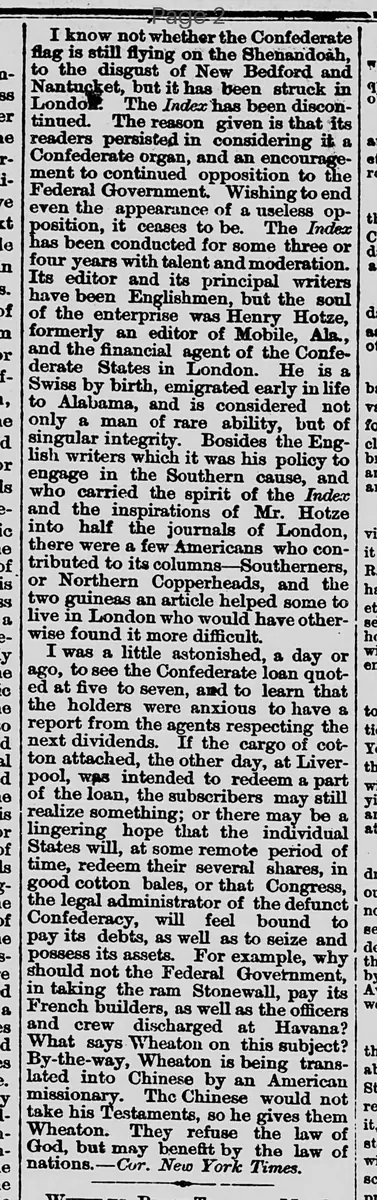
The Confederate-supporting newspaper The Index in London has been discontinued after readers viewed it as opposition to the U.S. Federal Government. Edited by Henry Hotze, a Swiss-born Confederate agent, it influenced British journalism. The Confederate loan trades at 5-7, with hopes of redemption via cotton or U.S. assumption of debts, including the ram Stonewall.
Clipping
OCR Quality
Full Text
I was a little astonished, a day or ago, to see the Confederate loan quoted at five to seven, and to learn that the holders were anxious to have a report from the agents respecting the next dividends. If the cargo of cotton attached the other day at Liverpool, was intended to redeem a part of the loan, the subscribers may still realize something; or there may be a lingering hope that the individual States will, at some remote period of time, redeem their several shares, in good cotton bales, or that Congress, the legal administrator of the defunct Confederacy, will feel bound to pay its debts, as well as to seize and possess its assets. For example, why should not the Federal Government, in taking the ram Stonewall, pay its French builders, as well as the officers and crew discharged at Havana? What says Wheaton on this subject? By-the-way, Wheaton is being translated into Chinese by an American missionary. The Chinese would not take his Testaments, so he gives them Wheaton. They refuse the law of God, but may benefit by the law of nations.--Cor. New York Times.
What sub-type of article is it?
What keywords are associated?
What entities or persons were involved?
Where did it happen?
Foreign News Details
Primary Location
London
Key Persons
Outcome
the index discontinued; confederate loan quoted at five to seven
Event Details
The Index, a Confederate organ in London conducted for three or four years with talent and moderation, has been discontinued because readers saw it as encouragement to opposition against the Federal Government. Henry Hotze, its soul and financial agent of the Confederacy, is a Swiss-born man of ability and integrity who engaged English writers for the Southern cause. Contributors included Southerners and Northern Copperheads. The Confederate loan is quoted at five to seven, with holders awaiting dividend reports; hopes linger for redemption via cotton or U.S. payment of debts, including for the ram Stonewall.